The popular myth about childhood myopia is tidy: children stare at screens, their eyes get worse, and the cure is parental discipline. The evidence is less convenient and more useful. Near work may matter, screens may contribute to an indoor visual life, and genetics certainly shape risk, but the strongest public-health signal is not a moral lecture about devices. It is a schedule problem: children who spend more time outdoors, especially during the years when the eye is still growing, are less likely to become myopic.[1][2][3]
That distinction matters because myopia is not just a nuisance solved by a new pair of glasses. The National Eye Institute defines nearsightedness as a refractive error in which the eye's shape causes light to focus in front of the retina rather than on it, making distant objects blurry.[1] NEI also notes that myopia usually starts between ages 6 and 14, worsens into the early twenties, and that severe myopia raises the risk of later problems such as retinal detachment.[1] The prevention question is therefore not cosmetic. It is about whether schools and families can reduce the number of children entering a lifelong risk track.
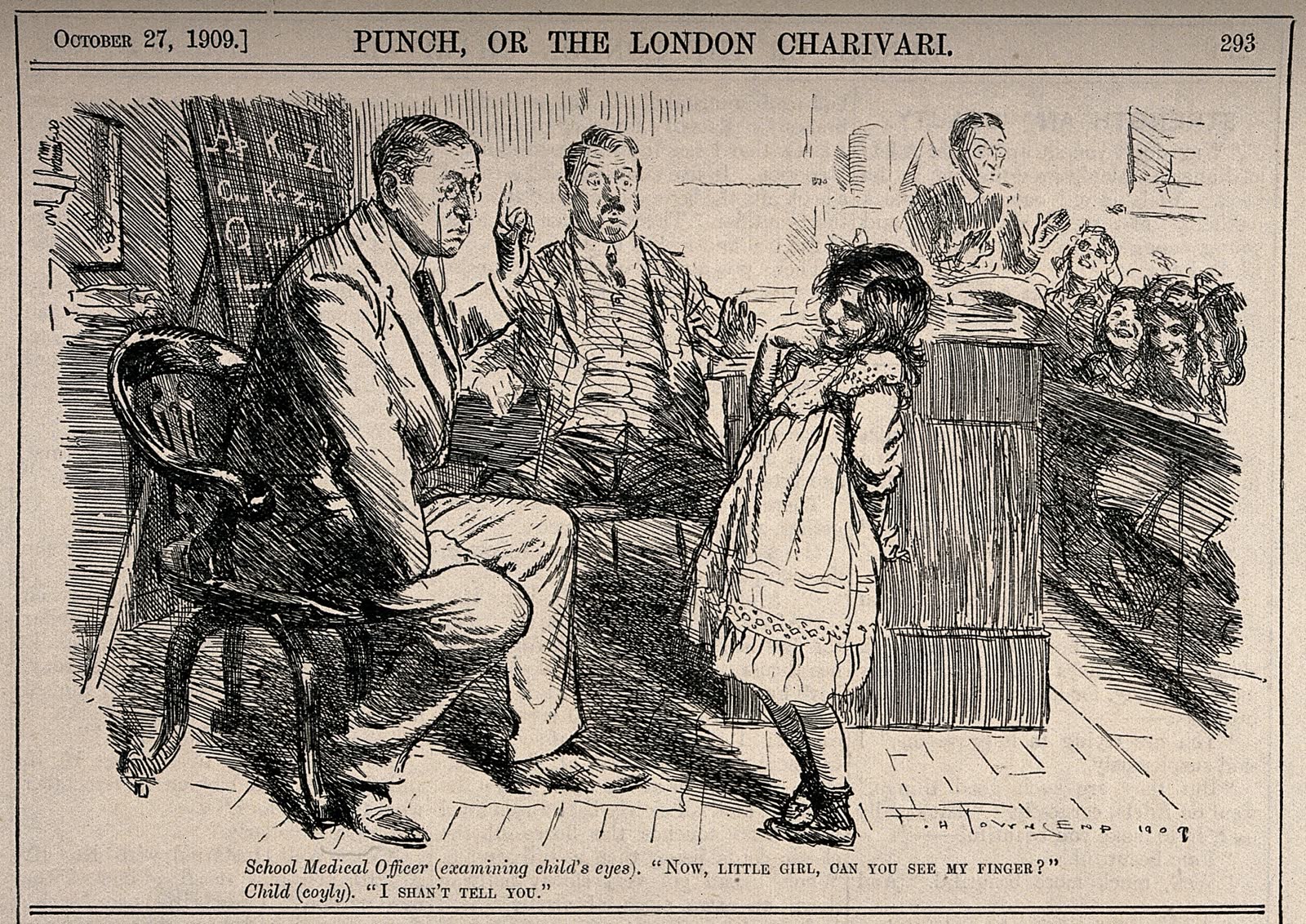
Image context: the lead image is a real 1909 Wellcome Library engraving of a school medical officer giving a child an eye test in front of classmates.[6] It belongs here because the article is about myopia as a school-age public-health issue. Vision care happens one child at a time, but prevention depends on what the school day repeatedly makes normal.
Timeline anchors
- 1909: the Wellcome image used here shows school eye testing as an early public-health scene, long before digital screens could be blamed for children's vision problems.[6]
- October 2010 to October 2013: the Guangzhou Outdoor Activity Longitudinal Trial tested an added 40-minute outdoor class during the school day in first-grade children.[2]
- May 2017 to May 2018: the Anyang trial randomized grade 2 children to a parent text-message intervention meant to increase outdoor time and light exposure, then followed eye outcomes for 3 years.[4]
- June 2024: Cochrane reviewed randomized and cluster-randomized trials of interventions to increase outdoor time for childhood myopia prevention and progression.[3]
- September 2024: the National Academies called for policy changes encouraging children to spend one to two hours outdoors each day.[5]
Myth: the problem is simply screens
The screen-only story is attractive because it offers a visible culprit. It also fits ordinary family conflict: homework, phones, games, tablets, and indoor entertainment all compete with sleep, outdoor play, and distance vision. But as a causal explanation, "screens did it" is too narrow. NEI's current public page keeps the mechanism broader: myopia happens when the eyeball grows too long from front to back, or when corneal or lens shape causes light to focus in front of the retina.[1] It also says family history raises risk, and that children who spend more time outdoors are less likely to be nearsighted, while experts are still working out why.[1]
The National Academies' 2024 statement is even more direct about the uncertainty boundary. It says there are important knowledge gaps about near work, both with and without electronic devices, while evidence supports aspects of the wider "visual diet," including light spectra and contrast.[5] That phrase is useful. A child's eye is not exposed to "screen time" alone. It is exposed to indoor light, outdoor daylight, reading distance, classroom routines, sleep timing, playground access, neighborhood safety, school pressure, genetic susceptibility, and the timing of eye growth.
So the better myth-vs-evidence split is not "screens harmless" versus "screens guilty." The better split is this: screen scolding overpersonalizes a population problem. If prevention depends on outdoor daylight, then the intervention cannot be left only to exhausted parents at 7 p.m. It has to be built into schools, recess, commuting, after-school care, and city space.
Evidence: a 40-minute school change lowered new myopia onset
The Guangzhou randomized trial is the cleanest practical demonstration because it changed the school day rather than only asking families to behave differently. Twelve primary schools were cluster-randomized between 2010 and 2013. Six intervention schools added one 40-minute outdoor activity class at the end of each school day; six control schools continued usual activity.[2]
After three years, the trial reported cumulative myopia incidence of 30.4% in the intervention group and 39.5% in the control group, an absolute difference of -9.1 percentage points with a 95% confidence interval from -14.1 to -4.1.[2] The intervention group also had a smaller three-year shift in spherical equivalent refraction, -1.42 diopters versus -1.59 diopters, a difference of 0.17 diopters.[2] Axial length change moved in the expected direction, 0.95 mm versus 0.98 mm, but that difference did not reach conventional statistical significance.[2]
Those details prevent both underclaiming and overclaiming. The study did not prove that a single outdoor class solves childhood myopia. It did show that a modest, school-controlled dose of outdoor time could reduce new myopia onset over a meaningful developmental window.[2] That is a public-health result because it does not depend on every family independently discovering, trusting, and enforcing the same behavior.
Evidence: the review signal is stronger for onset than for progression
Cochrane's 2024 review is useful because it keeps the evidence hierarchy disciplined. It included five randomized or cluster-randomized studies with 10,733 participants and looked specifically at interventions intended to increase outdoor time.[3] The review's summary is cautious but not empty: interventions may reduce the onset of myopia, while the evidence for slowing progression once myopia has already begun is lower-certainty.[3]
The numbers explain the caution. At 2 years, Cochrane reported myopia incidence of 22.5% in intervention groups versus 26.7% in control groups, with a risk ratio of 0.84 and a 95% confidence interval of 0.72 to 0.98.[3] At 3 years, the review reported 30.5% with intervention versus 39.8% with control, with a risk ratio of 0.77 and a 95% confidence interval of 0.59 to 1.01.[3] That is directionally consistent with prevention, but not a license to promise reversal.
This boundary is the article's central practical point. Outdoor time is best understood as a prevention and delay strategy, especially before or around onset. A child who is already myopic still needs eye care: refraction, follow-up, and discussion of evidence-based myopia-control options with an eye professional. Daylight is not a substitute for clinical management. It is a low-cost environmental lever that should be present before the eye has already traveled far down the elongation path.[1][3]
Evidence: reminders helped only because they changed daily exposure
The Anyang text-message trial adds a second lesson: information works when it changes a routine. In that randomized clinical trial, 268 grade 2 children were assigned either to an SMS intervention or control group. Parents in the SMS group received messages twice daily for 1 year encouraging outdoor time, and the children wore portable light meters on selected days to measure exposure.[4]
The intervention did not ask readers to believe in vibes. It measured eye outcomes. Axial elongation was lower in the SMS group than in controls during the intervention, 0.27 mm versus 0.31 mm, and remained lower at year 2, 0.39 mm versus 0.46 mm, and year 3, 0.30 mm versus 0.35 mm after the intervention.[4] Myopia prevalence also diverged: at year 2 it was 38.3% in the SMS group versus 51.1% in controls, and at year 3 it was 46.6% versus 65.4%.[4]
The useful interpretation is not that text messages are magic. It is that nudges can matter when they repeatedly redirect families toward the relevant exposure. A once-a-year poster saying "go outside" is weak. A schedule that protects recess, a teacher who takes a class outdoors, an after-school program with real daylight time, and parent reminders that make outdoor play concrete are stronger because they change the child's average visual environment.[2][4][5]
What daylight probably does, and what remains uncertain
The biological story is still being refined. The National Academies summarizes the likely environmental contrast in practical terms: outdoor settings expose the eye to brighter and more varied light and require different eye movements and focusing patterns than indoor settings.[5] It also says more research is needed to identify the most important factors.[5] NEI's patient-facing page stays similarly careful: children who spend more time outdoors are less likely to be nearsighted, but experts are not certain why.[1]
That uncertainty should not paralyze policy. Public health often acts on mechanisms before every molecular pathway is closed, as long as the intervention is plausible, low-risk, and supported by trials. Outdoor time meets that bar more cleanly than many lifestyle claims. The intervention is not a supplement, a device, or a proprietary program. It is a change in exposure: more daylight, more distance viewing, more varied visual scenes, and less continuous indoor near-focus time.
The remaining tradeoff is implementation. Outdoor time cannot mean unsafe heat exposure, sunburn neglect, playground inequity, or a new burden placed only on parents. It has to be designed: shade, weather plans, sunscreen norms where appropriate, safe recess space, flexible school scheduling, and attention to children who already need clinical myopia control.[3][5]
The evidence-based correction
The screen-time myth asks the wrong first question: "How do we make children stop doing the bad thing?" The evidence points to a better one: "How do we make the protective thing ordinary enough that it happens before vision has already changed?"
For a six-year-old in a dense school day, an extra outdoor class is not a lifestyle accessory. It is a population-level eye-health intervention with trial evidence behind it.[2] For an eight-year-old whose weekends are swallowed by indoor homework and transport, parent reminders can matter because they create repeated outdoor exposure rather than one-time awareness.[4] For a health system, the policy signal is broader still: classify myopia as a disease worth preventing, collect better surveillance data, and support school and community routines that give children at least a realistic outdoor-light floor.[5]
The careful conclusion is not that daylight cures myopia. It does not. The careful conclusion is stronger because it is more specific: childhood myopia prevention should be built around outdoor time as a routine, measurable environmental exposure, with the clearest evidence for reducing new onset and a more uncertain role in slowing progression after myopia has begun.[1][2][3] That is less satisfying than blaming a screen. It is also more actionable.
Sources
- National Eye Institute, "Nearsightedness (Myopia)" - definition, age of onset, risk factors, high-myopia risks, and outdoor-time caveat.
- Mingguang He et al., "Effect of Time Spent Outdoors at School on the Development of Myopia Among Children in China: A Randomized Clinical Trial," JAMA (2015), PubMed record - Guangzhou school-based outdoor-time trial and 3-year incidence outcomes.
- Cochrane, "Interventions to increase time spent outdoors for preventing incidence and progression of myopia in children" (2024) - randomized-trial review, participant count, onset/progression evidence certainty, and pooled incidence estimates.
- Shi-Ming Li et al., "Effect of Text Messaging Parents of School-Aged Children on Outdoor Time to Control Myopia: A Randomized Clinical Trial," JAMA Pediatrics (2022), PMC full text - Anyang SMS intervention, light exposure, axial elongation, refractive shift, and prevalence outcomes.
- National Academies of Sciences, Engineering, and Medicine, "New Report Recommends Myopia Be Classified as a Disease, Policies for Children to Spend Time Outdoors" (2024) - policy recommendations, one-to-two-hour outdoor-time framing, and research gaps on near work and visual diet.
- Wikimedia Commons, "A school medical officer trying to give a child an eye-test Wellcome V0011481.jpg" - source page for the archival 1909 Wellcome Library image used as the article image.