Asbestos is dangerous because it converts a workday into a delayed biological record. A miner, insulator, shipyard worker, construction worker, brake mechanic, demolition crew, or family member may breathe dust during a visible task, but the important event is too small to see: durable mineral fibers enter the air, reach deep lung spaces, resist clearance, and remain available to injure tissue long after the job, renovation, or product use has ended.[1][2][3]
That is why asbestos is a poor fit for the usual intuition that exposure and disease should arrive close together. The World Health Organization classifies all six main forms of asbestos as carcinogenic to humans and links exposure to cancers of the lung, larynx, and ovary, as well as mesothelioma of the pleural and peritoneal linings.[1] The National Cancer Institute describes asbestos as a known human carcinogen and says most mesotheliomas are thought to be due to asbestos exposure.[2] The central public-health problem is not mystery. It is persistence: in the body, in buildings, in industrial memory, and in disease statistics.
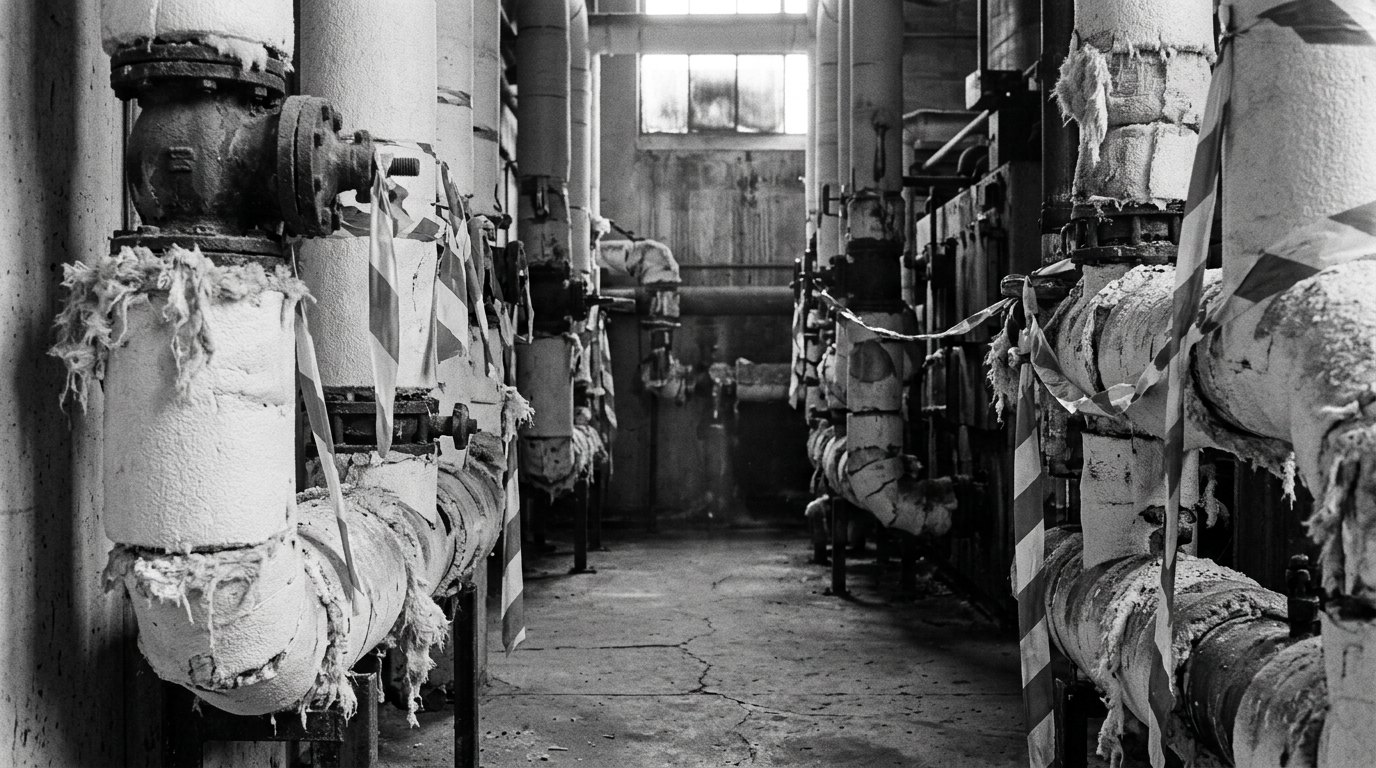
Image context: the lead image shows legacy insulation as a physical environment rather than an abstract hazard label. That matters because the disease mechanism starts before the clinic. Dust is generated by extraction, cutting, scraping, demolition, maintenance, or disturbance; illness becomes legible only after fiber behavior, tissue response, and latency have had time to unfold.
Timeline anchors
- 1960: J. C. Wagner, C. A. Sleggs, and P. Marchand published the landmark North Western Cape mesothelioma paper, describing 33 diffuse pleural mesothelioma cases, all but one with probable crocidolite asbestos exposure.[6]
- 1940-1970: ATSDR describes this as the peak asbestos-exposure period behind the later U.S. mesothelioma rise from the early 1970s to the mid-1990s.[4]
- 1989 and 1991: EPA issued a rule banning most asbestos-containing products in 1989, but the Fifth Circuit Court of Appeals overturned much of it in 1991, leaving only a limited set of product bans in place.[5]
- March 28, 2024: EPA finalized a rule prohibiting manufacture, import, processing, distribution, commercial use, and disposal of chrysotile asbestos under TSCA section 6(a).[5]
1. The first mechanism is aerodynamic
Asbestos is not one chemical in the way benzene or lead is usually discussed. It is a group of naturally occurring fibrous silicate minerals. The health problem begins with shape and size. Disturbing asbestos-containing material can release tiny fibers into the air; once inhaled, some reach the lungs and lodge in tissue, especially where airways branch and in lower lung fields.[3] That physical entry step explains why risk clusters around jobs and events that make friable or hidden material airborne: mining, milling, insulation, shipbuilding, drywall removal, demolition, brake work, firefighting, and asbestos abatement all appear in risk descriptions because they can turn solid material into respirable dust.[2]
This also explains why "asbestos in a building" and "asbestos exposure" are not identical statements. The dangerous transition happens when fibers are released and breathed. Old materials matter because maintenance, renovation, disaster damage, demolition, or improper removal can turn installed products into air contamination years after installation.[1] A ban on new uses can reduce future additions to the built environment, but it does not automatically remove legacy material already in walls, tiles, pipes, roofing, boilers, ducts, or industrial equipment.
2. Persistence turns dust into a long-term tissue problem
Once fibers enter the lung, clearance is incomplete. ATSDR explains that some deposited fibers can move into the lymphatic system, but many are retained in lung tissue for years; some short fibers can migrate from the lungs toward pleural and peritoneal spaces, especially along lymphatic drainage pathways.[3] The half-life of fibers varies by fiber type, dimension, and chemistry. The important point for public health is simpler: the body does not treat every inhaled fiber as a temporary irritant that disappears quickly.
The diseases follow from that persistence. Asbestosis is diffuse interstitial fibrosis caused by inhaled fibers lodged in lung tissue. ATSDR describes fibrosis beginning in small airway regions, especially subpleural portions of the lower lobes, and notes that it can progress even after exposure ceases.[4] That sentence is the mechanism in miniature. The exposure can stop while the injury process continues, because the material and the tissue response remain.
Pleural disease fits the same logic. ATSDR describes the pleura as more sensitive to asbestos than lung parenchyma, with pleural effects appearing at lower doses than fibrotic lung changes.[4] Pleural plaques, thickening, effusions, and rounded atelectasis are not all cancer, and they do not all mean the same clinical prognosis. But they are evidence that the lining around the lung is part of the exposure story, not a remote target.
3. Mesothelioma is the signal disease of latency
Mesothelioma makes asbestos risk unusually hard to manage socially because it arrives late. ATSDR gives a typical latency for pleural mesothelioma of 30 to 40 years, with a broader range of 10 to 57 years.[4] ATSDR also notes that asbestosis clinical manifestations commonly appear 20 to 40 years after exposure.[4] Those ranges turn asbestos into a time-shifted hazard: the disease curve can peak after the industry, product line, worksite, or building practice that created the exposure has changed.
The historical evidence made that time shift visible. Wagner, Sleggs, and Marchand's 1960 North Western Cape paper described a cluster of rare pleural tumors, with probable crocidolite exposure in nearly all cases and many exposures tied to the Asbestos Hills west of Kimberley.[6] That pattern matters because it broke a narrow workplace-only framing. People could be exposed through jobs, but also through environmental proximity, household contamination, and community life around mining and processing.[2][6]
The National Cancer Institute's occupational list makes the breadth plain: shipbuilding, asbestos mining and milling, textile manufacture, insulation work, construction trades, demolition, drywall removal, firefighting, automobile work, and asbestos removal all appear as settings of concern.[2] The National Cancer Institute's fact sheet also lists living with someone who works with asbestos and living or working in a building where asbestos-containing materials have been disturbed as risk factors.[2] The fiber can travel with work clothes, building dust, and disturbed material. It does not respect the boundary between worker and household as neatly as compensation systems often do.
4. Lung cancer and mesothelioma are not the same endpoint
Asbestos disease is sometimes flattened into a single cancer warning. That loses important distinctions. Lung cancer arises in lung tissue and has a strong interaction with tobacco exposure; WHO notes that co-exposure to tobacco smoke and asbestos fibers substantially increases lung-cancer risk.[1] Mesothelioma usually arises in the pleura or other mesothelial linings and is much more specifically associated with asbestos exposure.[2][4]
That distinction affects prevention language. Smoking cessation is crucial for people with asbestos exposure because it reduces lung-cancer risk, but it does not erase asbestos's independent causal role, and it is not a mesothelioma prevention strategy by itself.[1][2] Likewise, a normal chest image at one point in time does not rewrite exposure history. The latency window means that surveillance, occupational history, and careful clinical evaluation have to be tied to when and how exposure occurred, not only to current symptoms.
The numbers make the scale less abstract. WHO and ILO estimate that occupational asbestos exposure causes more than 200,000 deaths globally every year, based on 2016 estimates, and represents more than 70% of deaths from work-related cancers.[1] EPA's 2024 announcement linked asbestos exposure to more than 40,000 deaths in the United States each year.[5] These are not statistics about a vanished mineral curiosity. They describe a preventable exposure system whose consequences remain active because prior use was so widespread.
5. Regulation helps, but legacy exposure is the hard part
The strongest interpretation of asbestos history is not that regulators simply failed once and then fixed the problem. It is that asbestos created a long-tail exposure system. EPA's own timeline shows the problem: a broad 1989 ban-and-phaseout rule, a major court reversal in 1991, and then a 2024 chrysotile rule under amended chemical-safety authority.[5] That chronology matters, but it still addresses only part of the hazard. WHO emphasizes that deaths and ill health continue for many years after a country bans all uses because of latency and past widespread use.[1]
This is where the causal mechanism changes the policy imagination. If the public thinks asbestos risk ends when a product is discontinued, it will miss the places where exposure still happens: old building maintenance, demolition, waste handling, disaster cleanup, informal renovation, deteriorated materials, and workplaces that disturb installed products.[1][2] If the public thinks the danger is only a worker's past choice, it will miss take-home and environmental exposure. If the public thinks the disease is simply rare, it will miss the population-scale burden created by a rare cancer multiplied across millions of exposed people and decades of latency.[1][2][4]
The practical conclusion is narrow but demanding. Asbestos prevention has to operate before dust is made: identify materials, avoid disturbance, use trained abatement, protect workers, control waste, keep exposure records, and treat old buildings and old jobs as active information rather than dead history.[1][5] The fiber's durability is exactly why memory becomes a public-health tool. A mine photograph from 1923, a shipyard job in 1965, an insulation repair in 1980, or a tile removal in 2013 can all belong to the same mechanism. The exposure event ends. The fiber may not.
Sources
- World Health Organization, "Asbestos" fact sheet - carcinogenicity of all main asbestos forms, global occupational mortality estimate, exposure pathways, prevention, and long-latency challenge.
- National Cancer Institute, "Asbestos Exposure and Cancer Risk Fact Sheet" - known-carcinogen classification, mesothelioma and cancer risks, occupational groups, and nonmalignant pleural disease.
- ATSDR Environmental Medicine, "Asbestos Toxicity: What Is the Biological Fate of Asbestos?" - inhaled fiber deposition, retention, lymphatic movement, pleural and peritoneal migration, and fiber persistence.
- ATSDR Environmental Medicine, "Asbestos Toxicity: What Respiratory Conditions Are Associated with Asbestos?" - asbestosis mechanism, pleural sensitivity, mesothelioma latency, peak exposure history, and clinical endpoints.
- U.S. Environmental Protection Agency, "Asbestos Laws and Regulations" - 2024 chrysotile asbestos rule, TSCA authority, and the 1989 rule with 1991 Fifth Circuit reversal.
- U.S. EPA HERO record for J. C. Wagner, C. A. Sleggs, and P. Marchand, "Diffuse pleural mesothelioma and asbestos exposure in the North Western Cape Province" (British Journal of Industrial Medicine, 1960) - bibliographic record and abstract for the landmark 33-case crocidolite exposure paper.