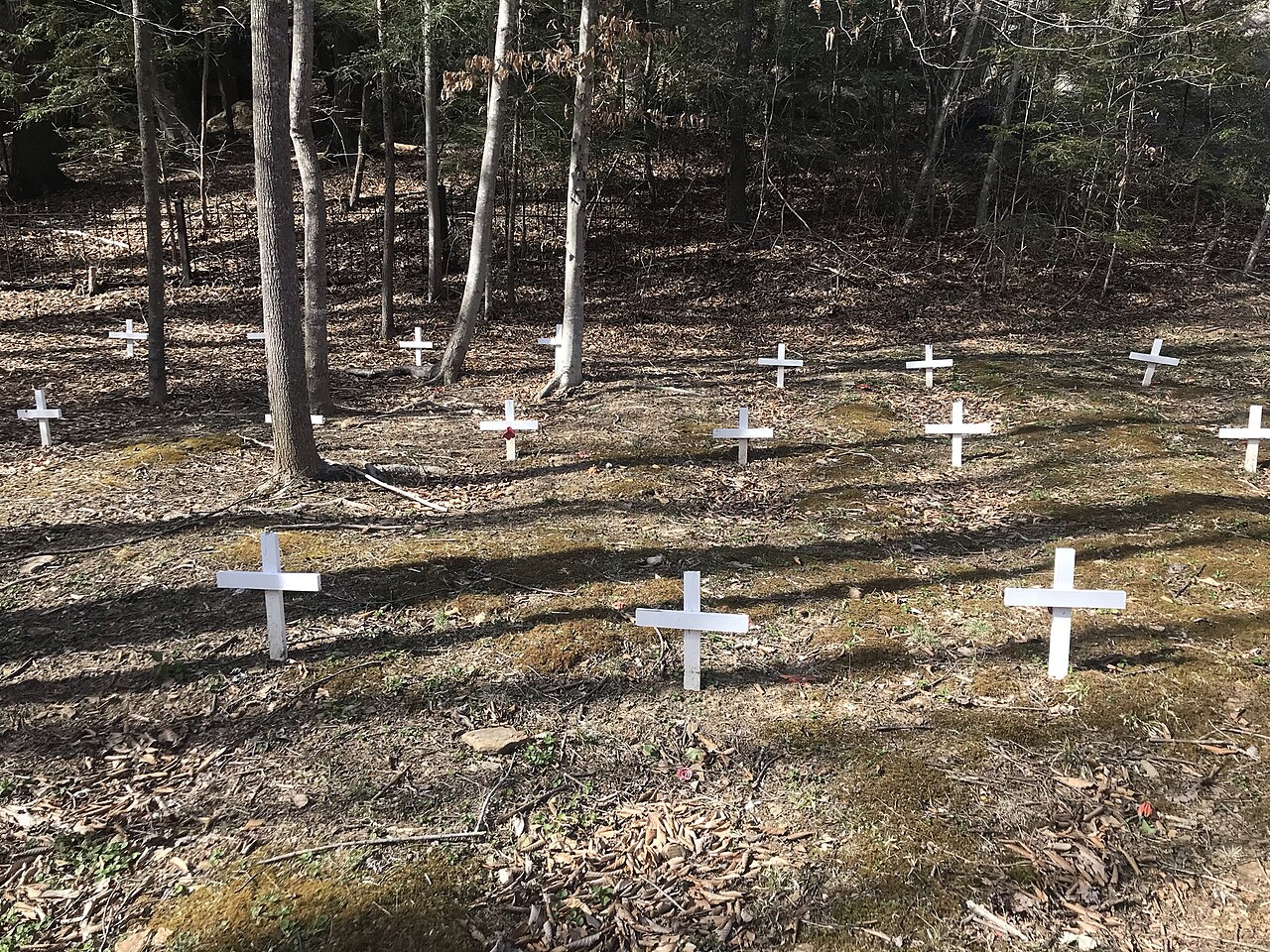
Hawk's Nest is difficult to remember because the tunnel still worked. It carried water through Gauley Mountain to make power for Union Carbide's metals operations, while the workers who cut it carried silica dust in their lungs. That split between engineering success and human ruin is the public-health problem at the center of the disaster. A tunnel can be finished, inspected, and folded into infrastructure; silicosis moves more slowly through breath, diagnosis, burial records, compensation fights, and family memory.
The basic timeline is stark. Construction began in 1930 on a roughly three-mile tunnel between Ansted and Gauley Bridge, West Virginia, designed to divert New River water to a downstream hydroelectric plant.[1] The tunnel went through rock with high silica content. Workers drilled and blasted in confined spaces with poor ventilation, dry drilling, limited respiratory protection, and dust thick enough that accounts describe men emerging from the mountain covered in white powder.[1][2] The National Park Service says about 5,000 men worked on the project, about 2,900 of them inside the tunnel, and that at least 764 died of silicosis; e-WV gives a close underground count of 2,982 men and stresses how short many work tenures were.[1][2]
Those numbers matter, but they are not the whole memory. Hawk's Nest is also a story about whose deaths were easy to count and whose were easy to misplace. The workforce was heavily Black and migrant, drawn by Depression-era work and then scattered by sickness, dismissal, travel, and death.[1][3] Some workers died away from West Virginia. Some certificates used diagnoses such as pneumonia or heart disease rather than silicosis. Some were buried as paupers in fields around Fayette County.[3] The memorial photograph above is therefore not an ornamental image of a finished tragedy. It is part of the evidence problem: white crosses and a cemetery sign standing where a paper record had long been partial.
Dust Became A Disease Record
Silicosis is not only a historical word. OSHA still describes respirable crystalline silica as tiny particles that can cause silicosis, lung cancer, chronic obstructive pulmonary disease, kidney disease, and other serious conditions; severe exposure can produce disabling or fatal scarring of the lungs.[5] In ordinary chronic silicosis, disease may appear after years. Hawk's Nest became notorious because exposure was intense enough that some workers became sick within months, giving the disaster its public-health force as an acute occupational lung event rather than only a slow industrial background hazard.[1][2][5]
That clinical distinction changes the moral one. The problem was not that silica was an unknowable mystery in 1930. Hard-rock mining and granite work had already made silicosis a recognized occupational disease.[2] The scandal was the mismatch between known hazard and work design: dry drilling through silica-rich rock, confined air, speed pressure, inadequate dust control, and a labor force with little power to refuse the job. The disease did not arrive from nature alone. It was produced by the way the work was organized.
The tunnel's licensing category sharpened the gap. NPS notes that because the project was licensed as civil engineering rather than mining, even modest mining safety practices were not applied.[1] That distinction now reads like bureaucratic weather around an avoidable exposure. The dust did not care whether a form said tunnel, mine, utility, or civil works. Workers inhaled what the air held.
The Public Case Arrived Late
The disaster became nationally legible only after the worst exposure period had passed. Congressional hearings in January and February 1936 gathered testimony from sick workers, family members, reporters, engineers, and officials.[4] Hawk's Nest Names, a modern archival project built around names and death certificates, treats those hearings as a critical source because they preserve competing accounts of work conditions, company defenses, medical claims, and witness memory.[3][4]
The hearing record matters because occupational disease often has to fight for narrative form. A collapse or explosion makes one event. Silicosis makes a sequence: hiring, dust, cough, diagnosis, discharge, travel, death, certificate, burial. By the time the sequence reaches public authorities, the employer can question causation, the worker can be gone, and the body can be in another county or state. Hawk's Nest therefore forced a hard question: what counts as evidence when the injury is inhaled during work but proven later in breathlessness, chest findings, undertaker lists, and widows' testimony?
That is why the disputed death toll is not a side issue. Official and company-linked records tended to count fewer dead than later investigators and memorial projects. NPS and Hawk's Nest Names both use the 764 estimate while acknowledging the uncertainty of confirmation.[1][3] e-WV emphasizes the high disease burden among a short-tenured underground workforce and points to the tunnel's later place in labor culture, journalism, and literature.[2] The exact count remains historically contested, but the dispute itself is instructive. It shows how occupational mortality can be minimized when workers are temporary, racialized, poor, mobile, and medically classified in ways that break the chain back to the job.
Names Are A Health Intervention After The Fact
Memory and commemoration can sound soft beside dust control, ventilation, respirators, and compensation law. Hawk's Nest shows why they are not soft. The first health failure was exposure prevention. The second was recognition. The third was remembrance: whether the workers would remain a mass number, a rumor of "tunnelitis," or a set of people with names, families, origins, and burial places.
Hawk's Nest Names calls itself an archive of workers and death certificates, and its list is intentionally incomplete because the record is incomplete.[3] That incompleteness is part of the point. A name can reconnect a death to a route of labor migration. A certificate can show both information and evasion. A grave site can bring the public-health meaning back into the landscape, especially when many of the dead were African American workers denied an easy place in the official story.[1][3]
The memorial in Summersville does not undo the exposure. It does something narrower and necessary: it refuses to let a completed tunnel be the only durable object left behind. NPS identifies the workers' memorial and grave site as part of an African American heritage driving tour, placing the disaster not only in industrial history but in the history of Black labor, segregation, burial, and public acknowledgment.[1] That framing matters. It prevents the event from becoming a generic cautionary tale about dust and turns it back into a situated health injustice.
Why Hawk's Nest Still Reads As Current
Hawk's Nest belongs to the 1930s, but the mechanism is not antique. OSHA's current silica page still warns that respirable crystalline silica is generated by cutting, drilling, grinding, and crushing stone, rock, concrete, brick, block, and mortar, and that there is no cure for silicosis.[5] Modern standards, wet methods, ventilation, exposure limits, medical surveillance, and respirators exist because the hazard is preventable. Their existence also proves the opposite: without systems that force dust down before it reaches lungs, the old mechanism can reappear in new trades and materials.
That is the strongest reason to remember Hawk's Nest through graves rather than only through the tunnel. The tunnel says the project achieved its industrial purpose. The cemetery says that purpose was priced through bodies whose injury was initially easier to obscure than to honor. The names archive says the count is not merely arithmetic but a continuing repair of the record. The silica standard says the lesson is practical: disease prevention has to be built into the job before exposure becomes biography.
Public-health memory is most useful when it resists a clean ending. Hawk's Nest did not become important because later generations found a perfect number or a final moral slogan. It remains important because it preserves a pattern: known hazard, weak protection, racialized labor, delayed recognition, contested records, and commemoration trying to make a dispersed disease visible. The workers entered a mountain to build an invisible water route. What they left behind was another route, harder to see but still traceable: dust to lung, lung to record, record to grave, grave to public responsibility.
Sources
- National Park Service, "Hawks Nest Tunnel Disaster" - official site overview of the 1930 tunnel project, work conditions, worker demographics, estimated deaths, and memorial context.
- Martin G. Cherniack, "Hawks Nest Tunnel Disaster," e-WV: The West Virginia Encyclopedia - historical synthesis on the underground workforce, silicosis, short work tenures, public exposure of the tragedy, and cultural afterlife.
- Hawk's Nest Names, "The Book of the Dead: An Archive of Hawk's Nest Tunnel Workers" - modern name-and-death-certificate archive documenting the disputed toll and partial record.
- U.S. House Committee on Labor, An Investigation Relating to Health Conditions of Workers Employed in the Construction and Maintenance of Public Utilities (1936 hearing transcript) - primary-source testimony on Hawk's Nest and silicosis.
- Occupational Safety and Health Administration, "Silica, Crystalline - Health Effects" - current official explanation of respirable crystalline silica, silicosis, latency, and related disease risks.
- Wikimedia Commons, "File:Hawks Nest Tunnel disaster - 2.jpg" - documentary photograph of the Hawks Nest Tunnel disaster graveyard used as the article image.