The 1993 Milwaukee Cryptosporidium outbreak began as a stomach illness story and became a public-works story only after the scale was too large to ignore. That is the first lesson. A drinking-water failure does not always announce itself at the plant gate. It may appear first in pharmacies, emergency departments, workplace absences, school cafeterias, and households trying to decide whether tap water has become unsafe.
In early spring 1993, a chlorine-resistant parasite passed through one of Milwaukee's two municipal water-treatment plants and reached city taps.[1][2] The later epidemiologic estimate was staggering: about 403,000 people in a five-county area became ill during the outbreak period, out of a regional population of roughly 1.61 million.[2] About 44,000 sought outpatient care and 4,400 were hospitalized.[2] An estimated 69 deaths, principally among people with AIDS, were attributed to the outbreak.[2]
Those numbers make Milwaukee the largest documented waterborne disease outbreak in modern U.S. history, but the more useful reconstruction is not simply "bad water caused diarrhea." The event exposed a chain problem. Source water, filtration, turbidity, laboratory testing, health-department surveillance, public notification, clinical vulnerability, and public trust all had to work together. In March and April 1993, they did not.
The signal surfaced outside the plant
The core clinical picture was cryptosporidiosis, a diarrheal illness caused by ingestion of Cryptosporidium oocysts.[1][2] The Milwaukee event mattered because the parasite was not defeated by ordinary confidence in chlorinated drinking water. Mac Kenzie and colleagues' outbreak report identified the public water supply as the transmission route and described oocysts that passed through the filtration system of one municipal treatment plant.[1]
The outbreak period used in the later cost analysis ran from March 1 to April 28, 1993, capturing both the acute contamination event and the wider period in which diarrheal illness was being attributed to the outbreak.[2] That range is important because it prevents the story from collapsing into one bad day. A water system is temporal. Operators see turbidity curves, laboratories see test delays, clinicians see waves of patients, and residents experience the event as a sequence: first taste or clarity concerns, then illness, then advisories, then distrust.
The vulnerable population also changed the moral stakes. Cryptosporidiosis can be self-limited for many healthy adults, but for people with severe immune suppression it can become prolonged, wasting, and fatal. The later mortality finding is why the outbreak cannot be remembered as a nuisance event scaled up by population size.[2] It was a mass gastrointestinal outbreak for the city and a lethal exposure for some of the people least able to withstand it.
Howard Avenue made filtration a public-health boundary
Milwaukee Water Works' own history says the city had been disinfecting and filtering lake water for decades before 1993.[3] The Howard Avenue Water Treatment Plant, completed in 1962, had eight filters and a rated capacity of 105 million gallons per day.[3] That history matters because the outbreak did not occur in a city with no water-treatment infrastructure. It happened inside a modern utility that believed it had the ordinary barriers in place.
That is the point of the event reconstruction. The boundary between "treated" and "safe" proved more fragile than the public had reason to understand. If Cryptosporidium oocysts pass through treatment, the finished-water label becomes a false reassurance. If turbidity is treated as an operational metric rather than a health-warning signal, the public-health meaning of cloudy or particle-laden water can be recognized too late. If clinical reports and utility data remain in separate channels, illness can outrun interpretation.
After the outbreak, Milwaukee described the change in explicitly barrier-based terms: source-water protection, ozone disinfection, biologically active filtration, and continuous monitoring.[4] That vocabulary is not cosmetic. It is an admission that safe water cannot depend on one line of defense. The post-1993 system had to assume that the lake, the plant, the lab, the health department, and the public notice process all belonged to the same safety architecture.
April 1993 became an economic event too
The cost study gives the outbreak another dimension. The estimated illness cost was $96.2 million in 1993 dollars: $31.7 million in direct medical costs and $64.6 million in productivity losses.[2] Those figures exclude several burdens: litigation, bottled-water purchases, intangible pain and suffering, chronic illness beyond the study window, and productivity losses from premature death.[2] In other words, the headline cost is a conservative floor, not the full civic bill.
The distribution of costs also corrects a common intuition. Severe illness accounted for only about 1% of outbreak-associated diarrheal illness, yet hospitalization drove most of the medical cost.[2] Mild illness, because it touched so many people, drove an enormous amount of lost time. That split is exactly what makes drinking-water safety different from many clinical interventions. A small process failure in a shared system can generate a citywide burden, while concentrating the worst harm among people with the least physiologic reserve.
This is why the phrase "public utility" understates the health role. A water department is part of the care system before anyone is sick. If it fails, hospitals, clinics, pharmacies, employers, schools, and families absorb the consequences downstream. The outbreak made that dependency visible in dollars, hospital records, and death certificates.
Closing the plant was not the whole answer
Later modeling by Eisenberg and colleagues examined whether the Milwaukee outbreak was best understood as a point-source event alone or as a transmission cycle amplified through people, sewage, Lake Michigan, treatment, and renewed exposure.[5] Their analysis suggested that direct person-to-person transmission contributed 10% of total cases, with a 95% confidence interval of 6% to 21%.[5] It also suggested that closing the drinking-water plant prevented additional cases, and that increasing the distance between wastewater effluent and drinking-water influent may have prevented the outbreak.[5]
The exact model is less important for a general reader than the system shape it reveals. The city was not facing a simple pipe with one contaminant flowing one way. It was facing a loop: infected people shed pathogens, sewage and lake dynamics moved risk through the environment, the drinking-water intake and treatment system became an exposure route, and more people became infected.[5] That is a public-health ecology, not a plumbing anecdote.
Milwaukee's post-outbreak investments reflected that wider frame. A city Water Works assurance document says the utility invested $508 million after 1993 in treatment, monitoring, mains, pumping facilities, real-time monitoring, customer service, and security.[4] It also describes an immediate 1993-1998 renovation of $89 million, including an $11 million extension of the Howard Avenue intake by 4,200 feet, bringing the extended intake to 11,767 feet from shore in 1996.[4] Ozone replaced chlorine as the primary disinfectant at both plants in 1998, in what the utility described as a $51 million design-build project.[4]
Those numbers are not proof that every later decision was perfect. They show the scale of repair required once a shared water system loses trust. A treatment plant can be repaired mechanically faster than residents can recover confidence. The deeper fix was the creation of a monitoring posture: more water-quality sampling, more continuous data, more collaboration between the utility and the health department, and more explicit risk messaging for people with weakened immune systems.[4]
The lasting lesson was institutional, not only technical
Milwaukee's current water-treatment page now describes a multiple-barrier process: ozone, coagulation, flocculation, settling, biologically active filtration, chlorine as a secondary disinfectant, corrosion control, chloramine residual, and SCADA data across treatment and distribution systems.[3] It specifically says ozone destroys illness-causing microorganisms such as Cryptosporidium and Giardia.[3] Read against 1993, that is not just a treatment description. It is institutional memory written into a process page.
The useful lesson is not that ozone alone saved Milwaukee. The stronger lesson is that no single barrier should be allowed to carry the whole public-health promise. A safer system treats turbidity as a warning signal, not housekeeping. It treats laboratory capacity as preparedness, not back-office science. It treats communication with immunocompromised residents as part of water treatment, not a public-relations afterthought. It treats data-sharing between water engineers and health officials as routine work before an emergency, because routine relationships are hard to invent during a crisis.
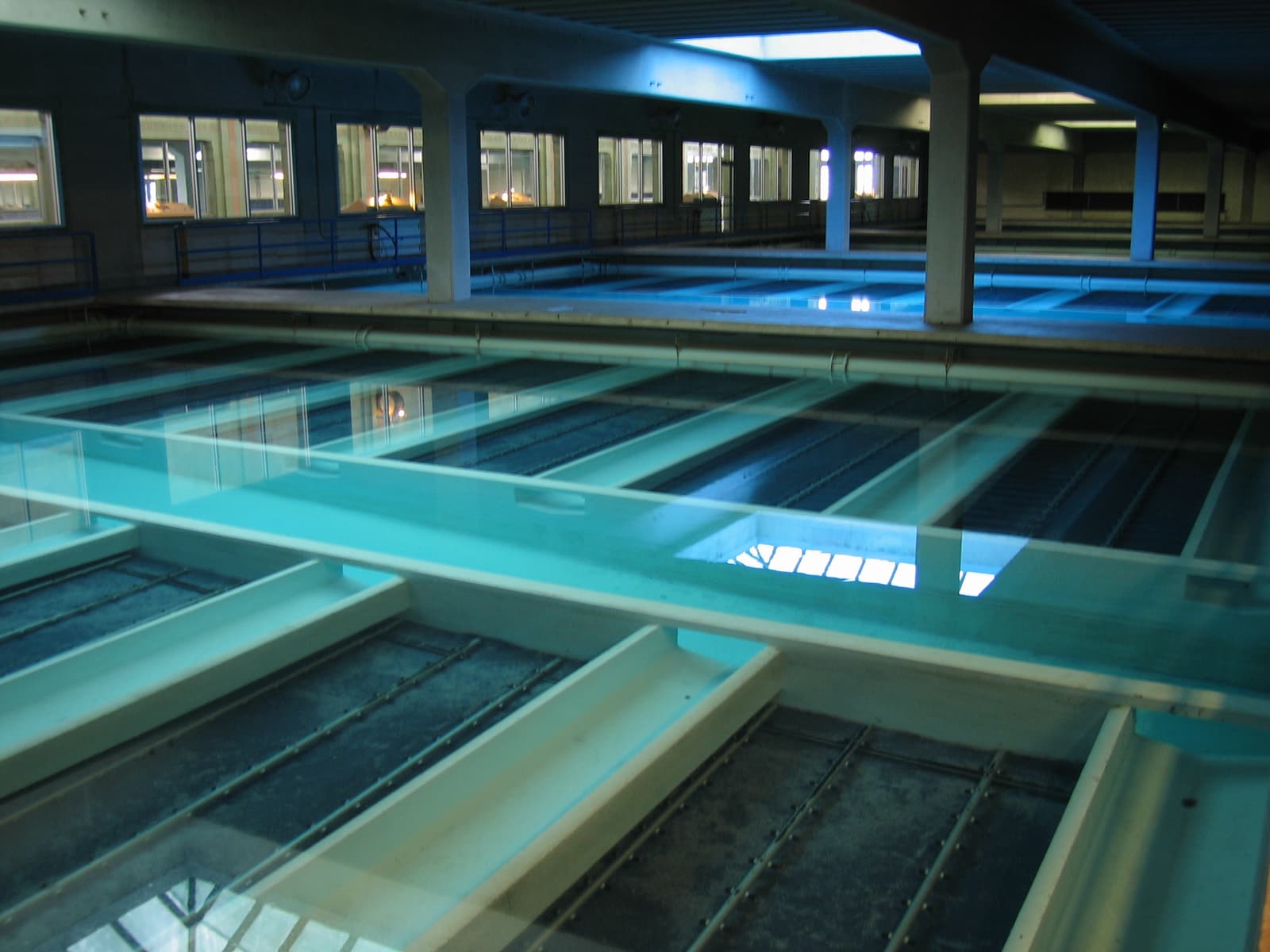
That is why the outbreak still matters. The cover photograph shows a filter gallery, a clean industrial room where water becomes drinkable through controlled stages.[6] But Milwaukee's 1993 lesson is that the room is only one part of the system. Safe tap water also depends on where the intake sits, what the lab can detect, what the health department can see, what residents are told, and whether the utility understands itself as being in the public-health business.
The outbreak did not merely contaminate water. It contaminated confidence. The repair therefore had to be technical, epidemiological, and civic at the same time. Milwaukee learned, at terrible cost, that a drinking-water system is not safe because a city believes in its plant. It is safe when evidence keeps moving through the plant, the lab, the clinic, and the public before illness has to make the case.
Sources
- William R. Mac Kenzie et al., "A Massive Outbreak in Milwaukee of Cryptosporidium Infection Transmitted through the Public Water Supply," New England Journal of Medicine, 1994 - DOI landing page for the outbreak investigation.
- Phaedra S. Corso et al., "Costs of Illness in the 1993 Waterborne Cryptosporidium Outbreak, Milwaukee, Wisconsin," Emerging Infectious Diseases, 2003 - burden, hospitalization, mortality, and cost estimates.
- Milwaukee Water Works, "Water Treatment" and "History of the Milwaukee Water Works" - current treatment process, plant history, intake details, and post-outbreak institutional framing.
- Milwaukee Water Works, "Water Quality Assurances in Milwaukee" - post-1993 investments, intake extension, ozone retrofit, filtration upgrades, monitoring, and health-department collaboration.
- Joseph N. S. Eisenberg et al., "The Role of Disease Transmission and Conferred Immunity in Outbreaks: Analysis of the 1993 Cryptosporidium Outbreak in Milwaukee, Wisconsin," American Journal of Epidemiology, 2005 - transmission-cycle analysis and intervention modeling.
- Wisconsin Watch, "20 years after fatal outbreak, Milwaukee leads on water testing," 2013 - article page containing the Milwaukee Water Works photograph used as the cover image and post-outbreak utility context.