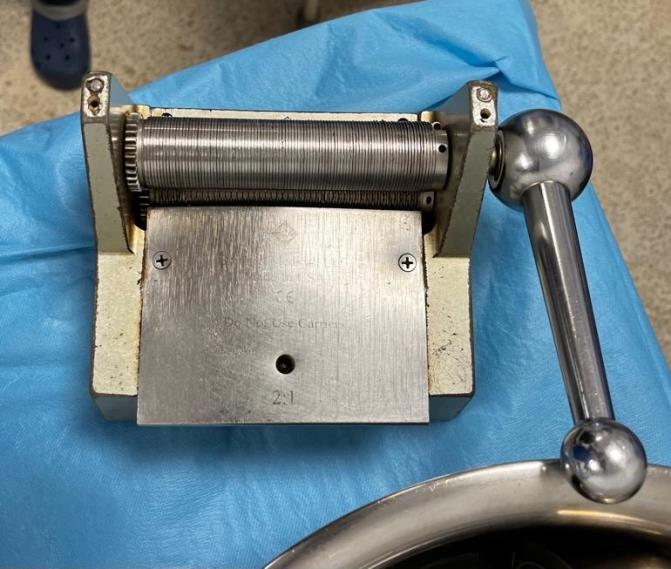
Give a burn surgeon a hundred square centimetres of healthy skin and a mesher marked three to one. How much wound can that skin cover? The arithmetic suggests three hundred square centimetres. In a study at the Antwerp Burn Center, the answer for that setting was closer to a hundred and fifty. And even within that smaller outline, some of the wound was still bare. To understand what the operation achieves, look inside one of the little diamonds in the mesh. [1][2]
In an extensive burn, every piece of a patient's own skin used for grafting has a cost. Harvesting a thin sheet removes the epidermis and part of the dermis, leaving a second wound that needs to heal. A surgeon with limited healthy skin to draw on has good reason to make each sheet reach farther. In September 1964, J. C. Tanner Jr. and colleagues published their account of a mesh skin graft. Its economy becomes clear if you picture what happens to the sheet as it passes through the instrument. [2][3]
The space between the strips
Imagine cutting short slits in a sheet of paper, staggering the rows like joints in brickwork. Pull gently across the cuts. Each slit opens into a diamond with a strip of paper on every side. Trace the outside edge of the sheet and your pencil encloses a larger area. Add up the paper inside that outline and you have just as much as you started with. A skin mesher exploits the same geometry. The stagger leaves the graft connected, so a surgeon can move it as one piece and spread strips of living skin across the wound. The openings also let fluid drain from underneath the graft. [2][4]
Paper can take the explanation only that far. On a wound, the edges of each opening are alive. As the graft takes, surface skin cells grow inward from those edges. A patch of exposed wound in the middle of the graft therefore has a source of new surface skin close by. Its distance from the outer edge of the whole sheet matters less than its distance from the nearest strip. A wider diamond asks the cells to cover more ground before the surface closes. [2][4]
What the number on the carrier measures
In June 1988, R. Peeters and A. Hubens reported the expansion they had actually obtained in Antwerp using a Zimmer mesh graft dermatome. Across 101 grafts at the nominal 1.5-to-one setting, they reported an expansion of 1.2 to one. Across 60 grafts at three to one, the measured figure was 1.5 to one. Those are measurements from one centre using one instrument. For the hypothetical hundred-square-centimetre donor sheet, they give a sense of how much a surgeon's estimate could change depending on which ratio went into the calculation. [1]
In 1997, J. J. Vandeput, Tanner and J. Boswick examined what goes into that ratio. The spacing between blades sets the width of the ribbons of skin. The length of each cut helps determine how far the opening can spread and how far skin cells will have to travel to fill it. The thickness of the graft and the way it is handled also affect the spread achieved in practice. Peeters and Hubens measured the shortfall. These later observations give several reasons it can arise, though they cannot tell us which mattered most for the Antwerp grafts. [1][4]
Consider what a ruler could tell a surgeon on the day of grafting. It could measure the span of the mesh and show whether another sheet would be needed to reach the edge of the burn. In the following days, a different part of that same graft would repay attention. At the centre of each diamond lies the last bit of exposed surface that cells coming from its edges must reach. The mesher buys coverage immediately. The patient supplies the skin that will fill the gaps. [2][4]
Sources
- R. Peeters and A. Hubens, “The mesh skin graft—true expansion rate,” Burns, 1988.
- Richard Davis and Vallery Logedi, “Split Thickness Skin Graft,” Global Surgical Atlas, April 2022. Clinical technique and instrument photograph.
- J. C. Tanner Jr. and colleagues, “The Mesh Skin Graft,” Plastic and Reconstructive Surgery, 1964.
- J. J. Vandeput, J. C. Tanner and J. Boswick, “Implementation of parameters in the expansion ratio of mesh skin grafts,” Plastic and Reconstructive Surgery, 1997.