In a 1960 photograph from a Rhode Island polio ward, the patient’s head rests outside a long metal tank. A nurse can lean close, and a mirror above the pillow gives the patient a view of the room. It looks like a considerate place to end the machine. It is also precisely where the machine has to end. To take a breath for someone whose breathing muscles are paralyzed, this model of iron lung needs the chest on one side of a seal and the mouth on the other. [1][2]
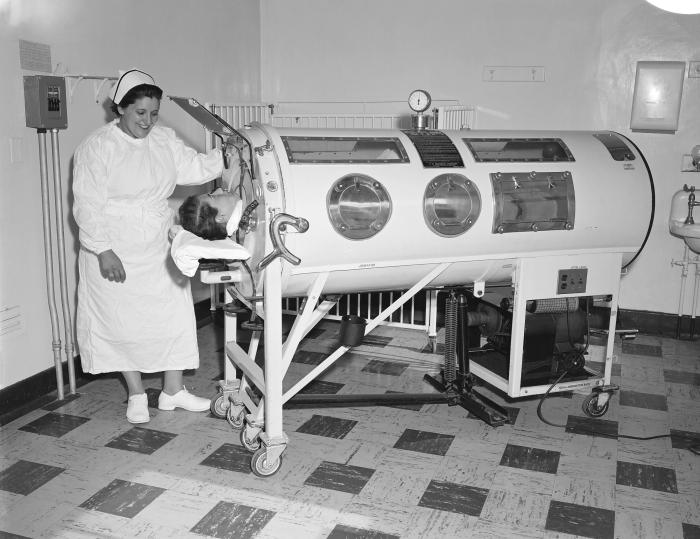
A breath from the far end of the tank
In an ordinary breath, the diaphragm contracts and descends. The chest cavity gets bigger, the lungs expand and the air pressure inside them briefly falls below the pressure at the lips. Room air flows in. Polio could leave a person with an open airway and lungs capable of exchanging gases, yet too little muscle power to make that first expansion happen. The tank took over the work of expanding the chest. [2][3]
John Haven Emerson’s 1931 design put a flexible diaphragm of its own at the patient’s feet. A motor drew it outward, increasing the space for air in the tank and lowering the pressure around the patient’s body. The snug collar kept room air from rushing in around the neck. With less pressure bearing on the chest, it expanded. Room air now had a route into the lungs through the nose and mouth. As the motor reversed its stroke, pressure around the body rose, the chest recoiled and the patient breathed out. The air moving around the patient’s pajamas and the air reaching the lungs stayed separate throughout. [2][3]
Consider what would happen if a nurse pulled the bed out mid-breath. Air from the ward would enter the open cylinder, equalizing the pressure across the doorway almost at once. The motor could keep turning, but it would have lost its hold on the patient’s chest. For someone who depended on the tank for every breath, even changing the bedding posed an engineering problem. [2][3]
How to reach the patient
On the tank that Barton Hebert Jr. used in Louisiana from the late 1950s, four long windows gave caregivers a view inside. Just below them, a row of access ports put the patient within arm’s reach. Hebert’s family donated his machine to the CDC, where visitors can still see how much of its side was given over to these openings. A British patient identified as Miss AW described what those little doors meant in practice. In an oral history recorded in 2008, she remembered a therapist timing the opening to her breathing cycle and reaching through a rubber seal to work with her inside the tank. [3][4]
For care that needed the whole bed exposed, later Emerson models carried a transparent dome at the head. An attendant could close it over the patient’s face and deliver air under positive pressure while the bed slid free. The two arrangements make a pair. With the tank closed, the machine lowered pressure around the chest. With the tank open, the dome raised pressure at the entrance to the airway. Either arrangement could produce the difference needed to move air into the lungs. [2]
Miss AW slept in an iron lung at home and went to work during the day. At bedtime her mother helped her settle one last matter after closing the tank. If her nose itched, she had to direct her mother to the spot. Her face was out in the room and her hands were inches away on the other side of the collar. It is hard to picture more exactly where the seal ran, or what it asked of the two people who closed it each night. [4]
Sources
- CDC Public Health Image Library, photograph 12009. Nurse caring for a patient in an Emerson respirator in Rhode Island, 1960.
- Ohio State University Health Sciences Library, “Emerson Respirator or Iron Lung.” Medical Heritage Center collection and account of the pressure cycle.
- David J. Sencer CDC Museum, “Polio and the Epidemic Intelligence Service.” Collection record for Barton Hebert Jr.’s iron lung.
- “The iron lung – a polio patient's story.” Oral history recorded for the Berkshire Medical Heritage Centre in 2008, published in the Journal of the Royal Society of Medicine in 2010.