MenAfriVac is easy to remember as a vaccine success story. The more useful reading is mechanical: it changed the time scale of meningitis control. Before it, countries in Africa's meningitis belt could vaccinate reactively with polysaccharide vaccines, treat cases, and prepare for dry-season epidemics. After it, group A meningococcal disease could be pushed toward prevention if immunity, campaign speed, age targeting, cold-chain flexibility, and surveillance all worked together.[1][2]
That "if" matters. Bacterial meningitis can kill quickly, and WHO still frames the disease as a medical emergency, with death and severe complications remaining major concerns even when treatment exists.[1] The belt running across sub-Saharan Africa has historically carried the heaviest epidemic burden. MenAfriVac did not make meningitis disappear. It solved a narrower problem with unusual force: serogroup A epidemics, once the dominant epidemic pattern, became controllable when a conjugate vaccine could generate durable individual protection and reduce carriage enough to protect communities.[2][4][6]
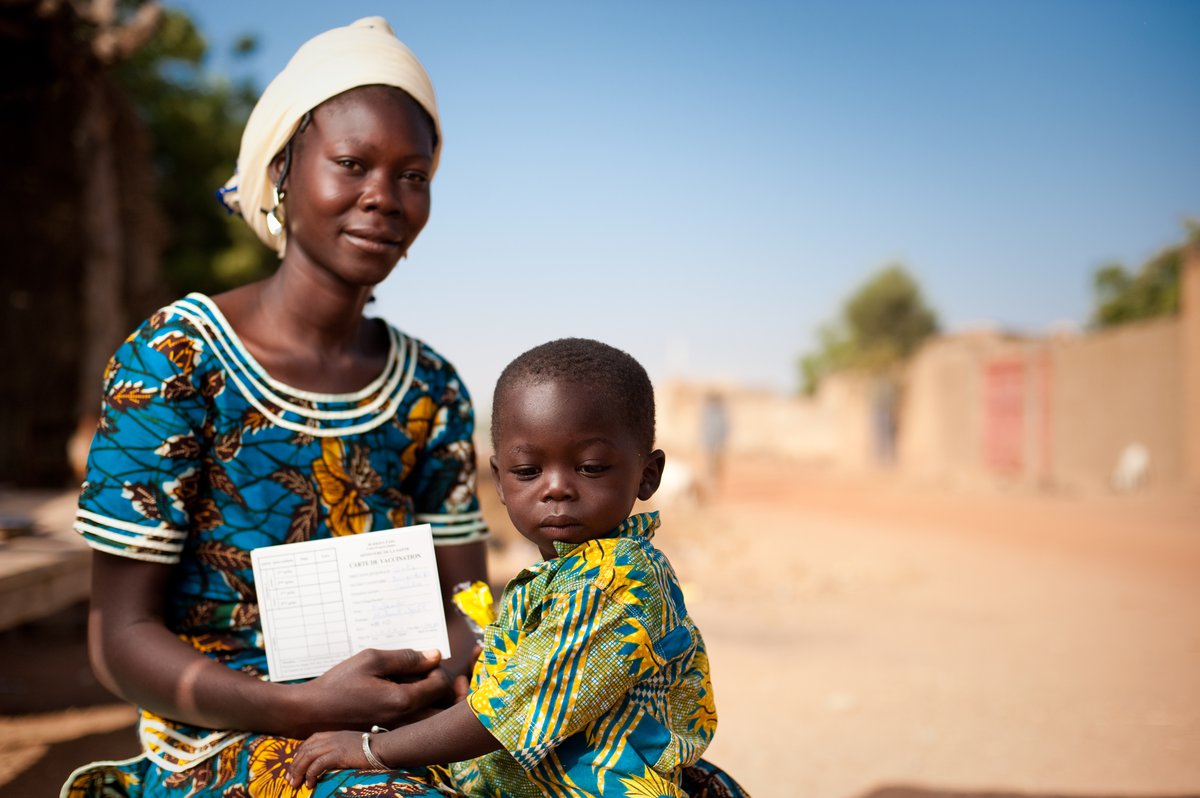
Image context: the photograph is not a generic vaccination scene. PATH identifies it as a mother displaying her child's vaccination record at the 2010 Burkina Faso launch of MenAfriVac, the first campaign moment when the new vaccine moved from development promise into the practical world of consent, supply, staff, records, and follow-up.[3]
Timeline anchors
- 2001: the Meningitis Vaccine Project began as a WHO-PATH partnership focused on creating an affordable serogroup A conjugate vaccine for Africa's meningitis belt.[3]
- June 2010: WHO prequalified MenAfriVac, clearing the way for international procurement and country introduction.[2]
- December 2010: Burkina Faso, Mali, and Niger launched the first mass campaigns; PATH describes more than 20 million people targeted across the three countries.[2][3]
- 2012: a Burkina Faso pilot used a controlled-temperature-chain approach that let the vaccine spend limited time outside the usual 2-8 C cold chain during campaign work.[5]
- 2024: Nigeria introduced Men5CV during an outbreak response, a reminder that MenAfriVac's success against serogroup A did not eliminate the wider meningitis problem.[7]
The old problem was speed after danger had already arrived
Epidemic meningitis control used to be biased toward response. Cases would rise, laboratory confirmation would lag the first panic, and authorities would try to vaccinate once transmission was already visible. That model was not irrational. It was the tool set available. But it gave the pathogen a head start and left communities waiting for the dry-season curve to declare itself.
MenAfriVac changed the causal chain because it was a conjugate vaccine, not just another emergency dose. WHO's 2010 launch account described the goal plainly: protect young children, reduce transmission, and create herd immunity rather than only blunt an outbreak after it began.[2] The economic design mattered too. The vaccine was developed for less than US$0.50 per dose, because a product priced for wealthy-market assumptions would not fit the public-health geometry of the belt.[2]
The target age range shows the same logic. Campaigns focused on people aged 1 to 29 years, not only the youngest children, because adolescents and young adults are central to meningococcal carriage and transmission. A vaccine strategy that protects infants but leaves the main transmission network untouched can save individuals while epidemics continue. MenAfriVac's age sweep treated the belt as an ecosystem of carriage, immunity, school-age mixing, household exposure, and seasonal risk.[2][3][4]
Herd immunity was the mechanism, not a bonus
The strongest evidence came after campaigns had time to change transmission. A Chad study reported a marked collapse in meningitis incidence in vaccinated regions after a 2011 campaign, with group A cases disappearing from the vaccinated regions in the monitored period.[4] Later multi-country analysis in The Lancet Infectious Diseases found that confirmed serogroup A disease fell by more than 99% in vaccinated populations across nine countries.[6]
Those numbers are important, but the interpretation is the point. MenAfriVac worked because the outcome was not only "vaccinated people got less sick." The larger achievement was that high coverage reduced the chance that group A meningococcus could keep moving through the population. That is why the project was designed around mass preventive campaigns before routine infant schedules could maintain gains. The first campaigns built the wall; routine immunization had to keep repairing it.
This is also why the story should not be simplified into "one vaccine ended meningitis." WHO's current disease page still emphasizes multiple causative organisms and multiple meningococcal serogroups.[1] Serogroups C, W, X, and Y can still cause outbreaks. MenAfriVac made one historically dominant epidemic engine much weaker. It did not retire surveillance, laboratory confirmation, outbreak thresholds, antibiotics, or the need for broader vaccines.[1][7]
Delivery design was part of the biology
The controlled-temperature-chain work is easy to treat as logistics, but in this case logistics was part of the health effect. A vaccine that requires a perfect cold chain in hard-to-reach dry-season settings may be biologically excellent and operationally fragile. The Burkina Faso pilot tested a different model: MenAfriVac could be kept for up to four days at temperatures up to 40 C under defined campaign conditions, instead of remaining constantly inside the standard cold chain.[5]
That flexibility mattered because mass campaigns fail at the margins. A team that can stay longer in a village, carry fewer ice packs, vaccinate without returning constantly to a refrigerator, and reduce vial wastage can reach people who would otherwise be missed. The pilot reported high coverage, minimal discard, strong vaccinator acceptance, and lower per-person cold-chain-related costs.[5] None of that changes the immune response inside one body. It changes how many bodies enter the protective network.
This is the central causal lesson. Public health often talks as if discovery and delivery are separate stages: first make the product, then roll it out. MenAfriVac's success came from designing the product and delivery context together. Price, presentation, regulatory prequalification, heat stability, campaign age bands, political launch, community trust, and post-campaign surveillance all belonged to the same mechanism.[2][3][5][6]
The unfinished part is the proof that the mechanism is real
Men5CV's 2024 Nigerian introduction clarifies MenAfriVac's legacy rather than replacing it. Nigeria used the newer five-strain vaccine in response to an outbreak that included serogroup C; WHO described Men5CV as covering serogroups A, C, W, Y, and X, and as building on the same kind of African public-health need that shaped MenAfriVac.[7] The move makes sense only if the older success is read precisely. Serogroup A was suppressed because a targeted vaccine matched the epidemic mechanism. Other serogroups require their own matched tools.
The danger of a triumph narrative is that it makes the maintenance phase look automatic. It is not. Birth cohorts age into the population. Routine schedules must preserve immunity after mass campaigns. Laboratories must identify the serogroup when cases appear. Countries need enough financing, staff, trust, and transport to respond before an outbreak becomes a regional wave. MenAfriVac showed that epidemic meningitis can be bent sharply downward. It also showed that the bend depends on keeping the whole chain intact.[1][6][7]
The practical inheritance is therefore disciplined optimism. MenAfriVac did not win because vaccines are magical. It won because the vaccine, the price, the age strategy, the delivery model, and the surveillance question were aligned around one transmission problem. That alignment turned meningitis A from a recurring epidemic panic into a maintenance task. Maintenance is less dramatic than emergency response, but in public health it is often the deeper victory.
Sources
- World Health Organization, "Meningitis" fact sheet - current disease overview, emergency framing, complications, and meningococcal serogroup context.
- World Health Organization, "Revolutionary new meningitis vaccine set to wipe out deadly epidemics in Africa" (December 8, 2010) - launch context, price target, prequalification, and herd-immunity ambition.
- PATH, "A groundbreaking partnership to eliminate meningitis epidemics" - Meningitis Vaccine Project history, 2010 campaign context, and source page for the article photograph.
- D. M. Daugla et al., "Effect of a serogroup A meningococcal conjugate vaccine (PsA-TT) on serogroup A meningococcal meningitis and carriage in Chad," The Lancet, 2014; PubMed record - Chad post-campaign incidence and carriage study.
- World Health Organization, "Use of MenAfriVac (meningitis A vaccine) in a controlled temperature chain during campaigns" - operational guidance and Burkina Faso pilot evidence.
- C. L. Trotter et al., "Impact of MenAfriVac in nine countries of the African meningitis belt, 2010-15," The Lancet Infectious Diseases, 2017; PubMed record - multi-country impact assessment of serogroup A reduction after vaccination.
- World Health Organization, "In world first, Nigeria introduces new 5-in-1 vaccine against meningitis" (April 12, 2024) - Men5CV launch and why non-A serogroups keep meningitis control unfinished.