Drowning prevention is often discussed as if it were a referendum on one virtue: a careful adult watches, or a child learns to swim, and tragedy stays away. That frame is emotionally understandable and practically weak. The harder evidence points to a layered system. Drowning can happen in seconds, often without the dramatic noise people imagine, and it begins whenever a child has access to water before a prepared adult can intervene.[1][2]
The useful question is not which single safeguard is best. It is what happens when any one safeguard fails for a normal reason: a door is left open, a phone rings, a group of adults each assumes someone else is watching, a confident preschooler follows a toy, or a swimmer meets fatigue, cold water, current, panic, or a medical event. Prevention works when no single ordinary lapse is allowed to carry the whole fatal load.[1][3]
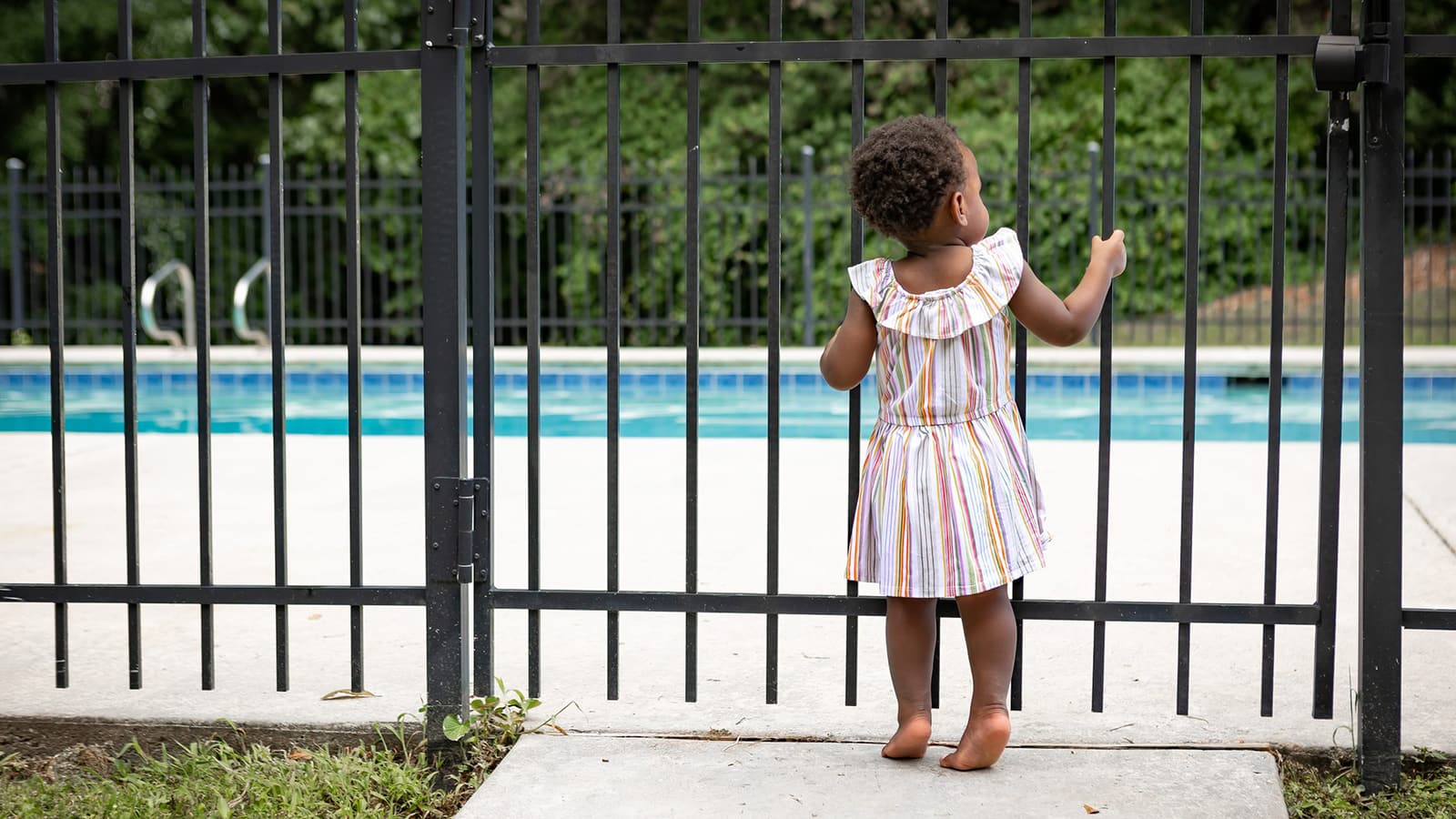
Image context: the cover photograph is not a generic pool scene. It shows the kind of environmental barrier that changes the risk before swim time starts. In a layered model, that matters because the most important rescue is often the one that never has to happen.[2][4]
Timeline anchors
- 1998: Cochrane's pool-fencing review examined case-control evidence and concluded that isolation fencing, meaning fencing that separates the pool from the house and yard access, was more protective than arrangements that still let children reach the pool through the home.[4]
- 2009: the swimming-lesson evidence summarized in CDC references included a case-control study on childhood drowning and lessons, helping explain why lessons are a risk-reduction layer rather than a guarantee.[1]
- 2019: the American Academy of Pediatrics policy statement, cited in CDC's prevention page, emphasized layered drowning prevention rather than a single tactic.[1]
- 2026: CDC, WHO, and HealthyChildren pages still frame drowning as preventable but fast, quiet, and dependent on access control, supervision, skills, equipment, and emergency readiness working together.[1][2][3][5]
Myth: "Good supervision is enough"
Supervision is necessary. It is not a wall, a lock, or a physics change. CDC guidance tells adults to designate a responsible watcher, avoid distracting activities such as phone use, reading, alcohol, and drugs, and keep close, constant attention when children are in or near water.[1] HealthyChildren makes the same point in parent-facing language: assign a water watcher who stays focused, avoids distractions, can act quickly, and is not relying on lifeguards to replace direct responsibility.[5]
The myth begins when supervision is treated as if it were continuous just because adults care. Real households are not continuous attention machines. People answer doors, use bathrooms, prepare food, talk to guests, tend to siblings, and mentally hand off responsibility in crowded gatherings. The same problem appears at vacation rentals, grandparents' houses, neighbors' yards, hotel pools, and unfamiliar homes: the water is available before anyone has made an explicit supervision plan.
Evidence-led prevention therefore separates two jobs. One job is active watching during water time. The other is access control outside water time. A four-sided fence with a self-closing and self-latching gate is not a substitute for supervision; it is protection against the moments when supervision has not yet begun or has silently lapsed.[1][4][5]
Myth: "Swim lessons drown-proof a child"
Swim lessons matter, and saying so does not mean overselling them. CDC summarizes formal swimming lessons as a way to reduce drowning risk, while also stating that children who have had lessons still need close and constant supervision around water.[1] HealthyChildren describes swim lessons as a layer of protection that may begin for many children starting at age 1, depending on readiness and context.[5]
The word "layer" is doing real work. A lesson can teach breath control, floating, turning, reaching an edge, listening to water-safety rules, and recovering from surprise. It cannot make a toddler developmentally reliable, make a tired child strong, turn a river into a pool, neutralize a current, remove cold shock, or guarantee judgment during panic. Swimming ability is also not one stable trait. It changes with clothing, water temperature, distance, fatigue, waves, medication, illness, and whether the person expected to be in the water at all.
The best reading of the lesson evidence is therefore neither dismissal nor faith. Lessons lower risk by adding capability. They do not erase the need for barriers, life jackets in the right setting, adult attention, and emergency response. A child who can swim still needs a closed gate after swim time, a sober and undistracted watcher during swim time, and a life jacket around open water when appropriate.[1][3][5]
Myth: "A pool fence is just a code detail"
Pool fencing can sound like a regulatory checkbox until the mechanism is made plain. Cochrane's review found evidence that pool fencing reduces child drowning risk and that isolation fencing around the pool is more effective than perimeter arrangements that still allow access from the house.[4] CDC's current prevention page translates the mechanism into design: use a four-sided fence at least four feet high, fully enclosing the pool, separating it from the house, with self-closing and self-latching gates; remove toys that might attract children into the pool area.[1]
That design is not aesthetic. It is a timing intervention. A child who slips out of a room, follows a ball, wakes before adults, or wanders during a family gathering has to meet a barrier before meeting water. The fence changes the sequence from "door, yard, pool" to "door, yard, locked gate, noticed delay." The point is not that a fence makes the pool safe. The point is that it turns unsupervised access from an easy path into a harder event.
HealthyChildren adds practical details that reveal why weak barriers fail: the fence should be four-sided, climb-resistant, properly spaced, and paired with a gate that closes and latches by itself; toys should be kept out of the pool area when the pool is not in use.[5] In myth terms, the fence is not proof that adults can relax. It is proof that adults have assumed attention will sometimes fail and designed the environment accordingly.
Myth: "Alarms, floaties, and CPR cover the rest"
Add-on devices are tempting because they feel active. Some can help, but the hierarchy matters. HealthyChildren describes alarms as an added layer, not a substitute for a properly installed pool fence.[5] CDC is similarly direct about flotation: life jackets reduce drowning risk while boating and around natural water, but air-filled or foam toys are not safety devices.[1] Inflatable arm bands and pool toys can create a false sense of security precisely because they look like equipment while behaving like toys.
CPR belongs in the system too, but it sits late in the chain. CDC encourages CPR training because those skills can help while waiting for paramedics.[1] That is important, not comforting. CPR is what the system hopes not to need. A prevention plan that begins with emergency rescue has already conceded too much time.
The same logic applies globally. WHO frames drowning as a preventable public-health problem and names access control, supervised childcare, basic swimming and water-safety skills, safe rescue, and resuscitation training as parts of a broader prevention package.[3] The package is not a menu where one preferred item cancels the others. It is a redundancy plan.
Evidence: The system should survive ordinary failure
The most useful mental model is not "responsible family" versus "irresponsible family." It is a system that expects ordinary failure and reduces the consequences. A locked four-sided fence reduces unsupervised access. A designated water watcher reduces diffusion of responsibility. Swim lessons add capability without pretending to make children invulnerable. Life jackets fit the open-water and boating problem better than pool toys do. CPR training improves the odds after a crisis starts, while emergency plans and local risk checks shorten confusion.[1][3][5]
This is why drowning prevention belongs in health writing rather than only safety pamphlets. The evidence forces a less flattering but more useful view of human behavior. Attention is fragile. Access is powerful. Children are fast. Water is quiet. A prevention plan that depends on flawless attention is not serious enough for the speed of the hazard.
The practical conclusion is simple but demanding: never let one layer impersonate the whole system. Supervision, fences, lessons, life jackets, alarms, CPR, and local hazard checks are different tools for different failure points. The strongest plan is not the one that chooses a hero. It is the one that still works when a normal human moment goes wrong.
Sources
- Centers for Disease Control and Prevention, "Preventing Drowning" - current prevention guidance on swim lessons, four-sided pool fencing, close supervision, life jackets, CPR, natural-water risks, and cited pediatric evidence.
- Centers for Disease Control and Prevention, "Drowning Facts" - U.S. child mortality framing and source page for the pool-fence photograph used with this article.
- World Health Organization, "Drowning" fact sheet - global public-health framing, risk factors, and prevention measures including access control, swimming skills, rescue, and resuscitation.
- Cochrane, "Pool fencing for preventing drowning of children" - evidence summary on isolation fencing and child drowning prevention.
- HealthyChildren.org / American Academy of Pediatrics, "Pool Dangers and Drowning Prevention - When It's Not Swimming Time" - parent guidance on layers of protection, pool fencing, alarms, water watchers, swim lessons, life jackets, and CPR.