
As of 2026-05-16 UTC, the World Health Organization's 50-second video "Medication Without Harm," published on October 6, 2017, is still useful because it compresses a sprawling patient-safety problem into a sequence of shared responsibilities.[1] It is not a technical tutorial, and that is exactly why it is worth annotating. In less than a minute, the video makes medication safety feel less like a private memory test and more like a system problem: a patient asks, a prescriber explains, a pharmacist checks, a caregiver watches for trouble, and the next handoff keeps the story intact.[1][2]
The stakes are not small. WHO identifies unsafe medication practices and medication errors as a leading source of avoidable harm in health systems, and its Medication Without Harm challenge set a global ambition to reduce severe avoidable medication-related harm by 50%.[2] WHO's patient-safety fact sheet puts the problem in more human terms: medication-related harm affects 1 out of every 30 patients in health care, and more than a quarter of that harm is severe or life threatening.[5] Those figures are useful not because every reader can solve the global medication system, but because they explain why a short public video has to do more than say "be careful." It has to teach where carefulness belongs.
That is the strength of this clip. It does not make the patient solely responsible for preventing errors, and it does not pretend that clinicians can prevent every mismatch without patient participation. Instead, it frames medication safety as a chain of questions and confirmations. The video belongs beside WHO's later 5 Moments for Medication Safety tool, which asks patients and caregivers to pause at five recurring points: starting a medicine, taking it, adding another medicine, reviewing medicines, and stopping a medicine.[3] The point is not to turn patients into pharmacists. The point is to give everyone a repeatable moment when the medication story can be checked before drift becomes harm.[2][3]
The opening move makes medication harm visible without making it melodramatic
The video begins from a familiar scene rather than from policy language: a person takes medicine with the expectation that it will help. That choice matters. Medication harm can sound abstract when it is discussed as an "adverse event" or a "systems failure." It becomes clearer when the ordinary act of taking a tablet, filling a prescription, or following a discharge instruction is understood as the end point of many earlier decisions.[1][2]
Around the first third of the clip, WHO shifts the viewer's attention from the pill itself to the chain around it: prescribing, dispensing, administration, and monitoring.[1] That sequence tracks the initiative page closely. WHO describes medication errors as arising when weak systems or human factors affect prescribing, transcribing, dispensing, administration, and monitoring practices.[2] The video is therefore doing a subtle but important editorial job. It keeps the viewer from imagining medication safety as a single heroic act at one counter or one bedside. A medicine can be correct when prescribed and still become unsafe if the dose is misunderstood, the old medicine list is wrong, the packaging is confused, renal function changes, or side effects are not noticed in time.
That system framing is especially important because medication safety is often narrated through blame. A patient "failed to take it correctly." A nurse "gave the wrong dose." A doctor "missed the interaction." Sometimes individuals do make mistakes, but the WHO frame is broader and more useful: fatigue, poor working conditions, weak communication, similar drug names, fragmented records, and rushed transitions all create error-friendly environments.[2][4] The video's plainness is therefore a virtue. It points away from shame and toward design.
The middle of the clip gives patients a role without dumping the system on them
The strongest public-health videos give viewers something to do while keeping the limits honest. This one does that by making questions legitimate. A patient can ask what a medicine is for, how and when to take it, what side effects should trigger help, and what happens when another medicine is added.[1][3] Those questions line up with the 5 Moments tool, which is explicitly designed for use by patients, families, and caregivers in collaboration with health professionals.[3]
That collaboration clause is the key boundary. A good medication-safety message should not imply that a patient who is sick, old, overwhelmed, uninsured, or moving between services is personally at fault for not managing a complex drug list alone. WHO's Global Patient Safety Action Plan treats patient safety as a health-system responsibility, not a consumer lifestyle project.[4] The written 5 Moments tool is strongest when read in that spirit. It gives patients a script for entering the conversation, while still assuming that clinicians, pharmacists, institutions, and policy makers must make the conversation possible.[3][4]
This is why the video's brevity works. It does not try to teach pharmacology. It teaches interruption rights. Before starting a medicine, ask why. While taking it, ask what to watch for. When another medicine is added, ask whether the combination changes anything. During a medication review, ask what can be simplified or stopped. When stopping a medicine, ask whether it should be tapered, replaced, or monitored.[3] Those are not exotic questions. They are the basic checkpoints that keep a medicine list from becoming an inherited pile of assumptions.
The hidden subject is the transition, where medication stories often break
The video's most important implied setting is not the exam room. It is the transfer: hospital to home, emergency department to primary care, specialist to generalist, paper list to pharmacy record, caregiver memory to electronic chart.[1][2] WHO names transitions of care as one of the three key action areas of Medication Without Harm, alongside polypharmacy and high-risk situations.[2] That priority makes sense because transitions are where medication stories are easiest to scramble. A hospital may stop one drug and start another. A discharge summary may arrive late. A patient may still have old bottles at home. A caregiver may know the actual routine better than the formal list.
The video gestures toward this by showing medication safety as a relay rather than a lecture.[1] That is the right mental model. The practical question is not simply "Did someone explain the medicine?" It is "Did the explanation survive the next handoff?" A safer system asks whether the patient's list has been reconciled, whether high-risk medicines have extra checks, whether the patient knows what changed, and whether someone is responsible for follow-up when side effects, nonadherence, or confusion appear.[2][3][4]
This is also where patients and caregivers can add information that records miss. They can say which medicines are actually being taken, which were stopped because of dizziness or cost, which over-the-counter drugs or supplements are in the house, and which instructions conflict with daily life. But that input only becomes safety work if the system has a place to receive it. Medication safety is therefore not achieved by asking patients to "speak up" in the abstract. It is achieved when clinicians invite specific questions, pharmacists have time to verify, discharge processes reconcile lists, and follow-up routes catch problems before they become emergency visits.[3][4]
Why this 2017 video still earns a place in 2026
Some health videos age badly because they depend on a particular campaign date or a narrow guideline detail. This one has lasted because it teaches a durable pattern: medicine safety lives in repeated moments of clarification.[1][3] The global patient-safety agenda has continued to broaden since the video was posted, with WHO's 2021-2030 action plan calling for the maximum possible reduction in avoidable harm across health care and for safer care to be embedded in policy, practice, and patient engagement.[4][5]
The clip should be watched as an entry point, not as the whole lesson. Its value is the first move: it makes the invisible chain around a medicine visible. The deeper work sits in the written WHO materials: identifying high-risk situations, managing polypharmacy, improving transitions of care, involving patients without blaming them, and building systems that treat medication review as ordinary maintenance rather than cleanup after harm.[2][3][4]
For a reader, the practical takeaway is narrow but powerful. Do not treat a medicine list as static. Treat it as a living handoff document. When a medicine starts, changes, combines with another drug, gets reviewed, or stops, that is the moment to ask what changed, why it changed, what to watch for, and who owns the next step.[3] The WHO video succeeds because it makes that behavior feel like normal participation in care. Medication safety is not a slogan printed on a poster. It is the habit of keeping the drug story intact as it moves from person to person.[1][2][3][4]
Sources
- World Health Organization, "WHO: Medication Without Harm," YouTube video, published October 6, 2017.
- World Health Organization, "Medication Without Harm" - initiative overview, launch context, 50% reduction aim, medication-use process, and key action areas.
- World Health Organization, "5 moments for medication safety" (July 1, 2019) - patient and caregiver engagement tool for starting, taking, adding, reviewing, and stopping medicines.
- World Health Organization, "Global Patient Safety Action Plan 2021-2030" (August 3, 2021) - strategic framework for eliminating avoidable harm and embedding patient safety across health systems.
- World Health Organization, "Patient safety" fact sheet - medication-related harm burden, patient-safety action plan context, and global patient-safety framing.
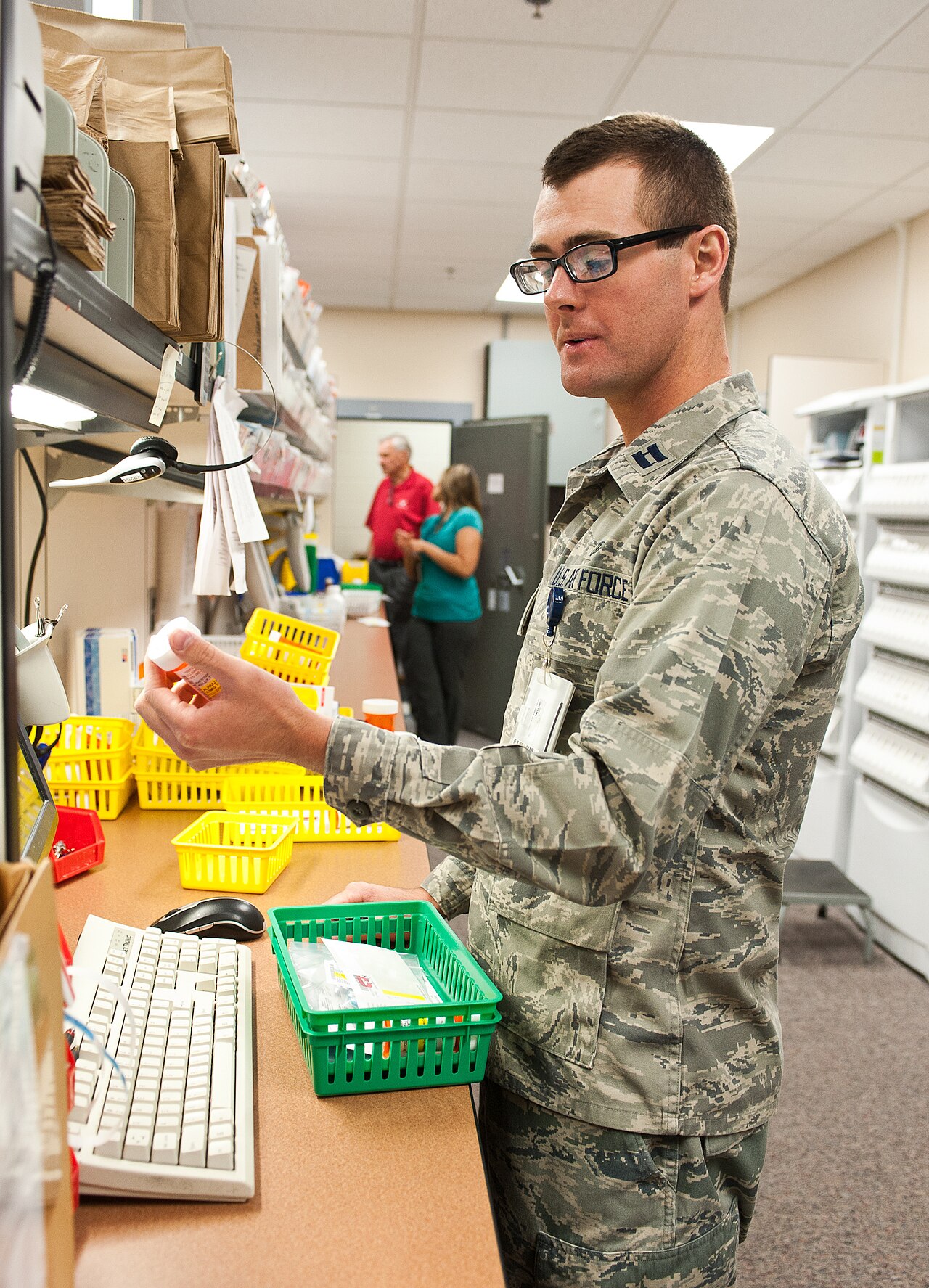
- Wikimedia Commons, "Pharmacy 120522-F-CC568-002.jpg" - U.S. Air Force photograph of a pharmacist verifying prescriptions during quality-control checks, used as this article's image.