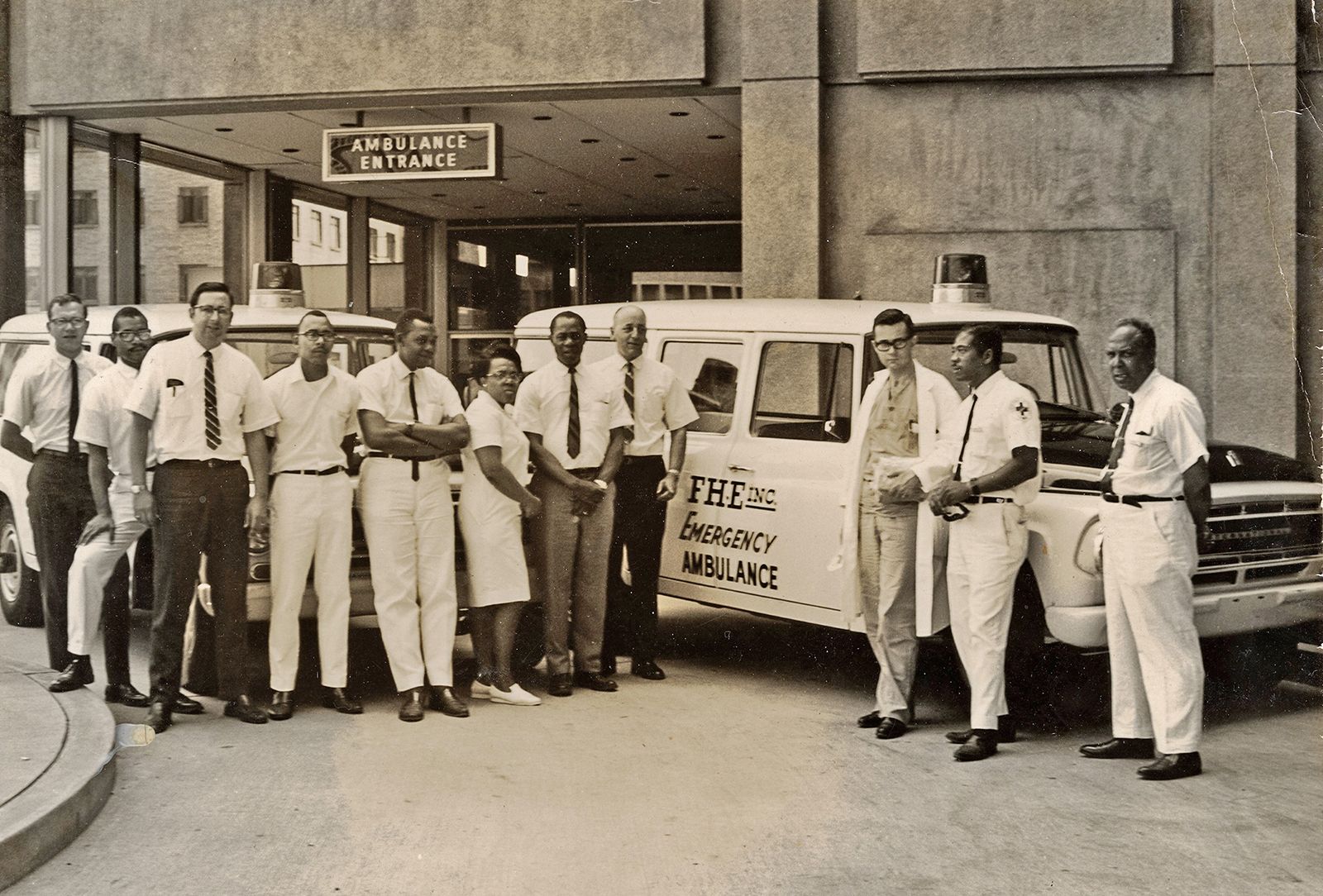
The crucial event in the Freedom House story was not the purchase of an ambulance. It was the moment a vehicle that had mostly meant transport became a place where medicine could happen before hospital arrival. In Pittsburgh's Hill District, between 1967 and 1975, a Black community organization, a hospital, and a group of physicians built a working answer to a national emergency-care failure: train neighborhood residents so thoroughly that the ambulance stopped being a wagon and started functioning as the first room of the emergency department.[2][3][4]
That reconstruction starts with a bleak baseline. In 1966, the National Academy of Sciences and National Research Council published Accidental Death and Disability: The Neglected Disease of Modern Society, a report that reviewed ambulance services, voice communications, emergency departments, intensive care units, trauma research, resuscitation, and disaster response. Its central complaint was not only that crashes and injuries were killing too many people. It was that the first medical link after injury was often disorganized, undertrained, badly connected to hospitals, and treated as a transportation problem rather than as clinical care.[1]
Pittsburgh added a sharper racial geography to that national failure. Before Freedom House, residents who could not use private ambulance services often depended on police or morticians for emergency transport. Britannica's history of the service describes the pre-1967 system as fragmented and especially inadequate for low-income and Black communities, with little or no care delivered during the ride. The Hill District did not simply need faster wheels. It needed an emergency response that residents could trust enough to call, and that would arrive with people trained to do more than load a patient into the back.[2]
The first reconstruction step is therefore institutional, not technological. Freedom House Enterprises, a Black-administered nonprofit connected to job training and community development, became the umbrella for an ambulance program created with Presbyterian-University Hospital. Pitt's Health Sciences Library System summarizes the partnership plainly: Freedom House Ambulance Service was established in 1967 as a cooperation between Freedom House Enterprises and the hospital, training unemployed Hill District residents to become EMTs and provide paramedic service to an area that lacked reliable emergency access.[3]
Peter Safar's role mattered because he saw the ambulance through the logic of resuscitation. Safar, a University of Pittsburgh anesthesiologist associated with CPR and intensive care, was approached for help with ambulance acquisition and equipment. The larger idea that emerged was more demanding: recruit Hill District residents, teach them a curriculum that exceeded routine first aid, put them under medical direction, and let the service test whether advanced prehospital care could be performed outside the hospital.[2][4]
The social design was as radical as the medical design. Freedom House recruited people whom ordinary professional pipelines often excluded: chronically unemployed residents, people with criminal records, Vietnam veterans, and others whom the surrounding city did not read as future clinical workers. Britannica describes a roughly 300-hour classroom course followed by nine months of field learning. The first class began training in June 1968 and served the Hill District and nearby Oakland. The point was not charity employment dressed up as medicine. It was medical training used as infrastructure: a way to solve an emergency-care problem by investing in the neighborhood that had been denied care.[2]
Once the service began operating, the ambulance changed function in small, cumulative ways. The crew had to assess, communicate, choose an intervention, and keep a patient alive while moving through city streets. Pitt's institutional summary notes that Freedom House trainees learned skills such as intubation and defibrillation that had not been performed in the out-of-hospital setting in the same way. Britannica adds cardiac care and intravenous drug administration to the later scope of ambulance-based practice. The exact repertoire developed over time, but the underlying turn is clear: the patient was no longer waiting for medicine to begin at the hospital door.[2][3]
The strongest evidence that this was not just a heroic local story came from comparison. In its first two years, Freedom House answered more than 5,800 calls, according to Britannica, and a 1971 study of more than 1,400 patients at three Pittsburgh hospitals found inappropriate prehospital care in 11 percent of patients transported by Freedom House, compared with 62 percent for police transport and 78 percent for volunteer fire departments and private ambulances. Smithsonian's 2025 account gives the patient count as 1,421 and reports the same 11 percent versus 62 percent contrast. Those numbers do not prove every later EMS claim, but they show why the program became hard to dismiss: it produced a measurable difference at the handoff point where emergency care could be judged.[2][6]
Nancy Caroline's later role sharpened the system logic. Britannica describes Caroline, Benson's successor as medical director, buying a police radio so Freedom House ambulances could arrive at emergency scenes that police dispatch might otherwise withhold. Smithsonian frames her as the physician supervising John Moon when he performed a field intubation in 1975, a moment remembered because it violated the older assumption that an airway procedure belonged only inside the hospital. These details matter because modern EMS is not just training. It is training plus communication, medical control, dispatch access, equipment, and permission to act.[2][6]
That is why the program's closure in 1975 is part of the event rather than an afterword. Freedom House had demonstrated a model, but it remained financially and politically vulnerable. Britannica describes unstable city funding, opposition from police and suburban fire departments, the loss of federal support, and the decision to create a new citywide network that closely resembled the Freedom House model while employing mostly white paramedics. The 2019 Journal of the History of Medicine and Allied Sciences article makes the interpretive stakes explicit: although Pittsburgh officials cited economic constraints, Black and majority newspapers and citizens understood the city's diminishing support in racial terms.[2][4]
The best historical reading is therefore double. Freedom House was a medical success because it helped prove that rigorous paramedic training, hospital connection, and ambulance-based intervention could improve prehospital care. It was also a civic indictment because the city was willing to absorb the lesson while weakening the Black institution and workforce that had supplied it. A 2026 Urban Studies article places Freedom House inside a broader argument about civil rights, urban policy, and emergency medical services: contemporary EMS standards did not emerge only from highway-safety anxiety or wartime medical transfer; they also grew from Black communities creating institutions in response to health discrimination and urban disinvestment.[5]
That broader frame changes what the word "first" should mean. Calling Freedom House one of the first modern paramedic services is accurate but too small. The event reconstructed here is not a trivia milestone in ambulance history. It is a conversion sequence: a national report identified emergency care as a public-health failure in 1966; Pittsburgh's Hill District exposed how that failure was intensified by race, policing, and poverty; Freedom House Enterprises and Presbyterian-University Hospital built a training pipeline in 1967 and 1968; the crews produced comparative evidence by 1971; and, by 1975, the city had both copied and displaced the program.[1][2][3][4][5]
The lasting lesson is uncomfortable because it is practical. Better emergency medicine required devices, protocols, radios, and doctors willing to authorize field care. But it also required labor policy, neighborhood legitimacy, and a refusal to assume that expertise had to be imported from outside the community being served. Freedom House made the ambulance clinical by training people who had been treated as marginal to become the first medical decision-makers at the scene. Its legacy is not only that ambulances became more capable. It is that a community health intervention showed the country what capability should look like, and then had to fight to remain visible inside the system it helped create.[2][4][5][6]
Sources
- National Academy of Sciences and National Research Council Committees on Trauma and Shock, Accidental Death and Disability: The Neglected Disease of Modern Society (NCBI Bookshelf republication of the 1966 report).
- Jordana Rosenfeld and Encyclopaedia Britannica Editors, "Freedom House Ambulance Service" - fact-checked overview and archival images.
- University of Pittsburgh Health Sciences Library System, "Freedom House Ambulance Service of Pittsburgh - Making Medical History" (August 2023).
- Matthew L. Edwards, "Pittsburgh's Freedom House Ambulance Service: The Origins of Emergency Medical Services and the Politics of Race and Health," Journal of the History of Medicine and Allied Sciences 74, no. 4 (2019).
- Justin Peter Steil, Ruth Gourevitch, Mark Brennan, and Chit Sum Eunice Ngai, "Civil rights, urban policy, and the origins of the U.S. emergency medical services system," Urban Studies (first published online March 22, 2026).
- Lillian Ali, "These Trailblazing Black Paramedics Are the Reason You Don't Have to Ride a Hearse or a Police Van to the Hospital," Smithsonian Magazine (May 21, 2025).