The famous central-line story is often shortened to "checklists saved lives." That is true enough to be memorable and too thin to be useful. The better explanation is that the Keystone ICU project turned central venous catheter placement from a private act of clinician vigilance into a repeatable system for controlling contamination at the skin, equipment, team, and time levels.[1][2][3]
A central line is not an ordinary tube. It creates a managed breach through skin into central circulation, often in a patient whose immune defenses, physiology, and hospital exposure already make infection more dangerous. The infection-prevention problem is therefore not one heroic sterile move. It is a chain: choose the site with infection and mechanical risks in view, clean the skin, use full barrier protection, keep hands and equipment from recontaminating the field, maintain the dressing and hubs afterward, and remove the line as soon as it is no longer needed.[1]
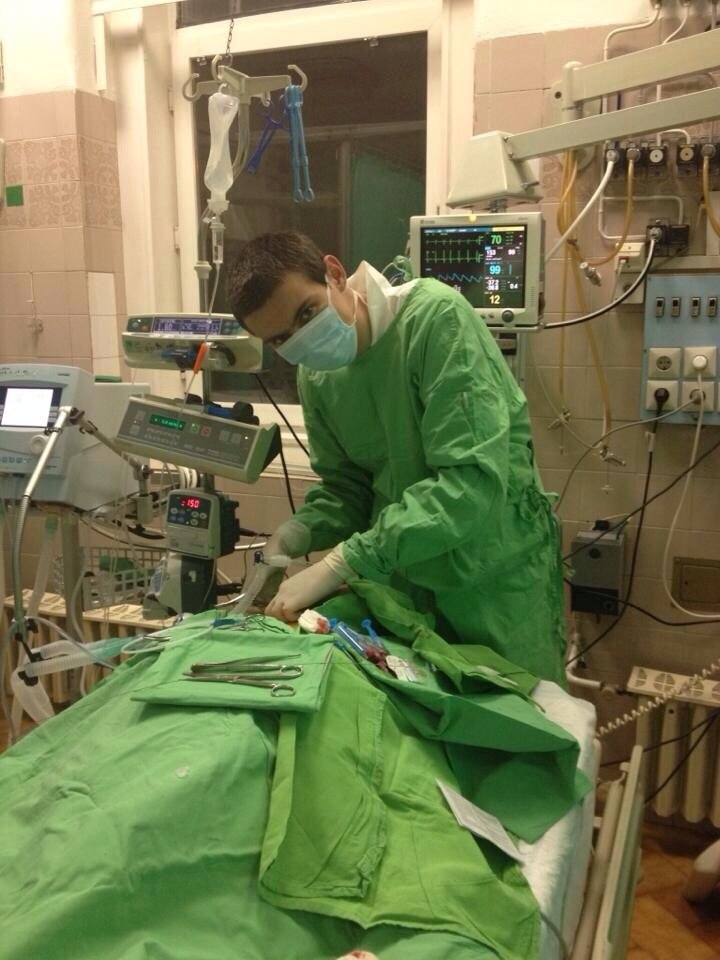
Image context: the cover uses a real photograph of central venous catheterization rather than a diagram or symbolic hospital image.[6] That matters because the mechanism is physical and procedural. A central-line infection begins when microorganisms gain a route along a device or through line handling; the safety response has to make the clinical scene harder to contaminate, not merely easier to audit.
Timeline anchors for the mechanism
- 2002: CDC's intravascular catheter guideline emphasized education, maximal sterile barrier precautions, chlorhexidine skin antisepsis, avoidance of routine replacement as a prevention strategy, and removal of unnecessary catheters.[1]
- 2004: a single surgical ICU intervention described five linked changes: staff education, a catheter cart, daily review of line necessity, a checklist for evidence-based steps, and nurse authority to stop non-adherent insertions.[2]
- 2006: the Michigan Keystone ICU report in The New England Journal of Medicine found that catheter-related bloodstream infection rates fell across a large collaborative cohort after the intervention.[2]
- 2010: the BMJ sustainability follow-up reported that reduced infection rates persisted for another 18 months, with the median infection rate remaining at zero through the sustainability period.[3]
- 2024-2026: CDC and AHRQ still frame CLABSI prevention as a bundled implementation problem rather than a single product problem: insertion practice, maintenance, feedback, staff training, and culture all remain part of the operating model.[1][4][5]
1. The bundle attacked several weak points at once
The core technical steps were not mysterious. CDC recommends hand hygiene before and after catheter insertion or manipulation, aseptic technique, sterile gloves for central catheter insertion, maximal sterile barrier precautions for CVCs and PICCs, chlorhexidine with alcohol for central venous catheter skin preparation when appropriate, and prompt removal of catheters that are no longer essential.[1] Each step targets a different opening for harm.
Hand hygiene reduces transfer from staff to field. Maximal sterile barriers enlarge the protected zone from a small puncture-site ritual to a whole-body sterile setup. Chlorhexidine with alcohol lowers skin microbial burden at the insertion site. Site choice matters because local flora density and catheter location affect infection risk. Daily removal review matters because every unnecessary catheter day keeps the route open.[1]
The causal point is that no single step fully substitutes for the others. A perfectly cleaned site can be recontaminated by broken sterile technique. A clean insertion can still become a later maintenance failure. A line placed well can become needless exposure if nobody asks every day whether it can come out. The bundle worked because it treated CLABSI risk as a process with multiple gates, not as a one-time insertion hazard.[1][2]
2. The checklist was a social tool, not a memory trick
The Keystone intervention is remembered for a checklist, but the checklist was only one part of the design. The 2006 report describes a program that taught infection-control practices, created catheter carts so needed supplies were available, used checklists to ensure adherence, measured infection rates, gave feedback, and empowered nurses to stop catheter insertion if guideline steps were missed.[2]
That nurse stop authority is the hinge. In a hierarchy-heavy ICU, the person who sees a sterile break may not be the person holding the needle or directing the procedure. A checklist without permission to interrupt can become retrospective paperwork. A checklist with stop authority changes the room's behavior before harm occurs. It converts "I noticed a problem" into "the procedure pauses until the sterile field is corrected."[2]
The cart mattered for the same reason. Telling people to follow best practice while making them hunt for gowns, drapes, chlorhexidine, caps, masks, and checklist forms adds friction exactly where reliability is supposed to improve. The cart made the desired behavior easier to perform under ICU tempo. The checklist made the behavior visible. The nurse stop rule made it enforceable.[2]
3. The outcome signal was large because the baseline was improvable
The Michigan result was not subtle. In the NEJM report, the median catheter-related bloodstream infection rate per 1,000 catheter-days decreased from 2.7 at baseline to 0 at 3 months after implementation. The mean rate fell from 7.7 at baseline to 1.4 at 16 to 18 months of follow-up.[2] Those numbers are why the project became a patient-safety landmark.
But the size of the effect should not be read as proof that forms have magic power. It suggests that baseline care contained preventable variation. CDC notes that in a March 2005 national survey of more than 700 U.S. hospitals, about one quarter reported that maximal sterile barrier precautions during central-line insertion or chlorhexidine as site disinfectant were not being used routinely, even though both had already been recommended.[1] The opportunity was not the invention of sterility. It was making known sterile practice happen reliably.
The follow-up matters because many quality projects fade after launch. In the BMJ sustainability study, 90 of the original 103 ICUs contributed data during the sustainability period, totaling 300,310 catheter-days. The authors reported that the median rate remained zero for the full 18-month sustainability period, with a greater than 60% reduction from baseline sustained at 36 months.[3] That is the difference between a campaign and a changed operating system.
4. Why the mechanism is still current
Modern CLABSI work has not abandoned the Keystone lesson. AHRQ's current CLABSI toolkit still treats the problem as implementation: evidence-based practices, unit culture, frontline engagement, leadership support, and measurement all sit together.[4] CDC's checklist similarly translates guideline recommendations into concrete insertion prompts: hand hygiene, appropriate skin prep, maximal sterile barrier precautions, sterile drape, and documentation of whether each step happened.[5]
This is also where the story becomes more precise than "checklist medicine." A checklist can fail if it is treated as a compliance artifact after the fact. The mechanism requires a live team behavior: somebody verifies the sterile steps while the line is being placed; the team has the supplies to comply; staff can interrupt violations; infection data return to the unit; and line necessity is reviewed after insertion.[2][3][4][5]
The best reading of Keystone is therefore neither romantic nor cynical. It is not romantic because the result did not come from everyone suddenly caring more. It came from changing the work so the safer action was prepared, prompted, measured, and socially authorized. It is not cynical because the checklist was not mere bureaucracy. In the right system, it became a small instrument for making a complex clinical scene behave predictably.
That is the durable health lesson. CLABSI prevention works when sterile line care stops depending on whether the busiest person in the room remembers every step under pressure. It works when the room, the cart, the checklist, the nurse, the data system, and the daily removal question all point in the same direction.[1][2][3][4][5]
Sources
- Centers for Disease Control and Prevention, "Background Information: Strategies for Prevention of Catheter-Related Infections in Adult and Pediatric Patients" - guideline recommendations on education, site selection, hand hygiene, maximal sterile barriers, chlorhexidine preparation, dressing practice, and line removal.
- Duke Scholars record for Pronovost et al., "An intervention to decrease catheter-related bloodstream infections in the ICU" (New England Journal of Medicine, 2006) - Keystone ICU intervention components and infection-rate results.
- Pronovost et al., "Sustaining reductions in catheter related bloodstream infections in Michigan intensive care units: observational study" (BMJ, 2010) - sustainability data after the initial Keystone ICU intervention.
- AHRQ Patient Safety Network, "Toolkit for Reducing Central Line-Associated Blood Stream Infections" - AHRQ toolkit entry for current CLABSI implementation resources.
- Centers for Disease Control and Prevention, "Checklist for Prevention of Central Line Associated Blood Stream Infections" - insertion checklist based on CDC prevention guidelines.
- Wikimedia Commons, "File:Healthcare worker performing a central venous catheterisation.jpg" - source page for the real clinical photograph used as the article image.