Medicare is usually remembered as an insurance milestone: a law signed on July 30, 1965 that finally gave older Americans a federal hospital and physician-coverage structure after years of failed national health-insurance fights.[1] That memory is true, but it is incomplete. The program's first operational deadline, July 1, 1966, also became one of the fastest civil-rights interventions ever imposed on American hospitals.[2][3][4]
The mechanism was not rhetorical uplift. It was certification. Hospitals that wanted Medicare patients and Medicare reimbursement had to satisfy federal participation standards and clear Title VI of the Civil Rights Act of 1964, which barred discrimination in federally funded programs.[2][4][5] In practice that meant the opening of Medicare was tied to a question that many hospitals, especially in the South, had long managed to evade: would they actually stop segregating patients, services, and staff access, or would they forfeit the new stream of federal money?[2][4][5]
That is why the episode deserves reconstruction as an event, not as a commemorative footnote. The important story runs from the law's signing in Independence, Missouri, through the winter and spring certification push of 1966, into the field inspections that preceded opening day, and then into the first evidence that formal hospital segregation could collapse when federal financing, civil-rights law, and on-site verification were forced into the same timetable.[1][2][3][4][8]
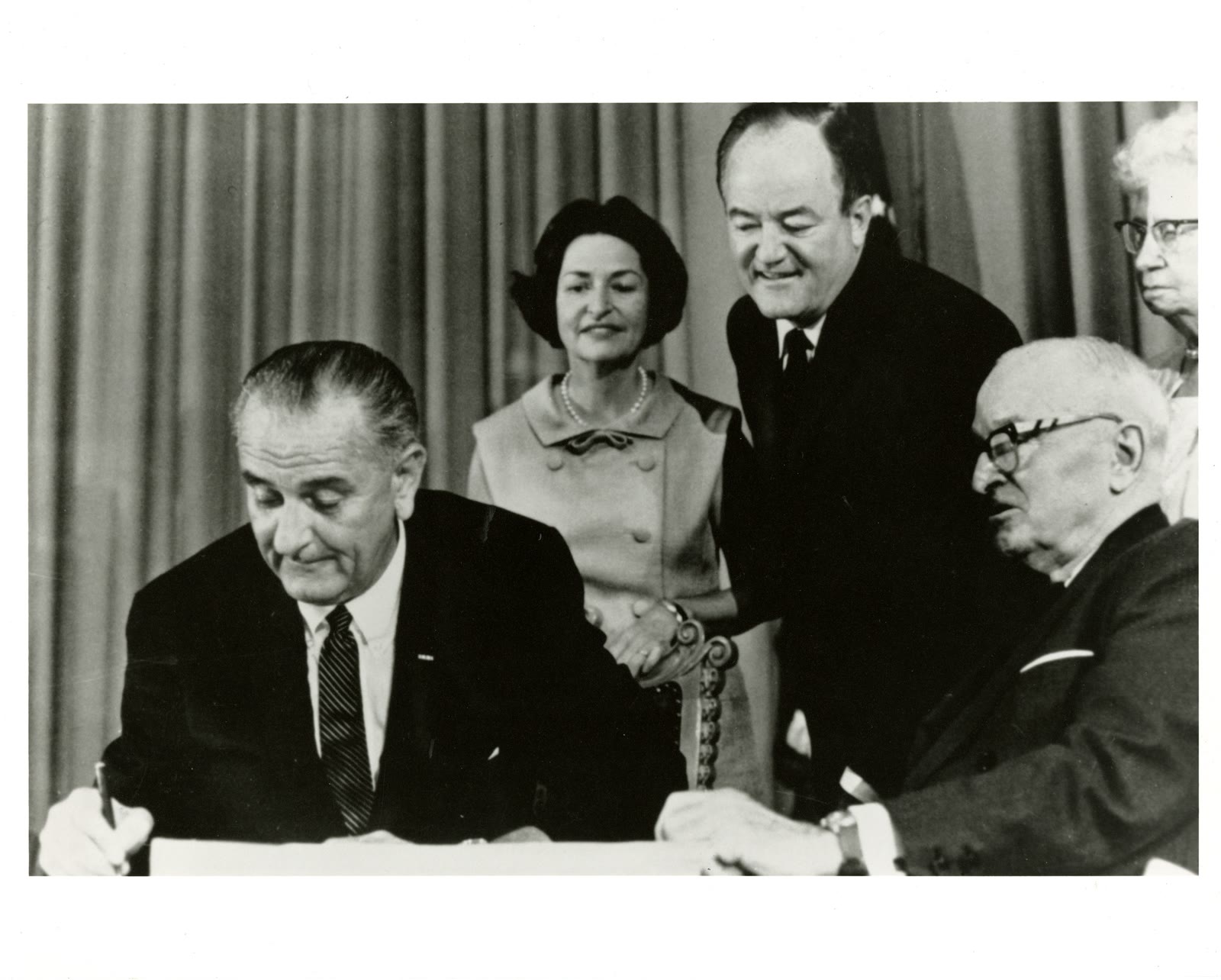
Image context: the lead photograph from the National Library of Medicine shows President Lyndon B. Johnson signing the 1965 Medicare bill as Harry and Bess Truman, Lady Bird Johnson, and Hubert Humphrey look on in Independence, Missouri. It works here because the article is about the moment when a public ceremony became a hard administrative lever with consequences inside real hospital wards.[6]
Before July 1965, there was already a civil-rights law, but not yet a system-wide payment lever
Hospital segregation did not begin with Medicare, and it did not end simply because Congress passed a statute. Reynolds's reconstruction of the period shows that explicit discrimination in the early 1960s still shaped patient admissions, physician staff privileges, and nurse appointments.[4] Title VI of the Civil Rights Act gave federal officials a legal basis to challenge that order, but law by itself did not automatically reorganize every hospital in the country.[4]
What Medicare added was reach. The new program touched almost every hospital because older patients were a large and financially important population. The statute that Johnson signed at the Truman Library on July 30, 1965 did several things at once: it created Medicare under Title XVIII and Medicaid under Title XIX, set the first-year federal budget at about $2.2 billion, and promised benefits that hospitals could not easily ignore, including up to 90 days of hospital care for covered beneficiaries.[1] A civil-rights rule that might otherwise have been treated as distant compliance language was suddenly attached to a major new payer.[1][4]
That shift in leverage matters because it changed the bargaining position of the federal government. Hospitals no longer faced only a moral appeal or a future lawsuit. They faced a date on which a national insurance program would go live and a requirement that participation depended on federal approval.[2][3][5]
From late 1965 into spring 1966, the government turned a statute into a survey-and-clearance machine
The implementation record on the Social Security Administration history site makes clear how administrative this revolution was.[2] The process did not start with a dramatic courtroom order on opening day. It started with mailings, draft regulations, applications, surveys, and repeated contact with thousands of institutions. The government first sent information and question-and-answer material to roughly 10,000 institutions, then narrowed the field to about 8,000 hospitals that might meet the statutory definition and sent formal applications through state agencies in February 1966.[2]
At the same time, federal officials were still writing the rules hospitals had to meet. Proposed hospital conditions of participation appeared in the Federal Register on February 15, 1966.[2] State agencies, regional Social Security offices, and the Public Health Service then moved into the labor-intensive part of the work: reviewing applications, conducting on-site surveys, and pressing institutions to correct deficiencies before the Medicare start date.[2]
Title VI sat inside that technical process, not outside it. The SSA history account states the rule bluntly: institutions seeking Medicare participation had to provide access to services without regard to race, color, or national origin, keep ancillary services equally available, recruit and employ staff without discrimination, and engage in no discrimination, separation, or other distinction in activities affecting admission, care, or treatment.[2] The point is easy to miss if one remembers Medicare only as an insurance card. In 1966, the program arrived as a federal inspection regime as much as a benefits regime.[2][7]
The National Library of Medicine's surviving March 4, 1966 "Medical Facilities Compliance Report (Civil Rights Act Title VI)" makes that administrative texture visible.[7] Hospitals and health facilities had to demonstrate that they were not practicing segregation in order to receive Medicare and other federal funds.[7] That surviving paper trail matters because it shows that desegregation was not left to speeches, editorials, or self-certification. It was built into the file stack.
The months before July 1 were a race against the deadline, not a symbolic grace period
The broader Medicare rollout was already enormous. The Social Security Bulletin history of the launch reports that SSA distributed more than 120 million booklets, delivered nearly 90,000 talks, made 194,000 radio broadcasts, and used thousands of offices, contact stations, and temporary service points to enroll the new beneficiary population.[3] But that mass public-information operation ran in parallel with another assignment: every hospital also had to be contacted and cleared for Medicare participation.[3]
The same SSA history emphasizes the desegregation consequence directly. While the agency was enrolling beneficiaries, it also had to certify that hospitals met Medicare requirements and complied with Title VI; one result, it says, was the "nearly complete desegregation" of U.S. hospitals.[3] The later SSA blog post on the episode is even more concrete about field operations. By the deadline, Commissioner Robert Ball recalled, the government had around 1,000 federal employees in the field visiting hospitals because officials had decided they would not simply accept assurances about desegregation; they would pay only if hospitals had actually changed their practices.[5]
That distinction between promise and inspection is the key mechanism in the story. A hospital administrator could delay a committee meeting, soften a public statement, or claim the institution was "moving in the right direction." The Medicare deadline narrowed that maneuvering room. Either the hospital would be cleared in time for July 1, 1966, or it would stand outside one of the largest new revenue streams in American medicine.[2][3][5]
On July 1, 1966, opening day proved that money and verification could move faster than custom
By the launch date, the scale was already striking. The SSA implementation history reports that about 19.1 million people had been enrolled in Hospital Insurance and 17.3 million in Supplementary Medical Insurance.[3] The same account says the agency had enlisted 6,800 hospitals, 4,000 extended-care facilities, more than 1,800 home health agencies, 2,400 independent laboratories, and 750,000 private physicians.[3] The more detailed SSA history page records that by July 1, 1966, over 6,200 hospitals had been certified as eligible to participate, with more added later.[2]
Those numbers matter because they show how little room remained for a segregated hospital to pretend that Medicare was optional noise. The program opened at national scale on its first day. If a hospital stayed out, it stayed out in full public view.[2][3]
The fastest visible change was spatial. The Commonwealth Fund's fiftieth-anniversary review summarizes the early effect in plain terms: hospitals integrated medical staffs, waiting rooms, and hospital floors in a period of less than four months once vigorous Civil Rights Act enforcement was made a condition of participation.[8] That line is a useful corrective to sentimental retellings. The transition did not happen because prejudice dissolved. It happened because administrators understood the deadline, the money, and the inspectors.[5][8]
The first year after launch shows both the force and the limit of the intervention
The intervention was forceful enough to be measurable even after opening day. As of July 31, 1967, the SSA history account says that roughly 55 hospitals that otherwise met participation conditions were still out because they lacked Title VI clearance, and around 100 additional hospitals that probably could have met Medicare standards had not applied because of the civil-rights requirements.[2] In other words, the federal government had already made segregation expensive enough that the holdouts were countable.
Other summaries describe the speed from a different angle. The Commonwealth Fund review points to downstream access effects as well: between 1961 and 1968, hospitalization rates for white Americans age sixty-five and older rose 38%, while rates for Black Americans in the same age group rose 61%, narrowing a longstanding access gap.[8]
Still, this was a break with formal segregation, not the end of racial inequality in care. Medicare could force admissions rules, room assignments, and formal staff barriers to change more quickly than custom had allowed.[2][4][5][8] It could not by itself eliminate all the stratification that survived in referral patterns, neighborhood hospital resources, professional hierarchies, or the broader political economy of American medicine. Treating the episode as total victory obscures the harder history that followed.[4][8]
Why this event still matters
The enduring lesson of Medicare's first year is that health policy sometimes changes institutions less by persuading them than by rewiring the conditions under which they are paid.[1][2][4] Title VI supplied the legal boundary. Medicare supplied the leverage. The 1966 certification drive supplied the enforcement machinery.[2][3][5][7]
That combination is what made the event so historically unusual. A law signed on July 30, 1965 became, within less than a year, a deadline that hospitals had to satisfy in their wards, waiting rooms, staffing patterns, and admission practices before federal money would move.[1][2][5] The opening of Medicare therefore belongs not only in the history of insurance coverage, but in the history of how the American state briefly proved that administrative detail could do civil-rights work at national scale.[2][4][8]
Sources
- LBJ Presidential Library, "Medicare and Medicaid Act" - signing date, statutory titles, early benefit design, and first-year budget context.
- Social Security Administration History, "Certification as Providers" and "Applicability of Title VI of the Civil Rights Act" from the Medicare implementation history.
- Social Security Administration, "Administering Social Security: Challenges Yesterday and Today" - Medicare rollout metrics, enrollment figures, and opening-day participation counts.
- Preston P. Reynolds, "The federal government's use of Title VI and Medicare to racially integrate hospitals in the United States, 1963 through 1967," American Journal of Public Health 87, no. 11 (1997).
- Social Security Administration, "How Social Security Helped Desegregate America's Hospitals" - overview of field inspections and Robert Ball's recollection of the desegregation deadline.
- National Library of Medicine Digital Collections, "(President Lyndon Johnson signs the 1965 Medicare bill 3)" - source page for the archival lead photograph used in this article.
- National Library of Medicine, "Medical Facilities Compliance Report (Civil Rights Act Title VI)" - March 4, 1966 compliance-report artifact from the Medicare desegregation process.
- The Commonwealth Fund, Medicare: 50 Years of Ensuring Coverage and Care - summary of early desegregation effects and hospitalization-rate changes by race.