San Francisco's 1918 mask ordinances now get recruited into two opposite stories. One says the city proved masks worked and then ruined the victory through impatience. The other says the Anti-Mask League and the city's heavy mortality proved public masking was little more than theater. The record is more useful than either slogan.[1][2][3]
San Francisco did use masks aggressively, but it also built a wider emergency package around them: school closures, gathering bans, open-air court sessions, transit ventilation, hospital masking, and a police-backed attempt to make compliance visible in daily life.[1] That matters because the real historical question is not whether one gauze rectangle saved a city. It is how a late, layered response with weak equipment and uneven adherence behaved inside a fast epidemic.
Markel and colleagues' 43-city comparison helps strip away some mythology. In that dataset, San Francisco's first nonpharmaceutical intervention came on October 18, 1918, after mortality acceleration dated to October 7; the city logged 67 total days of intervention, reached its first peak on October 29, and finished the study window with cumulative excess pneumonia-and-influenza mortality of 672.7 per 100,000.[2] Those are not the numbers of a city that moved early enough for one ordinance to do the whole job.
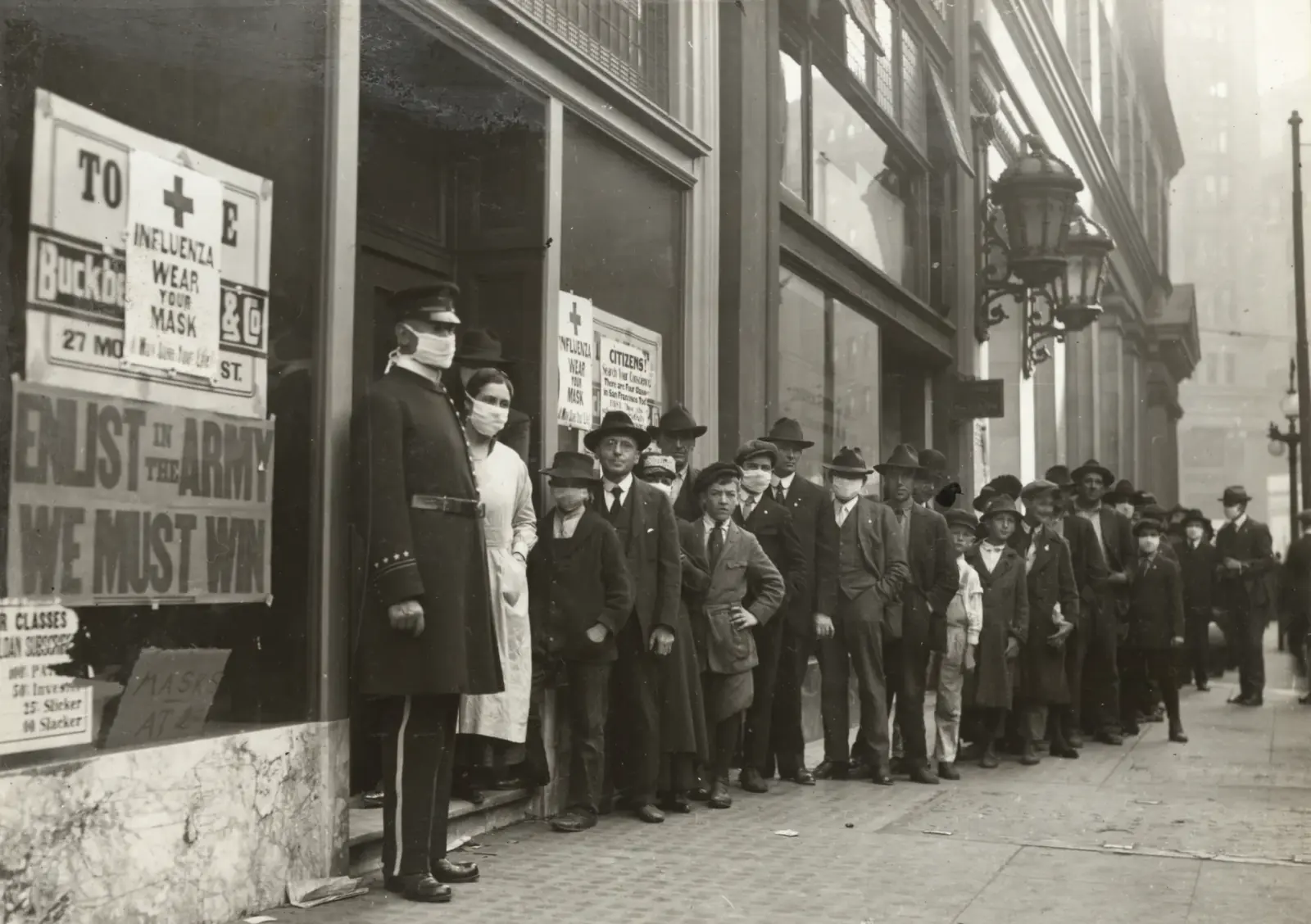
Image context: the lead image shows masked San Franciscans queueing on Montgomery Street to obtain masks in 1918. It works here because the dispute was always concrete. Masking arrived as a public campaign of lines, supply, civic pressure, and repeated daily compliance, all visible in one street scene.[5]
Timeline anchors before the debate
- September 23, 1918: San Francisco health officials identify the city's first known influenza case and quarantine the patient's home.[1]
- October 9, 1918: the city has at least 169 cases.[1]
- October 16-18, 1918: the count jumps above 2,000 within a week; the Board of Health closes schools and public amusements, bans many gatherings, and expands hospital and transit precautions.[1]
- October 21-25, 1918: strong public mask recommendations give way to a mandatory mask ordinance, effective October 25.[1]
- November 21, 1918: the first mask order is lifted amid celebration and a broader reopening mood.[1]
- January 17, 1919: a second public mask order takes effect after renewed spread and a December-January argument over whether voluntary masking can hold the line.[1]
Interpretation A: the mask ordinance worked, then the city lost its nerve
This reading has evidence behind it. San Francisco did not merely print a warning and hope for discipline to emerge by itself. Health Officer William C. Hassler and the Board of Health paired mask pressure with closures, crowd restrictions, and practical anti-crowding measures across hospitals, transit, and public institutions.[1] In the city's own narrative, masking became visible quickly: before the legal mandate took effect, officials and newspapers estimated that about four out of five people were already wearing masks in public.[1]
The local chronology also makes enforcement fatigue hard to dismiss. The city dropped the first order on November 21, reopened more of civic life, and then watched adherence collapse badly enough that officials themselves were caught violating the public rule.[1] By December and January, the argument had shifted from whether masks symbolized sacrifice to whether voluntary compliance had already broken down. On this interpretation, the main problem was not that masks were empty. The main problem was that San Francisco treated an early decline in cases as permission to relax a still-fragile regime.[1][4]
There is some broader support for that conclusion. Markel's 43-city study found that earlier, longer, and more layered nonpharmaceutical interventions were associated with lower peak mortality across American cities.[2] In that frame, San Francisco's mask ordinance belongs in a bigger story about timing and persistence. It was one part of a package, and the package arrived after acceleration had already started.
Interpretation B: the gauze masks were public theater, and the city proved it
The skeptical reading also has real evidence. The 1918 campaign did not distribute modern, well-fitted respirators. The San Francisco record is full of improvised materials: standard surgical gauze, linen substitutes, chiffon veils, and a range of loose or decorative coverings that contemporaries themselves described with some embarrassment.[1][4] A citywide order built on inconsistent materials and inconsistent fit is not the same thing as a high-quality respiratory protection program.
The outcome data also resist triumphalism. In Markel's city table, San Francisco's cumulative excess pneumonia-and-influenza mortality reached 672.7 per 100,000, far worse than cities that acted earlier and sustained layered controls more coherently, such as St. Louis at 358.0.[2] That comparison does not prove masks caused failure. It does show that San Francisco cannot honestly be treated as a clean historical demonstration that a mask ordinance by itself solved epidemic control.
Later reanalysis sharpens the same caution. Robert Barro's 2022 study argues that the classic NPIs of 1918-1919 clearly reduced relative peak death rates, but their effect on cumulative deaths was small and statistically insignificant.[3] Just as important for this debate, the core city datasets do not isolate mask laws as the central intervention category; they mainly track school closures, bans on public gatherings, and quarantine or isolation.[2][3] That means the skeptical side is correct about one thing: the evidence base does not let us extract one victorious mask effect from the rest of the civic response.
What the evidence does and does not support
The strongest reading sits between those two slogans. San Francisco's 1918 mask orders mattered because they formed part of a real public-health package and because officials returned to masking when voluntary behavior weakened under renewed spread.[1][4] Yet the same record shows clear limits. The city moved after acceleration had begun, depended on porous and inconsistently worn masks, and placed heavy symbolic weight on a tool that could not compensate for reopening pressure and imperfect enforcement.[1][2][3][4]
That is why the Anti-Mask League can mislead in both directions. If it is used to prove that masks never mattered, it ignores the wider NPI literature and the city's own repeated effort to restore visible public compliance when cases rose again.[1][2] If it is used to prove that only selfish citizens spoiled an otherwise perfect plan, it ignores material weakness in the masks themselves and the lateness of San Francisco's first decisive moves.[1][2][3][4]
The better historical lesson is narrower and more operational. San Francisco built a late, layered emergency response with masks at the center of its civic imagery. The ordinances likely helped make risk legible, reduce some contacts, and reinforce a broader control regime. The city's heavy mortality burden and repeated reversals also show how quickly that regime weakened when officials relaxed too early and asked porous gauze masks to carry more of the epidemic burden than they could carry alone.[1][2][3][4]
Best reading
So did masks "work" in San Francisco in 1918? The evidence does not support either extreme answer. The city's mask ordinances belonged to a package that likely helped flatten the first peak, but the record does not justify treating gauze masking as a single decisive lever that overpowered timing, policy mix, and reopening pressure.[2][3] The opposite myth is weak as well. San Francisco does not show that masks were empty costume. It shows a city trying to use a visible public signal inside a broader system that arrived late, used weak materials, and then lost adherence before transmission was securely suppressed.[1][2][3][4]
Sources
- University of Michigan Center for the History of Medicine, "San Francisco, California and the 1918-1919 Influenza Epidemic" - city essay with dates, ordinances, compliance claims, reopening chronology, and the second mask order.
- Howard Markel et al., "Nonpharmaceutical Interventions Implemented by US Cities During the 1918-1919 Influenza Pandemic" (JAMA, 2007) - 43-city comparison table including San Francisco's response timing, 67 intervention days, October 29 peak, and cumulative excess mortality of 672.7 per 100,000.
- Robert J. Barro, "Non-pharmaceutical interventions and mortality in U.S. cities during the great influenza pandemic, 1918-1919" (Research in Economics, 2022) - later reanalysis arguing that 1918 NPIs flattened peaks more clearly than they reduced cumulative deaths.
- National Park Service, "Masks of 1918 and Today" - San Francisco Maritime retrospective on gauze-mask construction, local sales drives, reinstated ordinances, and the practical limits of 1918 mask technology.
- Wikimedia Commons, "File:People San Francisco Spanish Flu 1918.webp" - source page for the archival Montgomery Street photograph used as this article's lead image.