Kidney failure is often described as if medicine found one answer and then gradually improved it. The actual history is more divided. Dialysis and kidney transplantation did not solve the same problem at different levels of quality. Dialysis made survival possible by moving part of kidney function outside the body and onto a schedule. Transplantation solved a different bottleneck by putting living kidney tissue back inside the body, where filtration, fluid balance, and endocrine work could run continuously rather than in machine sessions.[1][2][3][5][6]
That distinction still matters because modern patient language can flatten it too quickly. NIDDK's treatment guidance says a working transplanted kidney does a better job filtering wastes and keeping a person healthy than dialysis, and the long-run outcome literature generally favors transplant on mortality and quality-of-life measures.[2][6][7] But the same guidance also makes clear why dialysis never became obsolete: not every patient is a transplant candidate, donor kidneys are scarce, waiting can take years, and many people need dialysis while they wait or after a graft fails.[1][2] The comparison is not old tool versus new tool. It is intermittent extracorporeal support versus living internal replacement.
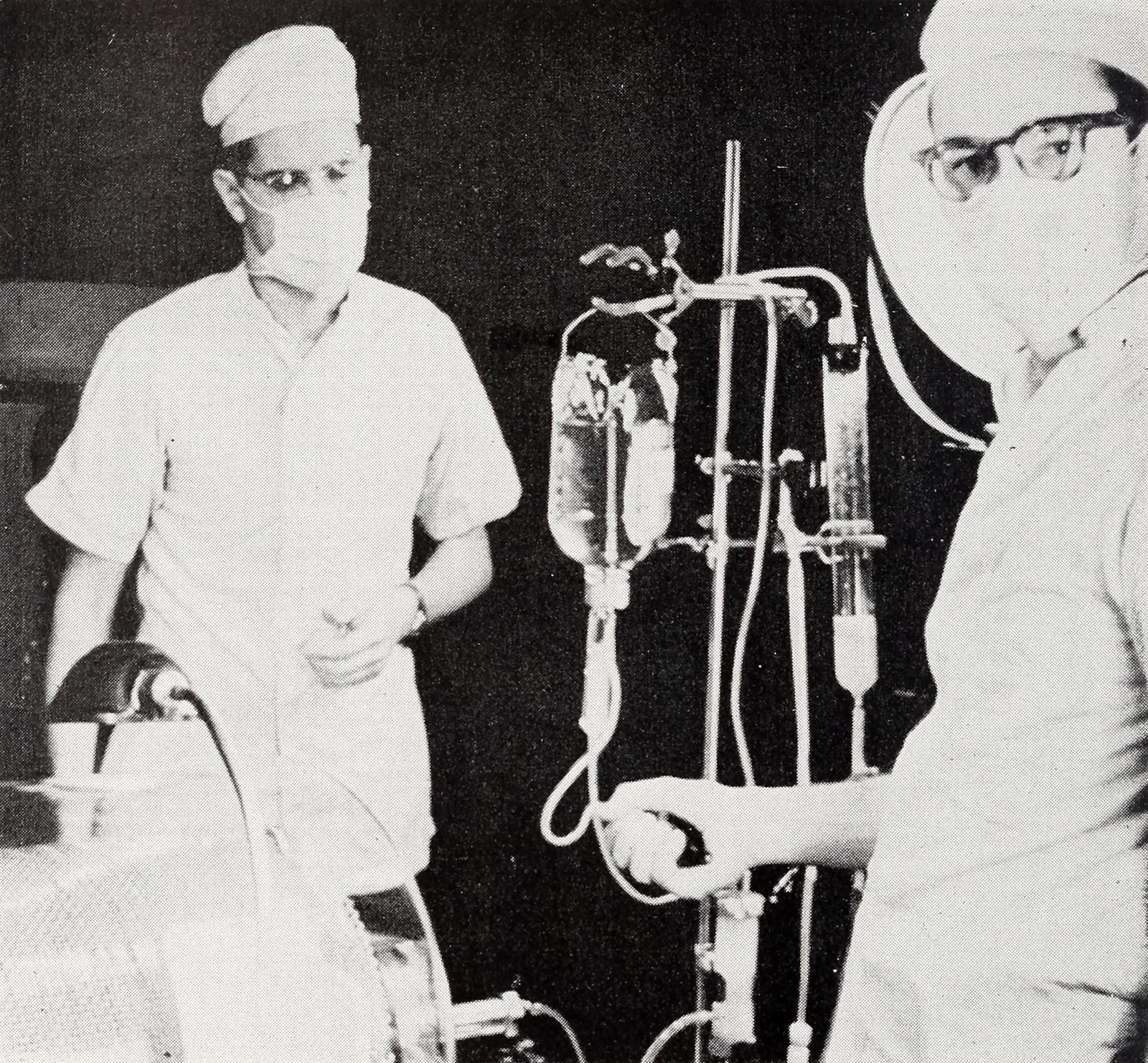
Image context: the cover uses a real 1955 U.S. Army photograph of a Kolff-type artificial kidney in operation. That choice matters because kidney-replacement history first became practical at the bedside as a visible apparatus of tubing, blood pumps, access, and clock time before it became a story of donor organs and immunosuppression.[8]
Timeline anchors before comparison
- 1945: Kolff's rotating-drum machine produced the first reported recovery of a patient treated with hemodialysis for acute renal failure, turning dialysis from laboratory possibility into a clinical rescue method.[3]
- 1954: Peter Bent Brigham Hospital performed the first successful human organ transplant, a kidney transplanted between identical twins.[5]
- 1960: Belding Scribner's shunt made repeated blood access possible, which changed hemodialysis from one-off rescue into the basis for maintenance treatment.[3][4]
- 1962: Seattle opened the first outpatient hemodialysis center in the United States, moving dialysis toward chronic community care rather than only hospital crisis care.[4]
- 1966: the Cimino-Brescia arteriovenous fistula reduced many of the complications seen with external shunts and stabilized long-term dialysis access further.[3]
- 1979: Brigham identifies the first demonstrated effectiveness of cyclosporin A as an immunosuppressant, one of the steps that helped transplantation move beyond rare immunologic luck.[5]
- 2011-2013: systematic reviews comparing renal replacement modalities found lower mortality, fewer cardiovascular events, and substantially better life participation among transplant recipients than among chronic dialysis patients, even while dialysis remained essential infrastructure.[6][7]
1. What dialysis solved first: chemical survival on an intermittent clock
The first thing dialysis answered was not normal life. It was uremic death. When kidney function failed completely, wastes, acid, and fluid accumulated faster than the body could tolerate. Dialysis offered a way to clear some of that burden without solving the underlying loss of organ tissue.[2][3] The achievement was radical and limited at the same time. A machine could now take over part of the kidney's work, but only for stretches, and only if the blood could be brought safely in and out of the body.
That access problem is why the early history matters so much. The general hemodialysis overview indexed in PubMed describes the turning points cleanly: Kolff's 1945 recovery made acute dialysis real, but maintenance treatment for end-stage kidney failure only became practical in 1960 with the external Teflon arteriovenous bypass designed by Scribner, Quinton, and colleagues.[3] NKF's historical summary then adds the institutional consequence: the Scribner shunt let clinicians use dialysis repeatedly, and the first outpatient hemodialysis center followed in Seattle by 1962.[4] In other words, chronic dialysis did not arrive when the membrane first worked. It arrived when access, repeatability, and care setting finally lined up.
Even now, dialysis still bears the mark of that origin. NIDDK describes home hemodialysis as occurring roughly 3 to 7 times per week, with sessions lasting about 2 to 10 hours depending on the schedule.[1] That is not a defect in engineering language; it is the therapy's underlying shape. Dialysis is support delivered in blocks of time. It can be life-extending, and it can be organized around home or center care, but it remains a treatment that interrupts kidney failure rather than dissolving it.[1][2]
This is why dialysis changed prognosis before it changed physiology. It made continued life possible and later made outpatient chronic survival imaginable. What it did not do was restore the kidney as a continuously acting organ.
2. What transplant solved next: internal continuity
Transplantation began by proving something dialysis could not. A replacement kidney could work all day, every day, inside the body rather than beside it. Brigham's historical record marks December 23, 1954 as the first successful human kidney transplant, performed between identical twins at Peter Bent Brigham Hospital.[5] That detail about identical twins is not incidental. The operation succeeded first where immunologic rejection was minimized by biology.
So the earliest transplant breakthrough was not yet a general answer to kidney failure. It was proof of concept under unusually favorable conditions. The next decades had to solve the harder parts: broader donor-recipient matching, organ preservation, and immune suppression strong enough to keep a graft alive without destroying the patient. NKF's history page places some of those steps close together: the first successful transplant between non-identical twins in 1961, then the Belzer perfusion machine in 1967, which kept donor kidneys viable for about 28 hours.[4] Brigham's transplant history adds the later immunologic hinge by noting the first demonstrated effectiveness of cyclosporin A in 1979.[5]
That sequence matters because it explains why transplantation eventually outperformed dialysis without making dialysis irrelevant. A functioning kidney graft does not merely clear solutes. It restores continuous filtration and the everyday internal rhythm that dialysis can only approximate intermittently.[2][6] NIDDK puts the patient-facing version plainly: a transplanted kidney works more like a healthy kidney, and people with a donated kidney have a greater chance of living longer than those who remain on dialysis.[2] Tonelli and colleagues' systematic review, covering 110 eligible studies and 1,922,300 participants, found that most studies showed significantly lower mortality and substantially better quality of life among transplant recipients than among chronic dialysis patients.[6]
The key historical point, then, is not that transplant was always "better" in some abstract sense. It was better because it restored continuity. Dialysis had already made survival possible. Transplantation made replacement more physiological.
3. Why dialysis did not disappear after transplant
If transplantation restored continuity, why did dialysis remain central? Because transplantation is not just a physiological technology. It is also a donor, surgery, and immunology technology. NIDDK emphasizes that a person may wait years for a deceased-donor kidney, may not be healthy enough for transplant surgery, and may need dialysis while waiting even after being listed once kidney function falls to 20 or less.[2] The better biological solution does not become the universal immediate solution when organs are scarce and candidacy is limited.
The patient-reported outcome literature shows the difference clearly. Purnell and colleagues reviewed 46 studies comparing life participation across hemodialysis, peritoneal dialysis, and kidney transplantation, and found that most studies reported greater life participation among transplant recipients, while hemodialysis and peritoneal dialysis were more similar to each other.[7] That result is important precisely because it does not say dialysis failed. It says dialysis and transplant organize daily life differently. One asks patients to live around treatment sessions and access sites. The other asks them to live with surgery, rejection risk, and lifelong immunosuppression in exchange for greater freedom from the machine.[2][7]
This is why the history does not end in succession, where one modality simply replaces the other. It settles into layering. Dialysis remains the bridge, the fallback, and for many patients the long-term destination. Transplant remains the more physiological option when it is feasible and durable.[1][2][6][7]
The strongest two interpretations
Interpretation A: transplant superseded dialysis, and the machine is mostly a waiting room
This reading gets an important outcome truth right. Transplant recipients usually do better on survival and quality-of-life measures than people who remain on chronic dialysis, and modern kidney medicine wants more patients transplanted sooner when possible.[2][6][7]
What it misses is the structural dependence. Dialysis solved the first mass survival problem, still supports people who are waiting or ineligible, and remains necessary after graft loss. A superior physiologic therapy does not eliminate the modality that keeps patients alive when donor organs and surgical eligibility do not line up.[1][2][4]
Interpretation B: dialysis and transplant are basically interchangeable forms of kidney replacement
This reading gets coexistence right but compresses the mechanism too much. Both are renal replacement therapies, but one is an intermittent extracorporeal clearance system and the other is a living internal organ under immune surveillance.[1][2][3][5] Their burdens, risks, and temporal logic are not the same.
What the comparison changes
The cleanest way to hold the history is this: dialysis bought time, and transplant bought continuity. Dialysis turned kidney failure from an immediate biochemical catastrophe into a treatable schedule once membranes, anticoagulation, and vascular access became reliable enough.[1][3][4] Transplantation then changed what replacement could mean by bringing living kidney tissue back into the body, though only after surgery, preservation, and immunosuppression matured enough to make that option durable beyond identical twins.[4][5][6]
That division is still useful in 2026 because patients and health systems keep living inside it. When clinicians compare modalities, they are not choosing between two versions of the same machine. They are choosing between two different ways of surviving kidney failure, each carrying a different relationship to time, body, and infrastructure.
Sources
- National Institute of Diabetes and Digestive and Kidney Diseases, "Hemodialysis" - current patient guidance describing hemodialysis schedules, including home treatments that usually run 3 to 7 times per week and 2 to 10 hours per session.
- National Institute of Diabetes and Digestive and Kidney Diseases, "Choosing a Treatment for Kidney Failure" - official comparison of dialysis and kidney transplant, including the statement that a transplanted kidney works more like a healthy kidney and the practical limits of waiting lists, surgery, and immunosuppression.
- Ronco C, La Manna G, "Renal replacement therapy by hemodialysis: an overview" (Giornale Italiano di Nefrologia, 2009; PubMed record) - historical overview citing Kolff's 1945 first recovery, the 1960 Scribner-Quinton access breakthrough, and the 1966 Cimino-Brescia fistula.
- National Kidney Foundation, "How NKF Got Here: Kidney Care in the 1960s" - historical summary of the Scribner shunt, the first outpatient hemodialysis center in Seattle, the first successful non-identical-twin kidney transplant, and the Belzer perfusion machine.
- Brigham and Women's Hospital, "Renal Division Brief History" - institutional history noting the first successful human kidney transplant in 1954 and later transplant milestones including cyclosporin A's demonstrated effectiveness in 1979.
- Tonelli M, Wiebe N, Knoll G, et al., "Systematic review: kidney transplantation compared with dialysis in clinically relevant outcomes" (American Journal of Transplantation, 2011) - systematic review of 110 studies and 1,922,300 participants finding lower mortality, fewer cardiovascular events, and better quality of life with transplantation.
- Purnell TS, Auguste P, Crews DC, et al., "Comparison of life participation activities among adults treated by hemodialysis, peritoneal dialysis, and kidney transplantation: a systematic review" (American Journal of Kidney Diseases, 2013) - review of 46 studies finding greater life participation among transplant recipients than among dialysis patients.
- Wikimedia Commons, "File:Artificial kidney (Kolff type) in operation.jpg" - source page for the 1955 U.S. Army photograph used as the article image.