River blindness is a useful test of how public health turns a good medicine into a durable control system. The disease is caused by Onchocerca volvulus, transmitted by repeated bites from infected blackflies that breed near fast-flowing rivers and streams.[1][2] Its most feared outcome, vision loss, is not an instant event after one bite. It is the cumulative consequence of parasite biology, repeated exposure, inflammation, and missed opportunities to lower the burden of microfilariae before skin and eye damage becomes disabling.[1][2]
That timing made ivermectin both powerful and incomplete. The drug could suppress the immature worms that drive symptoms and transmission, but it did not simply erase the adult-worm reservoir in one visit.[3] WHO recommends ivermectin treatment at least once yearly for 10 to 15 years, a duration that maps to the long life of adult worms rather than to an ordinary short drug course.[2] CDC's clinical page makes the same mechanism plain: ivermectin kills microfilariae, while adult worms can persist, which is why treatment becomes a long-term rhythm rather than a one-time cure.[3]
The causal chain therefore runs through repetition. A laboratory and pharmaceutical discovery mattered because it lowered microfilarial load. A donation mattered because it removed a procurement ceiling. Community-directed treatment mattered because annual or semiannual dosing had to reach villages again and again. Surveillance mattered because stopping treatment safely required evidence that transmission had actually been interrupted. River blindness control was not a rescue story. It was a logistics story built around a parasite clock.
The pre-drug bottleneck was the river
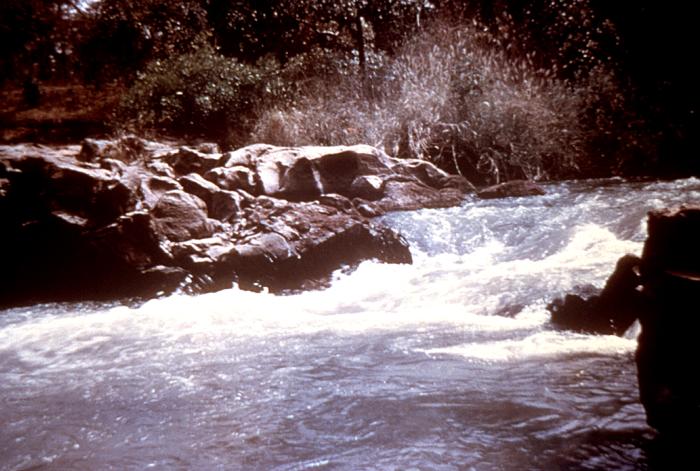
Before ivermectin could be distributed at scale, control depended heavily on attacking the vector. WHO describes the Onchocerciasis Control Programme in West Africa, active from 1974 to 2002, as using mainly helicopter and airplane spraying of insecticides against blackfly larvae, later supplemented by large-scale ivermectin distribution from 1989.[2] That history matters because it shows the shape of the original problem. The disease clustered near rivers not by metaphor but by breeding ecology: people most exposed were those living or working around the fast-running water that allowed the vector to reproduce.[1][6]
Vector control could work, but it was geographically and operationally demanding. It required identifying breeding sites, maintaining aerial larviciding, coordinating across river basins, and sustaining environmental and financial discipline across years. The medicine did not make those facts irrelevant. It shifted the main control point from the river alone to the human community as well.
The 2015 Nobel Prize press release gives the drug-discovery hinge. Satoshi Omura isolated promising Streptomyces strains from soil, William C. Campbell's group developed the antiparasitic lead into avermectin and then ivermectin, and ivermectin was later shown in humans to kill parasite larvae, including in infections that cause river blindness.[4] That explains why the discovery deserved scientific attention. It does not yet explain why a neglected tropical disease program could reach remote endemic communities. For that, the story has to move from compound to access.
The donation removed one ceiling but exposed another
In 1987, Merck committed to donate Mectizan, the ivermectin brand used for river blindness, "as much as needed for as long as needed" for control and ultimately global elimination.[5] The Mectizan Donation Program presents this as the first drug donation for control and elimination of a neglected tropical disease, and it notes why the medicine suited mass campaigns: a single-dose regimen could reduce microfilariae for about 12 months in infected people.[5]
That was the decisive access move. If a drug has to be taken across a decade or more, price and supply are not side issues. They determine whether annual treatment becomes a public-health instrument or remains a clinical fact known mainly to specialists. A donated drug did not solve mapping, delivery, trust, adverse-event management, or coverage, but it changed the bottleneck. The question became less "Can the medicine be bought?" and more "Can it be delivered repeatedly to enough people in the right places?"
This is where the mechanism gets easy to misunderstand. Mectizan did not work like a vaccine campaign that immunizes a cohort and moves on. It suppressed the microfilariae produced by adult worms, lowering symptoms and onward transmission pressure, but the adult-worm life span meant a missed round could matter. WHO's current fact sheet says at least 252.3 million people required preventive treatment in 2024, and 171.6 million people were reached worldwide that year.[2] Those numbers are not trivia. They show why the drug's public-health form had to be mass, repeated, and measured.
Community-directed treatment turned medicine into an operating model
The African Programme for Onchocerciasis Control, launched in 1995 and closed at the end of 2015, was built around community-directed treatment with ivermectin.[2] That phrase can sound administrative, but it is the core design choice. A repeated treatment program cannot depend entirely on visiting teams that arrive like rare expeditions. Communities need a role in deciding who distributes treatment, when distribution fits local life, and how annual coverage becomes a routine rather than an interruption.
The impact evidence supports that interpretation. A PubMed-indexed PLOS Neglected Tropical Diseases study estimated that APOC coordinated annual mass ivermectin treatment in 16 countries from 1995 onward and, between 1995 and 2010, averted 8.2 million disability-adjusted life years in APOC areas at a nominal program cost of about US$257 million, excluding donated drugs.[7] The authors projected another 9.2 million DALYs averted from 2011 to 2015.[7] Those are modeled estimates, not direct counts of every prevented case, but they capture the scale of the delivery system that emerged around the medicine.
The important point is not that ivermectin alone explains every gain. WHO's account explicitly preserves the sequence: OCP vector control first, large-scale ivermectin supplementation from 1989, APOC's community-directed treatment strategy from 1995, then the post-2015 transition toward elimination support through ESPEN and newer networks.[2] The mechanism is layered. Vector control lowered transmission in some places; ivermectin lowered microfilariae in people; community distribution made annual treatment plausible; surveillance and stopping rules became necessary once elimination replaced morbidity control as the goal.
The adult worm sets the tempo
The parasite biology is the hidden clock behind the program. CDC's DPDx life-cycle summary says adult worms commonly reside in subcutaneous nodules, can live for about 15 years, and female worms can produce microfilariae for about 9 years.[8] That is why a single successful treatment round can be real and still insufficient. If adult worms keep producing microfilariae, the program must keep returning until the reservoir ages out or transmission drops below a level that can sustain itself.
This also explains why river blindness control has a different rhythm from ordinary individual treatment. A clinician treating one patient asks whether symptoms are prevented, whether microfilariae are reduced, whether co-infection with Loa loa changes the safety calculation, and whether follow-up continues.[3] A public-health program asks a wider set of questions: Which communities are endemic? What coverage is high enough? Are mobile or marginalized groups being missed? When can mass drug administration stop? What diagnostic signal would restart action after stopping?
WHO's current research priorities make those uncertainties visible. They include reaching marginalized and migratory populations, validating safe strategies where onchocerciasis and loiasis overlap, refining stopping thresholds for mass drug administration, improving diagnostic tools, and integrating surveillance.[2] Those priorities are not afterthoughts. They are the natural next problems created by success. Once the disease is no longer obvious everywhere, the harder work is proving where transmission remains and where the repeated drug rhythm can safely end.
Elimination is proof of persistence, not simplicity
By 2025, WHO had verified five countries as free of onchocerciasis after decades of elimination activity: Colombia, Ecuador, Mexico, Guatemala, and Niger.[2] Niger's verification matters because it made the African proof point explicit, but the phrase "after decades" is doing real work. Verification is not the result of a dramatic final dose. It is the visible endpoint of mapping, repeated treatment, vector understanding, surveillance, and enough institutional continuity to keep attention on a disease that tends to affect poorer rural communities.
This is the best way to read Mectizan's importance. The drug opened a new route because it made mass treatment technically and economically possible at a scale vector control alone could not easily provide. The donation widened that route. APOC and related programs turned it into community practice. But the biology of O. volvulus forced patience: adult worms, annual suppression, years of coverage, and careful stopping.
The causal lesson is broader than river blindness. Public health often celebrates breakthroughs at the point of discovery: the compound, the trial, the approval, the pledge. River blindness control shows the next requirement. A breakthrough becomes population health only when it is made repeatable at the pace demanded by the disease. For onchocerciasis, that pace was set by rivers, blackflies, adult worms, community distributors, and surveillance systems that had to keep working long after the first successful treatment round.[1][2][5][7]
Sources
- Centers for Disease Control and Prevention, "About Onchocerciasis" (updated May 14, 2024) - overview of river blindness, symptoms, geography, blackfly transmission, and mass drug administration context.
- World Health Organization, "Onchocerciasis" fact sheet - current global burden, OCP/APOC history, treatment duration, elimination milestones, and research priorities.
- Centers for Disease Control and Prevention, "Treatment of Onchocerciasis" (updated May 14, 2024) - ivermectin mechanism, repeat-treatment duration, adult-worm limitation, doxycycline note, and loiasis safety boundary.
- Nobel Prize, "The 2015 Nobel Prize in Physiology or Medicine - Press release" - discovery pathway from Streptomyces strains to avermectin and ivermectin and its effect on river blindness and lymphatic filariasis.
- Mectizan Donation Program, "The Medicines" - Mectizan donation history, Merck's 1987 commitment, annual mass-treatment rationale, and microfilariae suppression profile.
- CDC Public Health Image Library, "ID# 6362" - 1978 CDC/Dr. Jesse Hobbs photograph of a blackfly riverine breeding place, public-domain source for the article image.
- Luc E. Coffeng et al., "African Programme For Onchocerciasis Control 1995-2015: model-estimated health impact and cost," PLoS Neglected Tropical Diseases via PubMed, 2013 - modeled DALYs averted, cost estimates, and APOC scale.
- Centers for Disease Control and Prevention, "DPDx - Onchocerciasis" - parasite life cycle, adult-worm longevity, microfilariae production, geography, and clinical presentation.