Dakin's solution is often remembered as a substance: dilute sodium hypochlorite, a chlorine-based antiseptic that could be poured or irrigated into infected wounds. That memory is partly right and historically too small. The Carrel-Dakin method mattered in World War I because it tried to turn antisepsis into a controlled bedside system. The problem was not merely finding a liquid that killed bacteria in a flask. The problem was making that liquid reach every surface of a torn, contaminated wound, at a useful strength, often enough, without destroying the tissue the surgeon was trying to save.[1][2][3]
That distinction is what makes the primary sources worth reading closely. Henry Drysdale Dakin's 1915 British Medical Journal paper is a chemist's text about selectivity: which antiseptic substances could kill microbes while doing less damage to living tissue. Alexis Carrel and Georges Dehelly's 1917 book, presented through the Rockefeller University collection, turns that chemistry into surgical choreography: debridement, access, tubes, solution strength, timed application, and bacteriological control.[1][2] A 1917 JAMA report from an ambulance at the front states the operating principle with unusual clarity: the chosen antiseptic had to contact the whole wound and maintain suitable concentration for a prolonged period.[3]
The timeline anchors the urgency. In 1914, industrial war began producing deep projectile wounds contaminated by soil, clothing, bone fragments, and delayed evacuation. In 1915, Dakin published on antiseptic substances for infected wounds while Carrel was pushing the method in wartime France.[1][2] In 1917, the technique was being taught, defended, criticized, and exported through articles, books, front-line reports, and training appeals.[2][3][4] This was before penicillin could do routine clinical work. The contested question was how to keep wound infection from deciding the fate of a limb or a life.
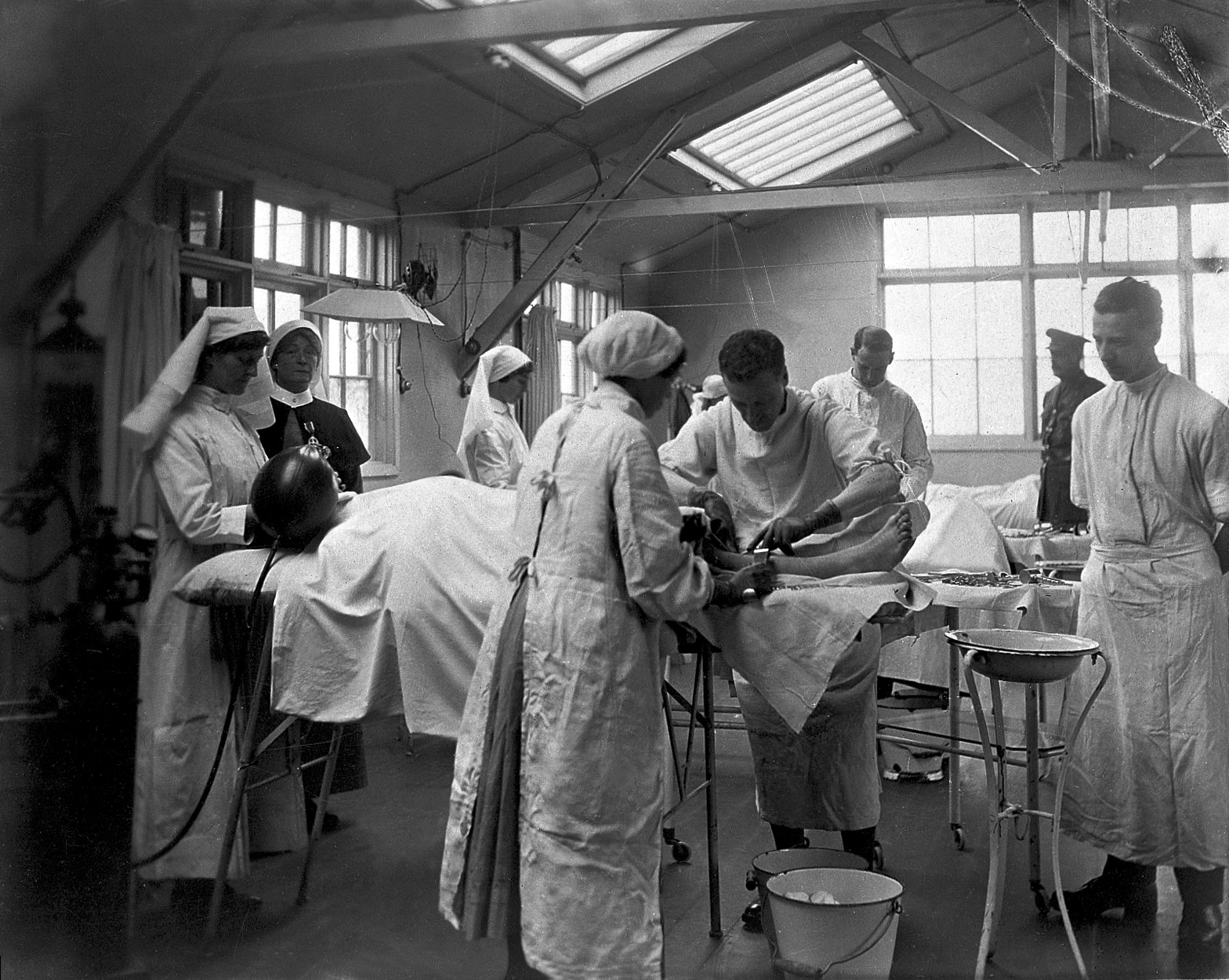
Image context: the cover uses a real Wellcome Collection photograph of a British army operating theatre near Boulogne during World War I.[5] It is not a photograph of Dakin's solution itself. That is the point: the Carrel-Dakin method only made sense inside a care setting where chemistry had to be translated into wound exposure, tubing, nursing labor, observation, and repetition.
The first claim is selectivity, not chemical force
Dakin's 1915 paper should not be read as a celebration of stronger antiseptics. Its sharper move is the opposite. He was trying to identify substances that could act against microbes while sparing tissue enough to let healing continue.[1] That was a practical correction to an older antiseptic temptation: if infection is dangerous, use a harsher chemical. In the body, that logic fails quickly. A substance that kills bacteria but also burns viable cells, inactivates too fast in serum, or cannot be applied evenly to a complex wound is not an effective treatment system.
This is why sodium hypochlorite appears in the history as a compromise rather than a miracle. Dakin investigated many antiseptic candidates and worked toward a buffered, dilute solution because the operating target was narrow: enough germicidal action, limited tissue injury, and behavior that could be reproduced in wartime hospitals.[1][4] The mechanism was not "bleach defeats infection." Household bleach is the wrong mental image. The historically useful idea was controlled hypochlorite chemistry embedded in surgical routine.
That selectivity claim also explains why the method did not belong to chemistry alone. If concentration mattered, preparation mattered. If tissue tolerance mattered, exposure time mattered. If wound surfaces mattered, anatomy mattered. A torn thigh, a shell-fragment track, or a compound fracture was not a flat laboratory plate. The method had to solve for folds, recesses, exudate, dead tissue, and microbial growth across time.[2][3]
Carrel and Dehelly turn liquid into procedure
The Rockefeller University description of Carrel and Dehelly's 1917 book gives the whole program in compressed form: choose an antiseptic fatal to microbes at the right concentration and exposure, while not producing obvious tissue damage, and pair it with surgical technique for septic wounds.[2] That paired requirement is the heart of the matter. The antiseptic was not enough. The wound had to be made treatable.
Carrel's method therefore depended on access. Dead and contaminated tissue had to be removed where possible. The wound had to be opened and arranged so the solution could reach it. Tubes or instillation routes had to distribute the liquid. Dressings and timing had to keep the process going. Bacteriological checks were used as a way to judge whether the wound was becoming cleaner rather than merely looking better.[2][3]
That is why the method reads so modern and so cumbersome at the same time. Modern, because it treats infection control as a measurable workflow rather than a surgeon's impression. Cumbersome, because the workflow required time, staff, equipment, chemical preparation, wound-specific placement, and repeated attention. Charles Ambrose's later discussion of Carrel's 1917 letter notes that the method was complicated, time-consuming, and not always followed by surgeons who doubted such exacting protocol.[4] That is not a side story. It is the central implementation problem.
The primary-source lesson is that an intervention can fail at the level of routine even when its theory is coherent. If tubes are poorly placed, if solution strength drifts, if irrigation is irregular, if the wound is not adequately opened, or if bacteriology is treated as ornamental, the "Carrel-Dakin method" becomes only the name of a liquid. The method's claim was stricter: chemistry, surgery, nursing, and measurement had to act together.[2][3][4]
The front-line report exposes the core mechanism
The 1917 JAMA report on disinfection of war wounds by the Carrel method is valuable because it states the mechanism without romance. To sterilize an infected wound, it says, the antiseptic must contact every part of the wound, maintain suitable concentration, and remain constant for long enough.[3] Each clause matters.
"Every part" attacks the geometry problem. War wounds were not clean incisions. They were irregular cavities, tracks, pockets, crushed tissue, and hidden surfaces. A splash on the top of a dressing could not solve a deep microbial problem. The method required the surgeon to think of the wound as a three-dimensional terrain that had to be reached.
"Suitable concentration" attacks the dilution problem. Pus, blood, tissue fluids, and proteins could weaken or consume antiseptic action. A strong solution at the bottle did not guarantee a strong enough solution at the deepest surface after it had mixed with wound secretions. Dakin's chemistry and Carrel's timing were both aimed at this instability.[1][3]
"For a prolonged period" attacks the time problem. Infection was not a single static deposit that could be erased by one heroic wash. Bacteria persisted, multiplied, and occupied tissue surfaces over time. The irrigation schedule tried to make antimicrobial exposure repetitive enough to change that trajectory before the wound was closed or allowed to heal.[2][3]
The method was therefore a system of contact, concentration, and clock. That triad is the best compact reading of Carrel-Dakin. It is also why the method could be admired and resented at once. It replaced a simpler act, applying an antiseptic, with a more demanding regime of maintaining conditions.
The method's limits are part of its meaning
There are two bad ways to remember Carrel-Dakin. One is triumphalist: before antibiotics, a brilliant solution saved war surgery. The other is dismissive: because the method was cumbersome and later displaced, it was just a historical detour. The sources support a more useful middle reading.
Its achievement was real. It forced surgeons to stop treating antisepsis as a momentary application and to ask whether the active agent was reaching the wound at the right strength for long enough.[1][2][3] That question still sounds like modern infection-control thinking. Dose, delivery, surface access, dwell time, tissue tolerance, and verification remain core problems across wound care, catheter care, sterilization, and antimicrobial stewardship.
Its limitations were also real. The method was labor-intensive, technically exacting, and dependent on compliance. Ambrose's account highlights resistance from surgeons and the need for training support.[4] The JAMA report itself implies the same fragility: if success depends on full contact, constant concentration, and prolonged exposure, then small failures in technique can become large failures in outcome.[3]
There is also an ethical and historical shadow around Carrel himself, whose later politics and eugenic commitments make any heroic memory of the man inadequate. The cleaner subject is not personal sainthood. It is the method's place in health history: a pre-antibiotic attempt to standardize wound infection control by joining laboratory chemistry to bedside procedure.[2][4]
That is why Dakin's solution should not be reduced to "dilute bleach." The World War I lesson is more demanding. A chemical became clinically meaningful only when embedded in a system that controlled where it went, how strong it stayed, how often it returned, and how clinicians knew whether the wound was changing. Carrel-Dakin made wound care a timed irrigation system because, before antibiotics, time and contact were the treatment.[1][2][3][4]
Sources
- Henry Drysdale Dakin, "On the Use of Certain Antiseptic Substances in the Treatment of Infected Wounds," British Medical Journal, 1915, PubMed record with DOI and PMC access.
- The Rockefeller University, "Carrel, A. The treatment of infected wounds," 1917 collection page describing Carrel and Dehelly's book and the Carrel-Dakin method.
- H. H. M. Lyle, "Disinfection of War Wounds by the Carrel Method: As Carried Out in an Ambulance at the Front," JAMA, 1917, abstract and citation page.
- Charles T. Ambrose, "A letter from Alexis Carrel concerning the preantibiotic treatment of war wounds: The Carrel-Dakin solution," Journal of Medical Biography, 2018/2021, abstract and DOI page.
- Wikimedia Commons, "File:World War I; British army operating theatre near Boulogne Wellcome L0008872.jpg," Wellcome Collection archival photograph source page.