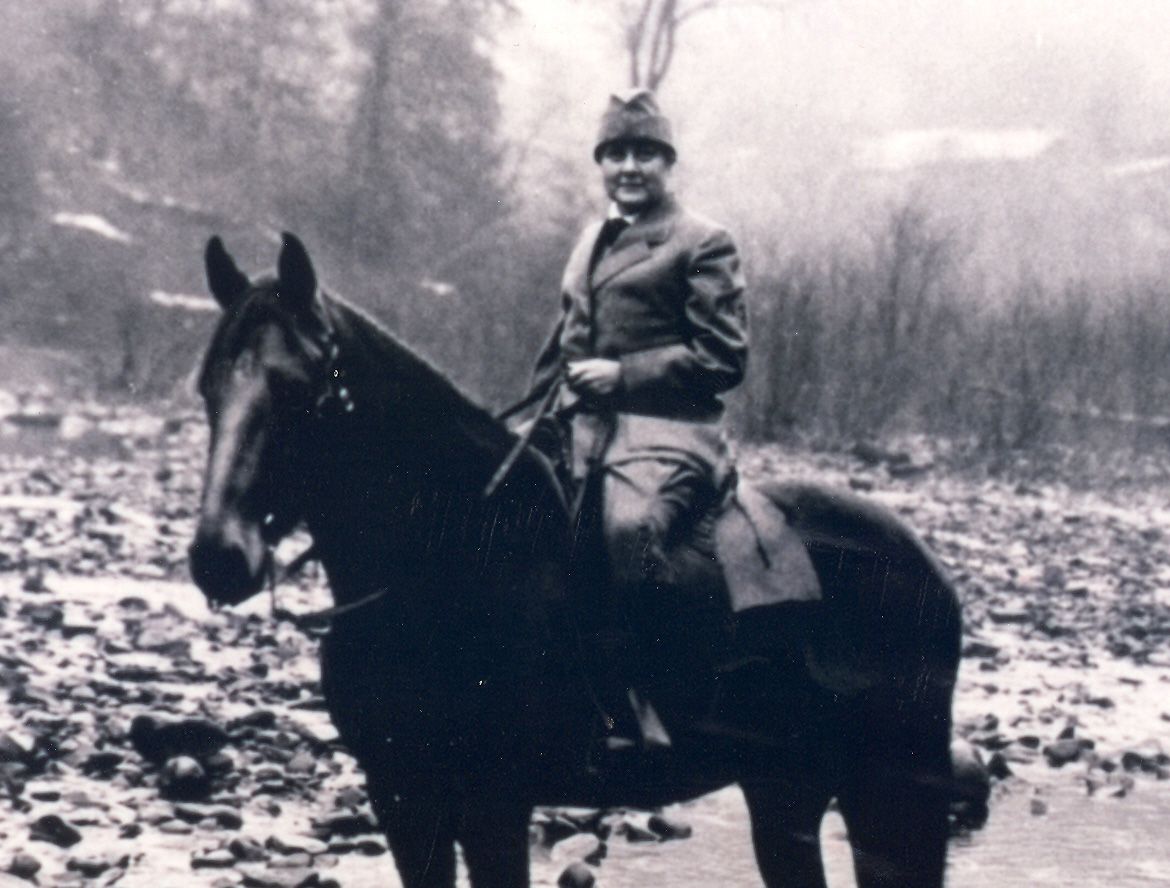
Mary Breckinridge is easy to remember in the wrong shape. She can be flattened into a heroine on horseback, a romantic Appalachian reformer, or the woman who "brought midwives" into rural Kentucky. Those memories are not false, but they miss the more exact achievement. Breckinridge's real innovation was organizational. In the mountains of eastern Kentucky, she built maternal and child health care as a route before it became a full institution: a hospital at the center, outpost clinics within riding distance, nurse-midwives making home rounds, births attended where families actually lived, and public-health work folded into the same journey.[1][2][3][4]
That is why her story matters beyond biography. The problem she chose in 1925 was not simply that Leslie County had too few doctors. The deeper problem was that care arrived too late, too irregularly, and in the wrong form for scattered households in difficult terrain. Breckinridge's answer was to redesign access itself. Rather than wait for poor mountain families to reach a distant building, the service would move repeatedly toward them.[1][3][4]
Image context: the cover uses a real archival photograph of Mary Breckinridge on horseback. It belongs here because the horse was not a picturesque accessory to the Frontier Nursing Service. It was part of the delivery system: a way to hold clinic schedules, prenatal visits, births, and follow-up care together across rough country where roads and rail links did not solve the daily problem of maternal and infant risk.[4]
Timeline anchors before the interpretation
- 1910: Breckinridge graduated from the St. Luke's Hospital School of Nursing in New York, giving her formal nursing training before the public-health turn that defined her later work.[1][4]
- After World War I: while working with the American Committee for Devastated France, she saw nurse-midwives and rural maternal-child programs in Europe, then studied midwifery in London and observed the Highlands and Islands Medical and Nursing Service in Scotland.[1][2][4]
- 1925: she founded the Kentucky Committee for Mothers and Babies in Leslie County, Kentucky, the organization that became the Frontier Nursing Service three years later.[2][3][4]
- 1928: a 28-bed hospital opened in Hyden, giving the service a clinical center without replacing its outward-moving outpost logic.[3]
- 1939: after many British nurse-midwives returned home as war began, Breckinridge founded the Frontier Graduate School of Midwifery so the model could be trained and sustained domestically.[1][3]
- 1958: Frontier nurse-midwives had attended more than 10,000 births, and the service's first three decades posted maternal and infant outcomes better than national benchmarks.[1]
Those dates show why this story is worth treating as a microhistory of design. The visible image is one woman on one horse. The historical object is a whole care system learning how to move.
1. Europe gave Breckinridge more than inspiration; it gave her a usable model
Britannica's short biography is helpful because it keeps the sequence intact.[4] Breckinridge trained as a nurse, endured the deaths of her young children, worked in public health, and then reached Europe after the First World War. In France she organized food and medical assistance for children, nursing mothers, and pregnant women. In Britain and Scotland she saw something American medicine had not yet normalized in rural regions: trained midwives working as part of a wider maternal-child system rather than as isolated helpers.[1][4]
That detail matters because it corrects a common simplification. Breckinridge did not return home with a vague belief in compassion or service. She returned with a structural lesson. The Highlands and Islands system in Scotland had shown that dispersed populations could still receive repeated, organized care if transport, staffing, and geography were treated as part of the medical problem.[1][4] In other words, the challenge was not only what clinicians knew. It was how a service reached a scattered population often enough to matter.
The Library of Congress guide to public-health nurses compresses the point well: after nursing in France, Breckinridge studied midwifery in England and then came back to found the Kentucky Committee for Mothers and Babies in 1925, later known as the Frontier Nursing Service.[2] That phrasing makes the chain visible. France sharpened the public-health mission. Britain and Scotland provided the staffing and service model. Kentucky became the place where she tested whether the model could survive American terrain, poverty, and distance.
2. The crucial invention in Kentucky was spatial
The Frontier Nursing University history page supplies the clearest operational description.[1] The service Breckinridge founded in southeastern Kentucky was built with a hospital at the center and outpost clinics placed within a five-mile ride on horseback. That single detail does more explanatory work than a dozen admiring adjectives. It means the unit of planning was neither the county line nor the distant hospital bed. It was riding distance. The system was arranged so that clinics, homes, and eventual referrals could all stay within a manageable loop.
Once that loop existed, the nurse-midwives could do more than attend labor. They held clinics, made home rounds on horseback, provided home care, and went directly to houses for births.[1] Each outpost served an average of 250 families.[1] That scale is important. It was small enough for repeated contact and local familiarity, but large enough to turn one outpost into a meaningful public-health node rather than a charity visit.
The work also did not stop at delivery. The same riders held immunization clinics at one-room schools and gave practical advice about wells and outhouses.[1] That means Breckinridge's maternal-care project was never only obstetrics. It bundled prenatal observation, birth attendance, child health, vaccination, and environmental sanitation into one recurring route. Many later health systems split those functions across separate offices, budgets, or professions. Breckinridge's system joined them because the mountain household encountered them as one lived reality.
The Kentucky historical marker underscores that this was not an incidental local experiment. It remembers English midwives helping bring medical service that saved hundreds of mothers and babies in the "remote hollows and hills" of Clay, Leslie, and Perry counties, notes the opening of the Hyden hospital in 1928, and marks the 1939 graduate school as one of only three such schools in the United States.[3] The marker's language is brief, but it captures the scale of the wager. Breckinridge was not opening a single admirable clinic. She was trying to make a sparsely settled region legible to a maternal-health workforce.
3. Why nurse-midwives, not just doctors, sat at the center
Breckinridge's choice of labor unit was decisive. If the point had been to reproduce an urban physician-centered model in a remote county, the project would have stalled on scarcity and travel time. Nurse-midwives were different. They could anchor prenatal care, labor support, postpartum follow-up, infant observation, and public-health teaching in one continuous relationship.[1][4] In a terrain where every trip cost time and weather mattered, that continuity was not secondary. It was the whole advantage.
This is why the British connection mattered so much. Frontier's own history says that until 1939 most of the service's nurse-midwives were British.[1] That was not a decorative international detail. It meant the program depended on a labor force already trained inside a system Breckinridge admired. When the Second World War pulled many of those women back home, the service faced a structural threat. If the skill base left, the route system could not simply continue on goodwill.
Breckinridge's answer was again organizational, not sentimental. She founded the Frontier Graduate School of Midwifery in 1939 so the service could train its own successors and convert one regional experiment into a reproducible American pathway.[1][3] That move is one of the strongest reasons to treat her story as infrastructure rather than legend. A charismatic founder can start a service. A school is how a service tries to outlive its founder.
4. The outcome numbers matter because they match the design
Stories like this often drift toward moral admiration and away from evidence. In Breckinridge's case, the performance data are part of the argument. Frontier Nursing University's centennial history says the service produced an immediate decrease in infant and maternal mortality and reports that, across its first 30 years of operation, all maternal and infant outcome statistics were better than national figures.[1] It gives the sharpest comparison in maternal mortality: 9.1 per 10,000 births for the Frontier service versus 34 per 10,000 births for the United States as a whole.[1] It also notes a low-birth-weight rate of 3.8% for Frontier versus 7.6% nationally.[1]
Those numbers should be read carefully. They do not mean Leslie County became a medical utopia, or that every feature of the model can be lifted unchanged into every later setting. But they do support the article's central claim. The system worked because its design matched the problem. Maternal and infant risk in scattered rural households was not only a matter of clinical knowledge in the abstract. It was a matter of whether skilled observation, safe delivery, follow-up, and referral could arrive repeatedly enough to alter outcomes.[1][3][4]
The Library of Congress film record for The Forgotten Frontier provides a final corroborating texture.[5] Filmed in 1929 through the winter and spring of 1930, the documentary shows nurse-midwives providing child hygiene, midwifery, sick nursing, dentistry, and public-health work while traveling by horseback for miles through the mountains. The film matters less as publicity than as a visual proof of service shape. It records the fact that care in this system was supposed to travel, not wait.
What the microhistory changes
The strongest way to remember Mary Breckinridge is not as a lone rider solving maternal mortality through grit. It is to see how precisely she matched labor, transport, and geography. She borrowed a nurse-midwifery model from Europe, adapted it to Leslie County in 1925, anchored it with a hospital in 1928, and protected its future with a training school in 1939.[1][2][3][4] The horse, the outpost, the school, and the statistics all belong to the same design.
That design still reads clearly in 2026. Rural health debates often default to buildings, specialist shortages, or new technology. Breckinridge's history points to an older but stubborn lesson: access is a system property. Care improves when the route from skilled worker to household is organized, repeated, and close enough to daily life that pregnancy, birth, infancy, and prevention can be treated as one continuum rather than as disconnected emergencies.[1][5]
Sources
- Frontier Nursing University, "A Century of Stories: Mary Breckinridge" - official institutional history with the Scotland model, five-mile horseback outpost design, average families served, and outcome comparisons against national maternal and infant benchmarks.
- Library of Congress, "Public Health Nurses" - manuscript guide summarizing Breckinridge's France-to-England-to-Kentucky sequence and the 1925 founding of the Kentucky Committee for Mothers and Babies.
- Kentucky Historical Society, "Frontier Nursing" historical marker - concise official record of the 1925 founding, the 1928 Hyden hospital, and the 1939 graduate school of midwifery.
- Encyclopaedia Britannica, "Mary Breckinridge" - biography covering Breckinridge's nursing training, France work, Scottish model, 1925 Leslie County move, and the service's maternal and neonatal mortality gains.
- Library of Congress, "The forgotten frontier" - catalog page for the 1930 documentary showing Frontier nurse-midwives traveling on horseback and bundling midwifery, child hygiene, and public-health work.