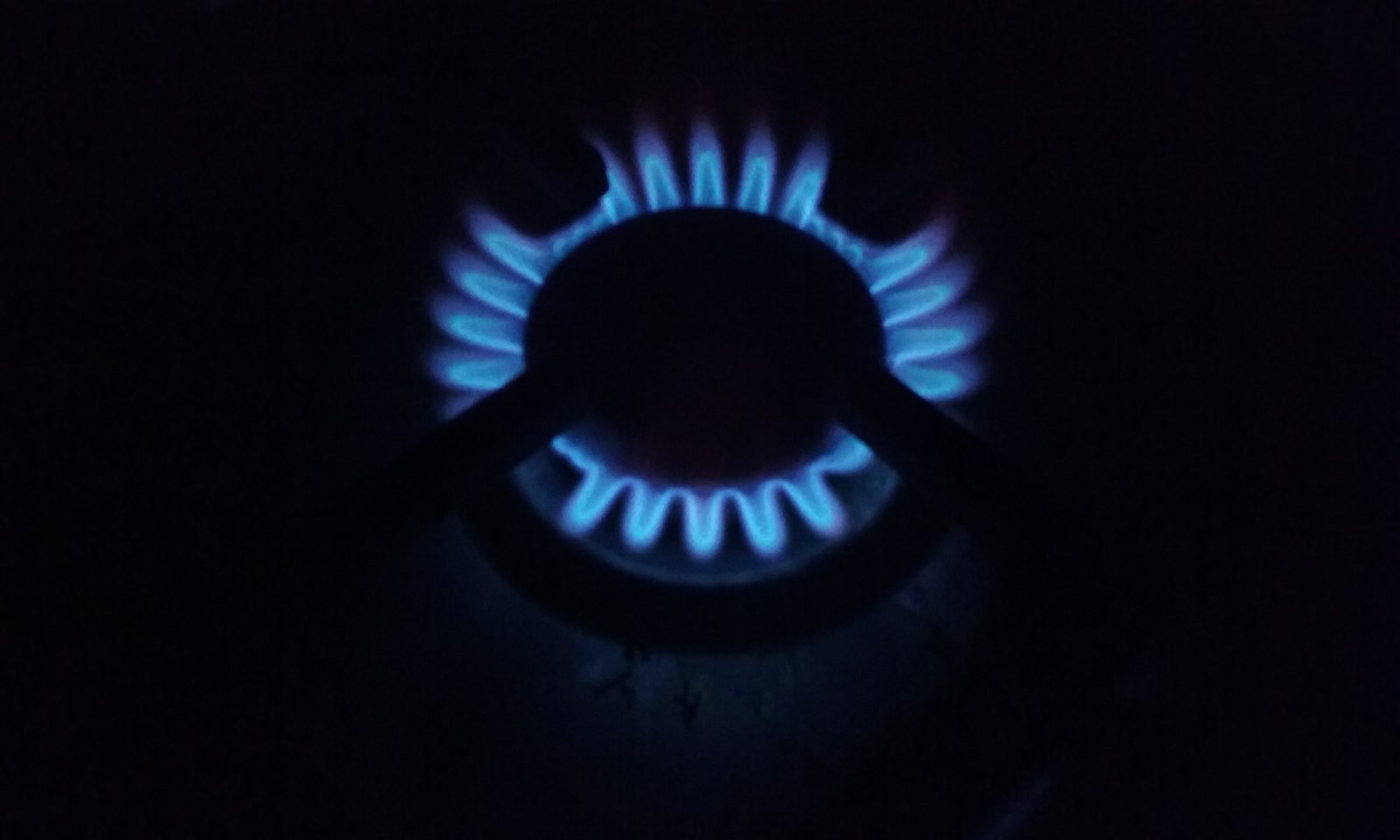
The argument over gas stoves often gets flattened into a culture-war sentence: either the stove is harmless because people have cooked on gas for generations, or it is treated as if one appliance explains childhood asthma by itself. Neither version is precise enough. The better question is mechanistic: what happens when combustion is moved into the room where people breathe, and how much of that exposure reaches a child's airways?
EPA's current indoor-air page gives the first step plainly. Nitrogen dioxide, or NO2, is a toxic, reactive oxidant, and indoor sources include combustion processes such as unvented appliances, including gas stoves.[1] EPA also states that low-level NO2 exposure may increase bronchial reactivity in some people with asthma, reduce lung function in people with chronic obstructive pulmonary disease, and raise respiratory-infection risk, especially in young children.[1] That does not prove that every gas stove causes asthma. It does establish the exposure pathway: burning fuel in a kitchen can create a respiratory irritant inside the home.
This is why the stove debate is really an indoor-air debate. The appliance is only the visible object. The relevant system is burner size, cooking time, kitchen volume, range-hood capture, whether the hood vents outdoors, whether windows are open, whether the home is small or large, and whether children with developing lungs spend time near the exposure. A gas flame is brief; indoor dose can be longer, because pollutants mix beyond the pan and beyond the kitchen.
The mechanism starts with combustion, not with the diagnosis
When methane or propane burns, the flame heats air enough to form nitrogen oxides, a family that includes NO2. A 2022 Environmental Science & Technology field study measured natural-gas stoves, cooktops, and ovens in 53 homes during off, on, ignition, and extinguishment phases.[3] The climate headline from that paper was methane leakage, but the health detail matters here: in 32 homes, the researchers measured NOx emissions and found them linearly related to the amount of gas burned.[3]
The same study estimated that natural-gas stoves emit 0.8% to 1.3% of the gas they use as unburned methane, with more than three-quarters of measured methane emissions occurring while the appliance was off.[3] That off-cycle finding is mostly a climate point, not an asthma mechanism. For respiratory health, the on-cycle point is more direct: families with poor ventilation or no range-hood use can surpass the 1-hour U.S. outdoor NO2 standard of 100 parts per billion within minutes of stove use, particularly in smaller kitchens.[3]
The word "outdoor" is important. EPA notes that no indoor nitrogen-oxide standard has been agreed upon, while outdoor standards and guidelines exist.[1] WHO's 2010 indoor-air guideline volume treated NO2 as one of several pollutants commonly found indoors at concentrations of concern and provided scientific guidance for public-health protection.[6] In practice, the absence of a neat indoor regulatory line does not make the exposure disappear. It just means the home has fewer formal guardrails than the outdoor air-monitoring system.
The epidemiology says risk, but not destiny
The strongest epidemiological summary is not a single dramatic case report. It is a pattern across studies. A 2013 meta-analysis in the International Journal of Epidemiology reviewed 41 studies published up to March 31, 2013, and estimated that gas-cooking exposure was associated with childhood asthma with a summary odds ratio of 1.32, with a 95% confidence interval of 1.18 to 1.48.[2] The same analysis found indoor NO2 associated with current wheeze, with an odds ratio of 1.15 and a 95% confidence interval of 1.06 to 1.25.[2]
Those numbers are meaningful, but they have to be read correctly. An odds ratio around 1.32 is not a diagnostic fingerprint. It does not tell a parent, "this particular child's asthma came from this particular stove." Asthma is multifactorial: viral infections, genetics, allergens, tobacco smoke, outdoor pollution, dampness, pests, socioeconomic conditions, and access to care can all matter. The meta-analysis instead says that, across populations, gas cooking and indoor NO2 sit on the risk side of the ledger.[2]
That distinction also keeps the counterargument honest. It is fair to ask how well observational studies separate gas cooking from housing, poverty, ventilation, secondhand smoke, and neighborhood outdoor pollution. It is not fair to pretend that confounding concerns erase the combustion pathway. We know gas and propane stoves emit NO2 indoors; we know NO2 is a respiratory irritant; and we have epidemiological evidence linking gas cooking and indoor NO2 with childhood respiratory outcomes.[1][2][3]
Why newer studies shifted attention to dose
The last few years have moved the debate from "is there an association?" toward "how much exposure does the stove add under real home conditions?" A 2024 Science Advances study estimated U.S. NO2 exposure from gas and propane stoves using emissions and concentration measurements from more than 100 homes, a room-specific indoor-air model, epidemiological risk parameters, and housing and behavior data.[5]
Its central estimate was that gas and propane stoves increase long-term NO2 exposure by 4.0 parts per billion on average across the United States, about 75% of the WHO exposure guideline cited by the authors.[5] The modeled exposure was not distributed evenly. People in homes smaller than 800 square feet incurred about four times more long-term NO2 exposure than people in homes larger than 3,000 square feet. American Indian/Alaska Native households and Black and Hispanic/Latino households incurred 60% and 20% more NO2 exposure, respectively, than the national average.[5]
Those differences are not side notes. They explain why the same appliance can be a minor exposure in one home and a much bigger exposure in another. A large kitchen with a strong outdoor-venting hood, short burner use, and good air exchange is not the same exposure system as a small apartment with a weak or recirculating hood and a child doing homework near the kitchen table. The flame may look similar. The dose does not have to be.
The 2024 study also estimated that the added long-term NO2 exposure likely causes about 50,000 cases of current pediatric asthma in the United States from NO2 exposure alone.[5] That estimate is model-based and should be read as population burden, not individual diagnosis. Its value is to make invisible indoor pollution visible at the scale where policy, building codes, appliance standards, ventilation, and electrification incentives are debated.
The population-attributable fraction is useful, but easy to misuse
The most-cited public number is the 2023 estimate that 12.7% of current childhood asthma in the United States is attributable to gas-stove use, with a 95% confidence interval of 6.3% to 19.3%.[4] That article combined prior risk estimates with state-level exposure prevalence to calculate a population-attributable fraction, or PAF.[4] The estimate helped turn a kitchen appliance into a public-health headline.
The strength of a PAF is also its weakness. It asks a counterfactual population question: if the exposure were removed, how much of the disease burden might disappear, assuming the causal estimate and exposure prevalence are right? That is a useful planning tool. It is not the same thing as measuring NO2 in every kitchen, following every child, and proving the cause of every asthma diagnosis one by one.
So the right reading is bounded. The 12.7% figure is too important to dismiss as a talking point and too indirect to treat as courtroom proof. It translates a body of association evidence into a public-health burden estimate.[4] The 2024 dose-modeling work then strengthens the exposure side by showing how gas and propane stove NO2 can move through homes, vary by housing size, and contribute to modeled pediatric asthma burden.[5] Together, the studies say there is a plausible, measurable, and unequally distributed indoor-air problem. They do not say every gas-stove household has the same risk.
What actually changes the exposure
Once the question is framed as indoor-air dose, the practical hierarchy becomes clearer. Removing combustion from the kitchen removes the source. Outdoor-venting exhaust can reduce exposure when it actually captures the plume and sends it outside. Opening windows can dilute some pollutants, though it depends on weather and outdoor air. A recirculating hood that blows air back into the room is not equivalent to exhaust ventilation for NO2. Home size, kitchen enclosure, burner duration, and occupant distance all change the dose map.[1][3][5]
This is not a moral ranking of cooks. It is exposure physics. A household may rent, lack authority to change appliances, lack money for a retrofit, or have a kitchen layout that makes ventilation weak. That is why the most useful public-health framing is not "good people choose the right stove." It is "combustion indoors has measurable respiratory consequences, and the people with the least control over housing often have the least margin."
The same framing avoids overclaiming. A gas stove is not the only indoor-air hazard. It is one controllable combustion source among others: tobacco smoke, kerosene heaters, fireplaces, poorly vented furnaces, candles, and outdoor pollution that enters the home can all matter. But "not the only source" is not a defense of a source. It is a reason to be precise about the whole indoor environment.
The boundary that should survive the argument
The strongest evidence-led conclusion is modest and consequential. Gas and propane stoves create NO2 indoors. NO2 is a respiratory irritant with particular relevance for children and people with asthma. Epidemiology links gas cooking and indoor NO2 with childhood asthma and wheeze. Newer exposure modeling suggests the dose burden is larger in smaller homes and uneven across demographic groups.[1][2][3][5]
The disputed part is not whether combustion can pollute indoor air. It is how much of the asthma burden should be attributed to this source in different populations, and how aggressively policy should respond. That is a real debate. It should be argued with exposure measurements, ventilation performance, housing constraints, and careful interpretation of population estimates, not with nostalgia for a blue flame or panic about a single appliance.
The gas stove belongs in health writing because it makes a broader lesson visible. Indoor air is not automatically safe just because it is familiar. A home can feel ordinary while carrying a pollutant pulse that no one sees, smells, or measures. The public-health task is to make that invisible dose legible before it becomes another background risk assigned to children, renters, and families with the least room to move.
Sources
- U.S. Environmental Protection Agency, "Nitrogen Dioxide's Impact on Indoor Air Quality" (last updated April 29, 2026) - indoor NO2 sources, health effects, home levels, and exposure-reduction measures.
- Weiwei Lin, Bert Brunekreef, and Ulrike Gehring, "Meta-analysis of the effects of indoor nitrogen dioxide and gas cooking on asthma and wheeze in children," International Journal of Epidemiology, 2013 - 41-study meta-analysis with gas-cooking and indoor NO2 respiratory-outcome estimates.
- Eric D. Lebel et al., "Methane and NOx Emissions from Natural Gas Stoves, Cooktops, and Ovens in Residential Homes," Environmental Science & Technology, 2022 - 53-home field study measuring methane and NOx emissions from residential gas appliances.
- Talor Gruenwald et al., "Population Attributable Fraction of Gas Stoves and Childhood Asthma in the United States," International Journal of Environmental Research and Public Health, 2023 - U.S. population-attributable-fraction estimate for gas-stove use and current childhood asthma.
- Yannai Kashtan et al., "Nitrogen dioxide exposure, health outcomes, and associated demographic disparities due to gas and propane combustion by U.S. stoves," Science Advances, 2024 - exposure modeling from more than 100 homes, demographic disparities, and modeled pediatric-asthma burden.
- World Health Organization, WHO guidelines for indoor air quality: selected pollutants (2010) - public-health guideline volume covering nitrogen dioxide and other indoor pollutants.
- Wikimedia Commons, "Natural gas burning on a gas stove.jpg" - real photograph of a household natural-gas flame, used as the article image source.