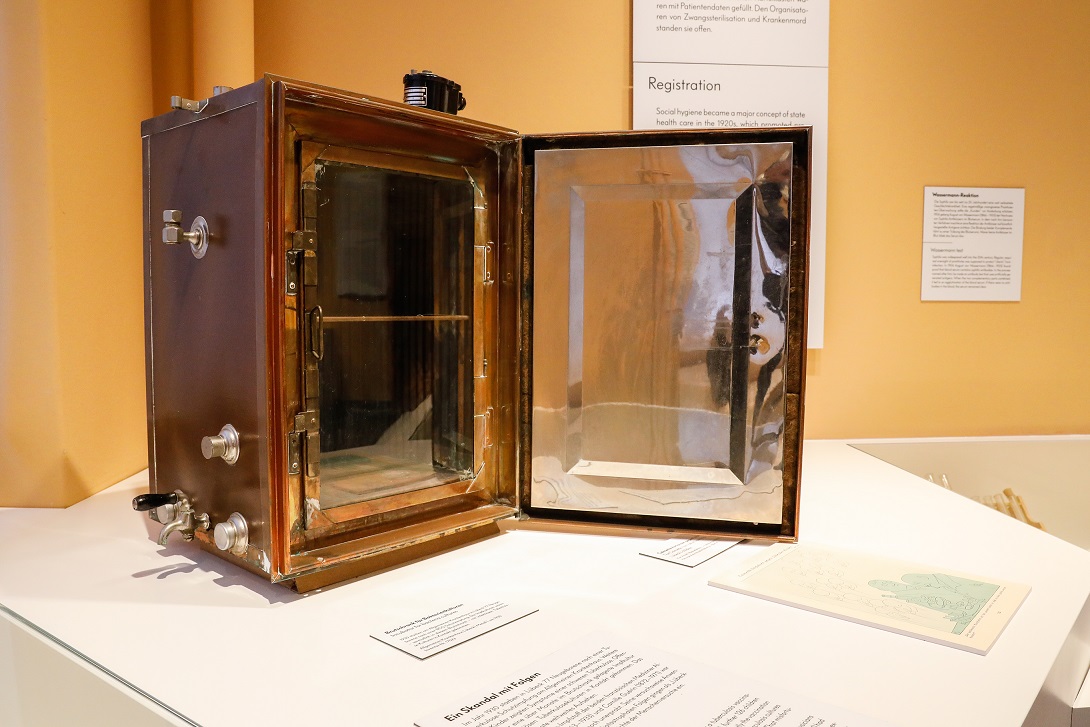
A copper cabinet in Hamburg's medical history museum once held cultures intended to protect newborns from tuberculosis. It also held the dangerous bacteria that would contaminate their vaccine. The museum identifies it as a laboratory incubator from Lübeck General Hospital, made around 1925.[1]
Had the weakened vaccine organism become dangerous again, or had another organism entered the preparation? Investigators established contamination, but never reconstructed the precise action that caused it. That gap between identifying a cause and recovering an event runs through Lübeck's history.[1]
A culture arrived with conditions
In 1929, hospital director Georg Deycke and health official Ernst Altstaedt planned a local BCG campaign. Developed in France, BCG used weakened, living Mycobacterium bovis, the bacterium responsible for bovine tuberculosis. A culture obtained from the Pasteur Institute would be grown and prepared in Lübeck. Immunologist Stefan Kaufmann describes a project launched despite German official caution about human use. The public campaign began in late February 1930.[2]
The instructions mattered as much as the culture. According to the museum's account, the incubator containing BCG was supposed to contain no other microorganisms, especially other tuberculosis bacilli. Lübeck housed the vaccine cultures alongside a virulent strain obtained from Kiel.[1]
Kaufmann also records that the local laboratory omitted the prescribed animal checks of the preparation's lack of virulence. Public notices and handouts failed to identify the intervention as a live vaccination, presenting it instead as feeding infants Calmette's remedy.[2]
These were different failures with different consequences. Laboratory separation concerned what reached the bottle. Testing concerned what could be detected before it left. Information concerned what parents understood they were accepting. Treating them as one lapse obscures the several opportunities to interrupt the sequence.
The first warning had another explanation
The campaign was preceded by individual vaccinations. A later review by Peter Donald and colleagues describes an infant vaccinated on December 12, 1929, who developed enlarged neck lymph nodes in January. A biopsy yielded virulent human tuberculosis bacteria, but the illness was attributed to congenital infection; the mother had severe pulmonary TB. In April, deaths among vaccinated infants, including cases with severe abdominal tuberculosis, made contamination increasingly evident.[3]
The earlier explanation shows how the intervention could remain outside suspicion. A mother's known disease offered an apparently coherent account of her baby's illness. The sequence suggests why comparison across families mattered: the circumstances of one household could obscure a danger shared by other vaccinated children.
Stopping production did not immediately stop exposure. Hanna Lohse's historical account records that, after the laboratory halted preparation in late April, bottles already distributed were not recalled. Some infants continued receiving second or third doses until April 30. Public disclosure followed in May.[5]
A stop inside a laboratory is only the beginning of a stop outside it. The remaining doses already had destinations. The delay makes the distribution chain part of the event itself: recognizing a hazard could protect the next child only if the information reached whoever held the bottle.
The surviving cultures carried a signature
The contamination explanation acquired evidence independent of the children's symptoms. Gregory Fox and colleagues' 2016 reconstruction reports that investigators found the Kiel strain in five of twelve tested stock cultures. One contained only virulent Mycobacterium tuberculosis. Material recovered from retained vaccine vials also yielded the pathogen. These findings supported contamination by another bacterium, rather than reversion of BCG itself to virulence.[4]
The distinction was consequential. Reversion would have implicated the stability of the vaccine organism. Contamination implicated the preparation delivered in Lübeck. Both could explain illness after vaccination in a superficial account; the cultures supplied a way to distinguish them.
Fox's review also describes the investigator Albert Moegling's reconstruction of different contamination levels from vaccination dates and clinical outcomes. The actual quantities swallowed were unknown. These were inferred exposure groups, not measured doses assigned in an experiment.[4]
That limitation should stay attached to the evidence. A pattern of worse outcomes can strengthen a causal reconstruction without identifying every infant's exposure. Equally, identifying a pathogen does not establish whose hand transferred it, at what hour, or through which particular piece of equipment. The strength of the microbiological conclusion does not license an invented scene at the laboratory bench.
Three death counts describe different judgments
The cohort comprised 251 infants. Fox's review records 77 deaths, attributing 72 to tuberculosis.[4] Donald and colleagues' 2022 re-examination of pathology and microbiology reports revised the TB-attributed count to 67, assigning ten deaths to other causes.[3] The deaths recorded during cohort follow-up and the cause-specific count must therefore be kept separate.
This disagreement concerns attribution within a catastrophic event. It does not overturn the evidence of contamination. Saying simply that 77 infants died of tuberculosis erases the distinction; silently replacing an older figure without explaining its basis also hides part of the historical record.
The reconstruction here depends on published reassessments of the original investigations, rather than a new examination of the individual case files. Where those reassessments differ, the defensible approach is to identify the difference. Precision sometimes requires keeping a qualification beside a number.
The trial could end before the harm did
The trial ran from October 1931 to February 1932. Deycke received a two-year prison sentence and Altstaedt fifteen months. Laboratory nurse Anna Schütze was acquitted for lack of evidence. Lohse emphasizes that the exact means of contamination was never established.[5]
Her oral-history project, based on interviews in 2011–2012, extended the record beyond the verdict. Survivors and relatives described lasting impairments, including hearing loss. Municipal help included food, housing support, and compensation arrangements.[5]
Those accounts change where an event reconstruction should end. A laboratory finding answers what made people ill. A judgment addresses responsibility under law. Neither, by itself, records what it meant to grow up with an impairment or to seek support years later. The children cannot become merely the evidence through which the vaccine's reputation was settled.
What can be carried forward
Later BCG standardization made preservation and production explicit subjects of international oversight. WHO records keeping freeze-dried seed lots from 1956, adopting written vaccine requirements in 1965, and subsequently revising production and testing standards. Its account describes continuing work on the identity and quality of a biological product.[6]
These later measures should not be presented as a single reform directly caused by Lübeck. They do, however, help explain the durable question the disaster raises: how does a named vaccine remain the intended preparation through cultivation, handling, and delivery?
The copper cabinet survives as an unusually concrete place to ask it. The investigation established contamination without recovering its exact moment. That unresolved detail leaves no need for speculation. There is already a demanding history to reconstruct in the barriers that failed, the evidence that survived, and the lives that continued after the verdict.
Sources
- Henrik Eßler, “Brutschrank,” Medizinhistorisches Museum Hamburg, University Medical Center Hamburg-Eppendorf — incubator provenance, photograph, laboratory separation instructions, and the unresolved transfer.
- Stefan H. E. Kaufmann, “Vaccine Development Against Tuberculosis Over the Last 140 Years: Failure as Part of Success,” Frontiers in Microbiology (2021), section “The Lubeck Disaster” — campaign preparations, omitted safeguards, and public communications.
- Peter Donald et al., “Pathogenesis of tuberculosis: the 1930 Lübeck disaster revisited,” European Respiratory Review (2022) — early warning cases and revised attribution of deaths; full text in the Max Planck repository.
- Gregory J. Fox, Marianna Orlova, and Erwin Schurr, “Tuberculosis in Newborns: The Lessons of the ‘Lübeck Disaster’ (1929–1933),” PLOS Pathogens (2016) — culture findings, inferred contamination levels, and the earlier mortality classification.
- Hanna Lohse, “The BCG disaster, Lübeck, 1930: An Oral History Project of the ‘Calmette Children’ and their Survivorship,” The International Journal of Urologic History 1(1):12–18 (2021) — distributed doses, trial, survivor interviews, and municipal support.
- World Health Organization, “BCG (Tuberculosis)” — seed-lot preservation and the development of written vaccine production and testing standards.