The most easily misread phrase in the FEAST trial is “no bolus.” It sounds like an absence of treatment. In fact, the control group received intravenous maintenance fluids, medicines against infection, and supportive care. What was withheld was an additional rapid infusion intended to restore circulation. That distinction is the entrance to a troubling result: among the children in the main comparison, giving the extra fluid increased deaths.[2][3]
Read as a contest between rescue and neglect, the trial makes little sense. Read as a test of adding one intervention to an existing package of care, it asks a precise question. Does a familiar emergency treatment improve survival in the patients and hospitals where clinicians propose to use it?
Read the control group first
FEAST—Fluid Expansion As Supportive Therapy—began in January 2009 at six hospitals in Uganda, Kenya, and Tanzania. Children arrived with severe febrile illness and evidence that blood was circulating poorly. The trial addressed a practice common in wealthy countries but much less established in these hospitals: rapidly administering fluid to improve circulation.[2]
The monitoring committee's later account supplies the details hidden inside the word control. Children across the treatment groups received antibiotics, antimalarial treatment when indicated, and maintenance fluid until they could retain oral fluids. Care also included treatment for low blood sugar and seizures; children meeting the protocol's severe-anemia threshold received blood transfusions. Staff had training in triage and emergency care. The wards had monitoring equipment, but mechanical ventilation beyond brief bag-and-mask support was unavailable.[3]
Those details change the ethical and clinical reading. A control group can represent active treatment. The question is what each group receives in common, and what the experiment adds. Here, the background care makes it possible to isolate the consequences of a rapid infusion more convincingly than a story about an untreated child could.
Keep the three denominators attached
The main comparison randomized 3,141 children to albumin boluses, saline boluses, or no bolus. At 48 hours, deaths numbered 111 of 1,050 in the albumin group, 110 of 1,047 in the saline group, and 76 of 1,044 in the control group: 10.6%, 10.5%, and 7.3%, respectively.[1]
For the two bolus groups combined, the reported relative risk was 1.45, with a 95% confidence interval of 1.13–1.86. The absolute increase was 3.3 percentage points. In plain language, that is roughly three additional deaths per hundred children assigned boluses under these trial conditions. It is a difference in group outcomes over a specified interval, not a prediction of which individual child would die.[1]
The two fluids produced similar mortality. The no-bolus comparison was therefore indispensable: a study comparing only albumin with saline could have found little difference between them while missing the worse outcome associated with both. That is a lesson about the design of the question, before it is a lesson about the contents of either bag.
The word “shock” needs a boundary
The main comparison excluded children with severe hypotension, meaning very low blood pressure by the trial's age-specific definitions. A separate group of only 29 children with severe hypotension received one of the two bolus treatments; it had no no-bolus control. That small comparison cannot establish what withholding boluses would have done in that population. The main trial also allowed rescue boluses if severe hypotension developed.[1][3]
Nor was FEAST a trial of replacing fluid lost through diarrhea, burns, or traumatic bleeding. Those conditions, and severe malnutrition, were outside its scope. The investigators' institutional summary explicitly distinguishes these losses from the illnesses studied and cautions against directly transferring the findings to hospitals with different patients and access to advanced life support.[2]
The appropriate boundary runs through the clinical problem and the available care, not simply through a map. Describing FEAST as an “African trial” identifies its setting. It does not, by itself, specify the physiology of every patient elsewhere. Equally, the fact that a treatment is familiar in another health system cannot supply the missing evidence for this one.
Stopping meant judging the local standard
Recruitment stopped in January 2011. The monitoring committee's 2013 account explains that it had initially discussed a demanding statistical threshold for proving benefit. When evidence accumulated in the opposite direction, it judged that continuing an intervention with no realistic prospect of superiority and evidence of harm was unjustified. The relevant existing standard was the local no-bolus approach.[3]
This is a revealing part of the record. A trial's stopping decision involves more than waiting for one numerical boundary to light up. It also depends on what participants would otherwise receive. The committee's published explanation lets readers examine that judgment instead of treating early termination as a mysterious administrative event.
A better first hour did not settle the question
A 2013 follow-up analysis found that signs of shock resolved within an hour more often with boluses: 43% versus 32%. Yet that early response did not explain away the mortality finding. The researchers' classification of terminal events pointed chiefly toward excess cardiovascular collapse, rather than the obvious fluid-overload events they had initially suspected. This was an investigation of possible mechanisms within the trial, not a fresh randomized experiment proving one biological explanation.[4]
A 2019 analysis examined when deaths occurred. Its models suggested that mortality risk declined more slowly after bolus treatment, with the difference extending over about four days. The pattern did not resemble only an immediate catastrophe during infusion. Because this was a retrospective analysis, it helps describe the timing of harm without completely identifying its cause.[5]
These papers leave a demanding standard for reading emergency-care evidence. Define the patients. Recover the treatment hidden inside the comparator's shorthand. Then follow outcomes beyond the moment when an intervention appears to work. In FEAST, the control group mattered because it made an otherwise invisible question answerable: what was the additional fluid actually contributing?
Sources
- Kathryn Maitland et al., “Mortality after Fluid Bolus in African Children with Severe Infection,” New England Journal of Medicine 364:2483–2495 (June 30, 2011) — original paper, including treatment groups, mortality estimates, and the separate severe-hypotension stratum; full-text PDF hosted by the University of KwaZulu-Natal.
- UCL Innovative Clinical Trials Unit, “FEAST” — the investigators' study summary, participating hospitals, enrollment period, exclusions, and limits on transferring the results.
- Jim Todd et al., “When enough is enough: how the decision was made to stop the FEAST trial,” Trials 14:85 (March 26, 2013) — background care, monitoring, and the committee's explanation of early termination.
- Kathryn Maitland et al., “Exploring mechanisms of excess mortality with early fluid resuscitation: insights from the FEAST trial,” BMC Medicine 11:68 (March 14, 2013) — early responses and classifications of terminal clinical events.
- Elizabeth C. George et al., “Mortality risk over time after early fluid resuscitation in African children,” Critical Care 23:377 (November 27, 2019) — retrospective modeling of the timing of mortality risk.
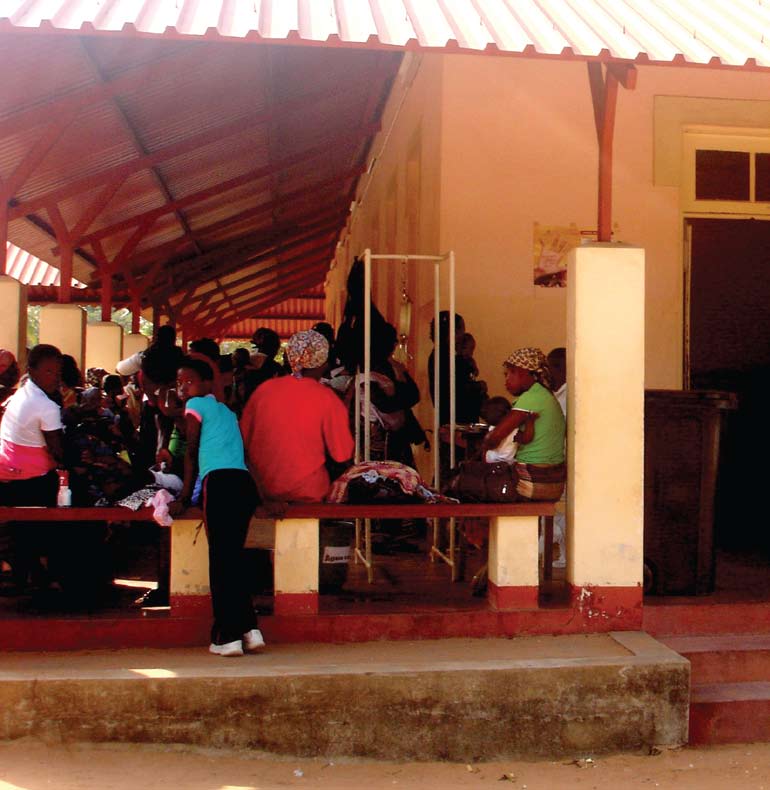
- Malaria Consortium, Greater Impact through Partnerships: Annual Review 2010–2011, printed page 10 — archival photograph of Homoine District Hospital, Mozambique; printed page 14 documents the FEAST research partnership.