Lillian Wald is often remembered as a saintly visiting nurse, which is true but too small. Her real importance is infrastructural. She helped make health care travel through the neighborhood itself: the tenement hallway, the kitchen table, the school classroom, the lunch line, the playground, the labor campaign, and the city budget.[1][2][3] What she built on the Lower East Side was larger than bedside charity. It was an early public-health routing system for people who could not reliably reach hospitals, specialists, or sanitary housing on their own.
The origin story matters because it already contains the method. In 1893, while teaching home nursing in an old building on Henry Street, Wald was pulled away from her lesson by a little girl who led her to a rear tenement where a mother lay sick after childbirth.[1] Wald's memoir makes the scene unforgettable because the encounter rearranged her professional horizon. Within days she and Mary Brewster decided to live in the neighborhood, work as nurses there, and identify themselves socially with the district rather than treat it as an occasional field site.[1] That choice is the hinge in the story. It moved nursing from charitable visitation to neighborhood residence.
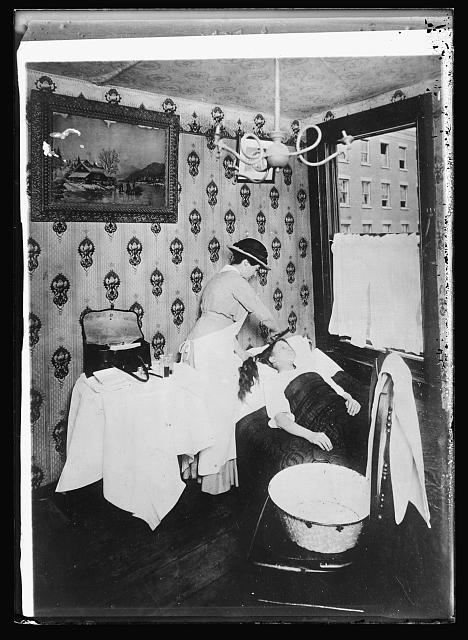
Image context: the cover image is a Library of Congress photograph of a Henry Street district nurse finishing care in a patient's home. It belongs here because the article's central claim is spatial. Wald's innovation was not simply compassionate bedside manner. It was the decision to put skilled care inside the domestic interiors where poverty, crowding, contagion, and recovery were already unfolding.[6]
The bedside call became a neighborhood address
The usual way to narrate Wald is to say that she founded Henry Street Settlement. That is correct, but the stronger description is that she changed the address of medicine. Hospitals still mattered, and Wald had hospital training, yet the Lower East Side exposed the distance between formal medical institutions and ordinary urban illness.[1][4] A feverish child, an infected eye, a postpartum crisis, or a case of pneumonia could not wait for clean transport, spare wages, and a day free from work. If care depended on the patient's reaching an institution, then the poor would arrive late or not at all. Wald answered that problem by moving the institution toward the patient.
Henry Street therefore developed as more than a single nursing outpost. Henry Street Settlement notes that by 1913 the organization had expanded to seven buildings and two satellite centers, with 92 nurses making 200,000 visits per year while classes and clubs served 3,000 members.[3] Those figures matter because they show scale, repetition, and density. A nurse was no longer a rare visitor dropping in from outside the district. Nursing had become part of the neighborhood's everyday circulation.
The system was flexible because it treated health as something embedded in living conditions. Wald's own memoir moves quickly from dressings and fevers to airshafts, overcrowding, food, child labor, recreation, and schooling.[1] That sequence was not mission drift. It reflected a hard lesson of urban medicine: a child sent back to a dark room with untreated trachoma, poor nutrition, and no adult available for follow-up was not really "treated" at all. Care had to travel with explanation, inspection, persuasion, and return visits.
Karen Buhler-Wilkerson's history in the American Journal of Public Health gives the larger frame. She argues that Wald's legacy rested on three experiments: inventing public health nursing in 1893, building payment mechanisms for home-based care, and helping create a national public-health nursing service.[2] Even at that abstract level, the pattern is consistent. Wald kept trying to solve the same problem at a larger scale: how to make skilled care reach people before they had already been sorted out by money, distance, or institutional friction.
The school nurse changed the direction of inspection
The clearest microhistory of Wald's method came through the schools. Wald's memoir describes the prehistory bluntly. In 1897, New York put 150 doctors into the schools to inspect children for contagious disease, and the effect was largely exclusion.[1] Children with suspicious symptoms were sent out of class. Many received little treatment. On the Lower East Side, Wald could see the absurdity: children were barred from school to protect classmates, then returned to crowded homes and streets where no one made sure the condition was actually managed.[1]
Her response was typical of Henry Street. She did not reject inspection; she changed its direction. Instead of treating the school as a sorting gate, she pushed for a nurse who could connect classroom, clinic advice, and home follow-up. The New York State Association of School Nurses summarizes the 1902 experiment clearly. Wald assigned Lina Rogers, a Henry Street nurse, to 4 New York City schools serving 10,000 children. After one month, absenteeism had fallen 50%. By the end of the 1902 school year, 27 school nurses were working in the city system.[5]
What changed was not merely staffing. The purpose of the intervention shifted from exclusion to continuity. Wald wrote that the addition of the nurse made it possible to reverse medical inspection "from excluding the children from school to keeping the children in the classroom and under treatment."[1] That sentence captures her whole public-health imagination. A system is good when it reduces friction between illness, treatment, and ordinary life. It is weak when it notices disease but leaves the patient stranded.
This is why Wald matters in the history of population health. She did not divide the child into separate compartments called medicine, education, and welfare. The school nurse model assumed that untreated minor infections could become lost school time, parental lost wages, educational delay, and later civic exclusion.[1][5] A dab of eye medication, a home visit, a translated instruction, or a reminder about cleanliness could therefore be educational policy as much as medical care. Henry Street made those categories porous on purpose.
Henry Street treated social conditions as clinical conditions
Wald's career kept widening the boundary of what counted as health work. Henry Street's own history page is striking on this point. It credits her not only with public health nursing and school nursing, but with helping found the National Organization for Public Health Nursing, Columbia's School of Nursing, and a long list of reform bodies beyond medicine narrowly defined.[3] The National Park Service page on the Lillian Wald House makes the same argument from a different angle: Henry Street was residence, workplace, social laboratory, and political node at once.[4]
That broader reach can seem diffuse until one remembers the district she served. On the Lower East Side, disease was braided into rent, sanitation, dangerous work, hunger, and the administrative weakness of city services. A nurse who entered homes every day could see patterns that hospitals saw only in fragments. Wald learned from those patterns and built outward. Public-school lunch, playgrounds, housing reform, labor protections, and the Children’s Bureau all made sense to her because each of them changed the conditions under which illness was produced and managed.[1][3][4]
The NAACP detail is revealing. The NPS notes that Wald became one of its co-founders in 1909 alongside W.E.B. Du Bois and Jane Addams.[4] That fact should not be treated as a decorative add-on to a nursing biography. It fits the same logic as the neighborhood visits. If public health means protecting life chances before crisis hardens into catastrophe, then civil rights, labor rights, and anti-segregation work belong inside the same moral field. Wald's politics were expansive because her clinical vantage point was expansive.
Why the scale proves the idea
The strongest evidence that Wald built a system rather than a noble anecdote is what Henry Street looked like by the time she retired. The NPS states that when Wald stepped down in 1933, the settlement had employed more than 260 nurses and served over 100,000 patients.[4] Those numbers do not describe a sentimental side project. They describe a durable urban health infrastructure.
Seen from that endpoint, the famous 1893 tenement visit becomes less a conversion story than a design brief. Wald recognized that the poor were not failing to use medicine because they were irrational or indifferent. The city had organized medicine in ways that made access late, expensive, discontinuous, and culturally distant. Henry Street answered with residence, repetition, translation, follow-up, and public financing pressure.[1][2][3] It made care move along existing neighborhood paths.
That is why Wald still reads as modern. Contemporary health systems speak about "meeting patients where they are," yet Wald built a version of that principle in brick, leather nursing bags, school corridors, and municipal budgets more than a century ago.[2][4] She understood that public health was strongest when it reduced the number of steps between vulnerability and competent help.
Her biography therefore resists the safest commemorative language. She was compassionate, but compassion was not the main invention. The invention was logistical and civic. Wald turned the block into a health interface. She made home visits count as real medicine, made schools part of treatment continuity, and made neighborhood conditions visible as causes rather than background scenery.[1][3][5] Public health in her hands ceased to be a hospital's afterthought. It became a route through ordinary city life.
Sources
- Lillian D. Wald, The House on Henry Street (Project Gutenberg ebook of the 1915 memoir) - primary-source account of the 1893 tenement visit, the move into the neighborhood, and Wald's account of school nursing reversing exclusion into treatment continuity.
- Karen Buhler-Wilkerson, "Bringing care to the people: Lillian Wald's legacy to public health nursing" (American Journal of Public Health, 1993) - peer-reviewed historical overview framing Wald's three major experiments in public health nursing, payment, and national service.
- Henry Street Settlement, "Lillian Wald" - institutional history covering the 1893 founding, 1913 scale of Henry Street, school nursing, and Wald's reform network.
- U.S. National Park Service, "Lillian Wald House" - public-history summary of Wald's residence and workplace, including the 1893-1933 timeline, service scale at retirement, and wider reform activity.
- New York State Association of School Nurses, "History" - concise official summary of the 1902 Lina Rogers school-nursing experiment, the 10,000-student scope, 50% absenteeism reduction, and rapid municipal expansion.
- Library of Congress, "District Nurse from Henry St. Settlement finishing caring for her patient" - source page for the archival photograph used as the article image.