Oral rehydration therapy is often remembered as a humble recipe that somehow turned miraculous: salt, glucose, water, stir, save a child. That memory catches the simplicity and misses the design. ORT did not become revolutionary because clinicians finally found a drink that stopped diarrhoea. It became revolutionary because they learned to aim at the lethal part of diarrhoeal disease first. The danger was dehydration, and the intestine in cholera was still capable of absorbing sodium and water if the solution arriving in the lumen was built the right way.[1][2]
That sounds small until the delivery consequences become visible. Once the target shifts from stopping stool output to preserving fluid balance, the whole geography of treatment changes. A therapy no longer has to wait for an IV line, a doctor, a hospital bed, or a well-stocked ward. It can move into cups, packets, family hands, and refugee camps. That is why ORT belongs in public-health history as much as in physiology. Its power was chemical, but its scale came from logistics.[2][3][4]
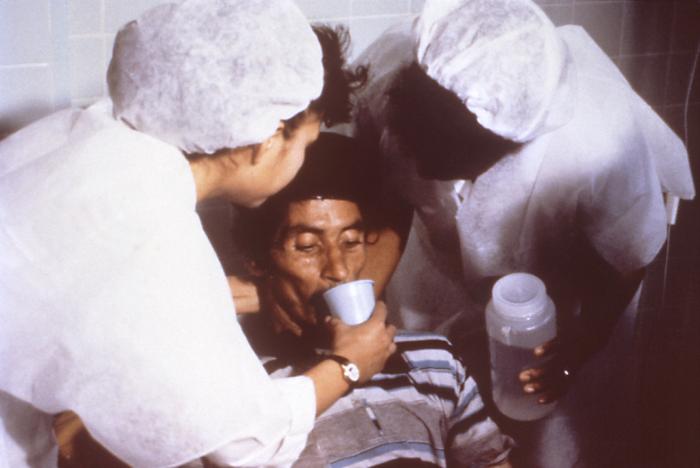
Image context: the cover uses a real CDC archival photograph from 1992 showing a cholera patient drinking oral rehydration solution with assistance from caretakers. That scene matters because ORT's decisive act is visible and repeatable. Survival turns on sustained drinking and replacement, not on a dramatic intervention hidden behind equipment.[7]
Timeline anchors before the larger shift
- 1960s: physiologic work on cholera clarified that glucose-coupled sodium absorption remained usable even while the gut was secreting large volumes of fluid.[1][2]
- 17 August 1968: a Lancet report described successful oral maintenance therapy for adults hospitalized in shock from cholera gravis, proving that oral replacement could work even in severe disease when done correctly.[1][2]
- 1971-1973: the Bangladesh refugee crisis forced the method beyond the specialist ward; Mahalanabis and colleagues documented oral fluid therapy among refugees, showing that the treatment could function under field scarcity as well as in hospital research settings.[3]
- 1979: ORT became the cornerstone of global diarrhoeal-disease control programmes, not the only intervention but the one that changed case management most directly.[6]
- Since 2003: WHO and UNICEF have recommended a reduced-osmolarity ORS formulation with better effectiveness than the older formula.[4][5]
Those dates matter because they show that ORT was not a single flash of discovery. It was a chain: physiology, bedside proof, field improvisation, packet standardization, and then decades of uneven implementation.
1. The decisive move was to stop arguing with the stool
Before ORT, severe cholera still pulled treatment thinking toward the wrong contest. Clinicians understandably focused on the spectacle of fluid loss: the violent stool output, the vomiting, the speed of collapse. A treatment culture built around that spectacle can drift toward trying to suppress symptoms first or toward assuming that only intravenous rescue counts as real therapy. The ORT literature marks a different turn.[1][2]
The central insight was that secretory diarrhoea does not shut down every absorptive pathway. As the historical reviews summarize, research groups in Dhaka and Calcutta showed that sodium and glucose cotransport remained intact in cholera patients.[1][2] In practical terms, this meant that a properly formulated glucose-electrolyte solution could still pull sodium inward, and water would follow. ORT therefore did not need to stop cholera toxin from driving secretion. It only needed to exploit the transport mechanism the disease had failed to destroy.[1][2]
That distinction is the heart of the story. ORT is not a cure for diarrhoea in the ordinary dramatic sense. It does not make the stool disappear on command. It buys survival by keeping net balance from tipping irreversibly toward shock. Once that is understood, the therapy's simplicity becomes less quaint and more exact. The cup is working on a transporter, not on a folk belief.[1][2]
2. Chemistry mattered, but volume discipline made the chemistry usable
The 1968 cholera work mattered because it proved oral therapy in the zone where many clinicians would have assumed it belonged least: among adults hospitalized in shock from severe cholera.[1] JAMA's fiftieth-anniversary perspective describes that report as the moment oral rehydration solution was shown to promote positive water and electrolyte balance even during severe diarrhoea, drawing on years of basic research on glucose-mediated sodium transport.[1]
The older historical review adds the operational implication: clinical studies in Dhaka and Calcutta showed that nearly 80% of intravenous fluid could be saved when patients were hydrated by the oral route.[2] That line is easy to flatten into a cost-saving slogan. Its deeper meaning is about method. ORT only works when the replacement logic is disciplined. Patients have to keep drinking. Caregivers have to keep matching losses. Clinicians have to recognize when the oral route is enough, when it is not, and when IV fluid is still needed as backup.[2][5]
This is why ORT should not be romanticized as a magic powder that made hospitals obsolete. WHO still states the boundary clearly: ORS, particularly the low-osmolarity formula, is a proven lifesaving commodity for childhood diarrhoea, but severe dehydration or shock may still require intravenous fluids.[4][5] The revolution was not that ORT replaced every other therapy. The revolution was that it displaced the old assumption that effective rehydration must begin and remain inside intravenous medicine.
3. The refugee camp made ORT a public-health method
The hospital proof was necessary, but it was not enough. A therapy can succeed in a research ward and still fail to change population outcomes if it depends on scarce staff, scarce tubing, or fragile hospital access. The Bangladesh refugee crisis supplied the harder test. In that emergency, Mahalanabis and colleagues used oral fluid therapy for cholera among refugees under conditions where intravenous therapy could not possibly scale cleanly.[3]
That episode matters because it changed what counted as feasible medicine. In a camp setting, the relevant question is not whether a therapy is elegant under ideal supervision. The question is whether it can survive crowding, shortage, rapid triage, uneven training, and family participation. ORT could. The treatment did not ask the field to become a modern intensive-care ward. It asked for something simpler and more reproducible: a correct solution, repeated administration, and a care process centered on replacing losses before collapse outran the supply chain.[3]
This is the point where ORT stopped being merely a physiologic success and became an administrative one. Once the therapy moved into camps and homes, its unit of action was no longer a bottle hanging above a bed. It was an instruction set. Mix. Give. Continue. Watch for severe dehydration. Escalate when needed. Public health rarely gets a tool that is simultaneously that teachable and that consequential.[3][6]
4. Standardization made the cup portable
The next step in ORT's history was not more drama but more standardization. WHO's ORS production guidance states the governing principle plainly: dehydration from diarrhoea can be prevented by extra fluids at home or treated simply, effectively, and cheaply in all age groups and in all but the most severe cases by giving an adequate glucose-electrolyte solution by mouth.[4] That is a manufacturing statement, but it is also a design statement. Packetization makes the therapy portable, teachable, and inspectable.
WHO and UNICEF's later shift to a reduced-osmolarity formula sharpened that portability rather than abandoning the original logic. Since 2003, they have recommended the newer ORS formulation because of improved effectiveness over the old one.[4] The WHO diarrhoea topic page still frames ORS, particularly the low-osmolarity formula, as a proven lifesaving commodity and pairs it with zinc and continued feeding inside a broader diarrhoea-control package.[5]
The article's strongest lesson sits here. ORT became durable not because medicine discovered that one perfect mixture solves every diarrhoeal problem. It became durable because one sufficiently robust formulation could be used across wide settings without forcing each caregiver or clinic to rebuild the chemistry from scratch. The packet turned physiology into infrastructure.
5. The unfinished story is implementation, not invention
The invention story is clean enough to tell in one paragraph. The implementation story is not. The Bulletin of the World Health Organization noted that in 1980, diarrhoea accounted for 4.6 million child deaths annually and that ORT rapidly became the cornerstone of diarrhoeal-disease control programmes after its introduction in 1979.[6] The same paper is careful on causality: mortality fell through multiple interventions, implemented with varying strength across countries.[6]
That caution is worth keeping. ORT should not be turned into a solitary hero that somehow ended diarrhoeal mortality on its own. Water, sanitation, nutrition, breastfeeding, vaccination, zinc, and health-system reach all matter.[5][6] But caution does not shrink the achievement. It clarifies it. ORT's singular contribution was to give families and front-line workers a way to act on the deadliest mechanism early, cheaply, and repeatedly.[4][5][6]
This is why the therapy still reads as modern. Even now, the hard problem is rarely whether the underlying physiology is true. The hard problem is whether the right packet, instructions, trust, and escalation pathway reach the child before dehydration deepens. ORT worked because it treated dehydration first, used the gut that remained available, and then reorganized treatment around what ordinary people could keep doing. The stool still mattered. It just stopped being the first target.
Sources
- Glass RI, Stoll BJ. "Oral Rehydration Therapy for Diarrheal Diseases: A 50-Year Perspective" (JAMA, 2018) - overview of the 1968 severe-cholera milestone and the glucose-mediated sodium-transport logic behind ORT.
- Bhattacharya SK. "History of development of oral rehydration therapy" (Indian Journal of Public Health, 1990) - historical review explaining intact sodium-glucose cotransport in cholera and the finding that oral therapy could save most IV fluid.
- Mahalanabis D et al. "Oral fluid therapy of cholera among Bangladesh refugees" (Johns Hopkins Medical Journal, 1973) - field report documenting how ORT functioned during the Bangladesh refugee crisis outside the specialist hospital setting.
- World Health Organization, Oral Rehydration Salts: Production of the New ORS (2006) - WHO guidance stating that diarrhoeal dehydration can often be treated effectively by mouth and noting the post-2003 recommendation for the improved formulation.
- World Health Organization, "Diarrhoea" - current WHO topic page describing ORS, especially the low-osmolarity formula, as a proven lifesaving commodity and marking the IV boundary in severe dehydration or shock.
- Victora CG, Bryce J, Fontaine O, Monasch R. "Reducing deaths from diarrhoea through oral rehydration therapy" (Bulletin of the World Health Organization, 2000) - review of ORT's role in diarrhoeal-disease control and the broader mortality decline context.
- Wikimedia Commons, "File: Cholera rehydration nurses.jpg" - source page for the 1992 CDC photograph of a cholera patient drinking oral rehydration solution used as the article image.