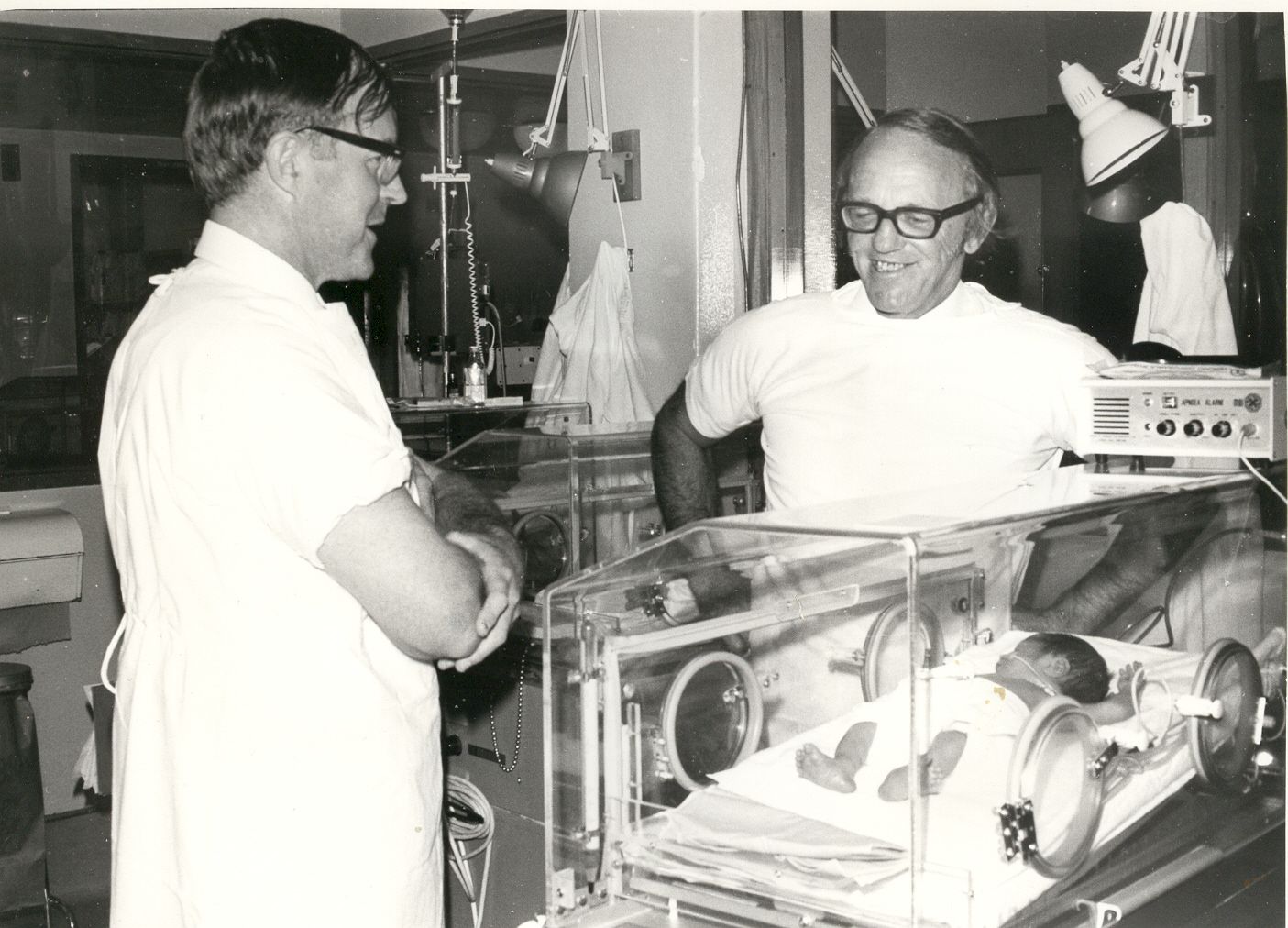
The baby had not yet taken a breath. That was the opportunity Graham Liggins and Ross Howie wanted to use: could a steroid given during pregnancy help immature lungs cope when birth came too soon? Their Auckland trial moved a question about newborn breathing into the hours before delivery.[1]
The clue had arrived from another question entirely. In a retrospective written in February 1982, Liggins recalled studying what triggered birth in sheep. In 1967, some lambs delivered very prematurely after experimental hormone infusions could breathe effectively. Their lungs retained air when he had expected the dense appearance of immaturity. He passed the observation to specialists in lung physiology; confirmation encouraged a human trial. The first woman enrolled in December 1969.[1]
This origin matters because an observation in an animal is an invitation to test a possibility. It cannot establish the balance of benefit and harm for a pregnant woman and her child. The clinical experiment had to supply that missing comparison.
Read the treatment before the result
The October 1972 report of betamethasone treatment analyzed 282 mothers whose delivery before 37 weeks was threatened or planned. A pharmacist randomized coded vials and held the identification key. The comparison preparation contained low-potency cortisone; it was not simply an empty injection. A second injection followed 24 hours later if birth had not occurred.[2]
Respiratory distress syndrome required both clinical signs and characteristic chest X-ray findings. Among liveborn infants after unplanned premature labor, it occurred in 11 of 122 treated babies (9.0%), against 25 of 97 controls (25.8%). These are infant denominators from one part of the trial, not outcomes for all 282 mothers.[2]
The authors located the clear respiratory benefit in babies born before 32 weeks whose treatment had begun at least 24 hours before delivery. Yet the interval until birth was not itself randomly assigned. The study randomized treatment, not the moment labor would end. Its timing pattern therefore cannot establish a precise hour at which benefit switches on.[2]
The report ended by calling for further trials before routine adoption. Its caution belongs beside its striking result.[2]
The clock is not a switch
A useful distinction emerges here: evidence that preparation takes time is different from evidence that shorter preparation is worthless. The first can be true while the second remains unproved. Reading a subgroup result as a universal rule loses that distinction.
The authors explaining WHO’s 2022 recommendations explicitly preserved it. They described benefit with an interval of one to seven days between treatment and birth, while allowing that benefit may begin within the first 24 hours and persist beyond seven days. They also acknowledged uncertainty about the best interval.[4]
Timing is only one condition. WHO’s framework requires accurate assessment of gestational age, a high likelihood of preterm birth, no clinical evidence of maternal infection, and adequate care during childbirth and afterward. Its supporting discussion distinguishes the strong evidence before 34 weeks from a different balance of benefits and harms later in pregnancy.[4]
That last requirement expands the meaning of preparation. The accompanying care includes keeping the baby warm, supporting feeding, treating infection and providing respiratory support when needed. The drug sits inside a maternity and newborn service. Knowing that it can help does not eliminate the need to identify the right patient or to care for the child after delivery.[4]
A few prenatal hours, followed for decades
Preparing a fetus for early birth also raises a longer question: could an immediate advantage carry a delayed cost? A newborn result cannot answer that. The original allocation becomes especially valuable when investigators return to the participants later, provided they can still find enough of them.
A 2024 PLOS Medicine report followed adult offspring from the larger Auckland trial, which had continued beyond the first publication. Researchers assessed 424 people, 46% of surviving offspring, at a mean age of 49.3 years. They combined questionnaires with administrative health records to examine cardiovascular outcomes after antenatal betamethasone or control exposure.[5]
The adjusted relative risk for having a cardiovascular risk factor was 1.02, with a 95% confidence interval of 0.89–1.18. The study found no evidence of increased cardiovascular risk from treatment. However, fewer than half of survivors participated, there were no in-person examinations, and major cardiovascular events were uncommon. Those limits matter when interpreting reassurance: the study cannot exclude every possible difference or every kind of later harm.[5]
Following people into middle age gives a brief intervention a much longer observation period. It also changes the reader’s question. Instead of asking only whether a newborn breathed more easily, we can ask what became of the person who grew up.
Liggins and Howie’s achievement becomes more substantial when its boundaries remain visible. An unexpected observation became a controlled comparison; a promising comparison became something later evidence could refine. The enduring idea is that the first breath can be helped before it happens. The continuing obligation is to establish when that help works, under what conditions, and with what consequences afterward.
Sources
- G. C. Liggins, “This Week’s Citation Classic,” written February 4, 1982 and published March 29, 1982 — first-person account of the animal observation and the trial’s beginnings; University of Pennsylvania archive.
- G. C. Liggins and R. N. Howie, “A Controlled Trial of Antepartum Glucocorticoid Treatment for Prevention of the Respiratory Distress Syndrome in Premature Infants,” Pediatrics 50 (October 1972), 515–525 — original paper, especially methods and Tables V and VIII; full-text teaching copy.
- University of Auckland, “The Liggins legacy” — institutional timeline and archival photograph identifying Howie and Liggins at National Women’s Hospital in 1972.
- Joshua P. Vogel et al., “Updated WHO recommendations on antenatal corticosteroids and tocolytic therapy for improving preterm birth outcomes,” The Lancet Global Health (November 16, 2022) — timing uncertainty, gestational-age boundaries and care prerequisites.
- Anthony G. B. Walters et al., “Cardiovascular outcomes 50 years after antenatal exposure to betamethasone: Follow-up of a randomised double-blind, placebo-controlled trial,” PLOS Medicine (April 1, 2024) — adult outcomes and follow-up limitations.