The modern ECG feels almost too ordinary to notice. Adhesive stickers go on, a few seconds pass, and a page of peaks appears. That apparent simplicity hides the historical hinge. The important event was not merely the discovery that the beating heart generates electricity. By the late nineteenth century, that much was already known. The harder problem was turning weak surface currents into a stable written trace that physicians could compare across patients, across time, and across disease states.[1][2][3][4]
That is why an event reconstruction works better here than a loose inventor legend. Willem Einthoven's achievement arrived in steps. He first corrected the distortions of the old capillary electrometer in 1894 and 1895. He then built the string galvanometer in 1903 to record the signal directly. By 1906, he had shown that characteristic heart diseases altered the trace in recognizable ways and even proposed telecardiograms from hospital beds several kilometers away.[1][2] The ECG became durable medicine when the heartbeat stopped being a vague pulse event and became a reproducible paper object.
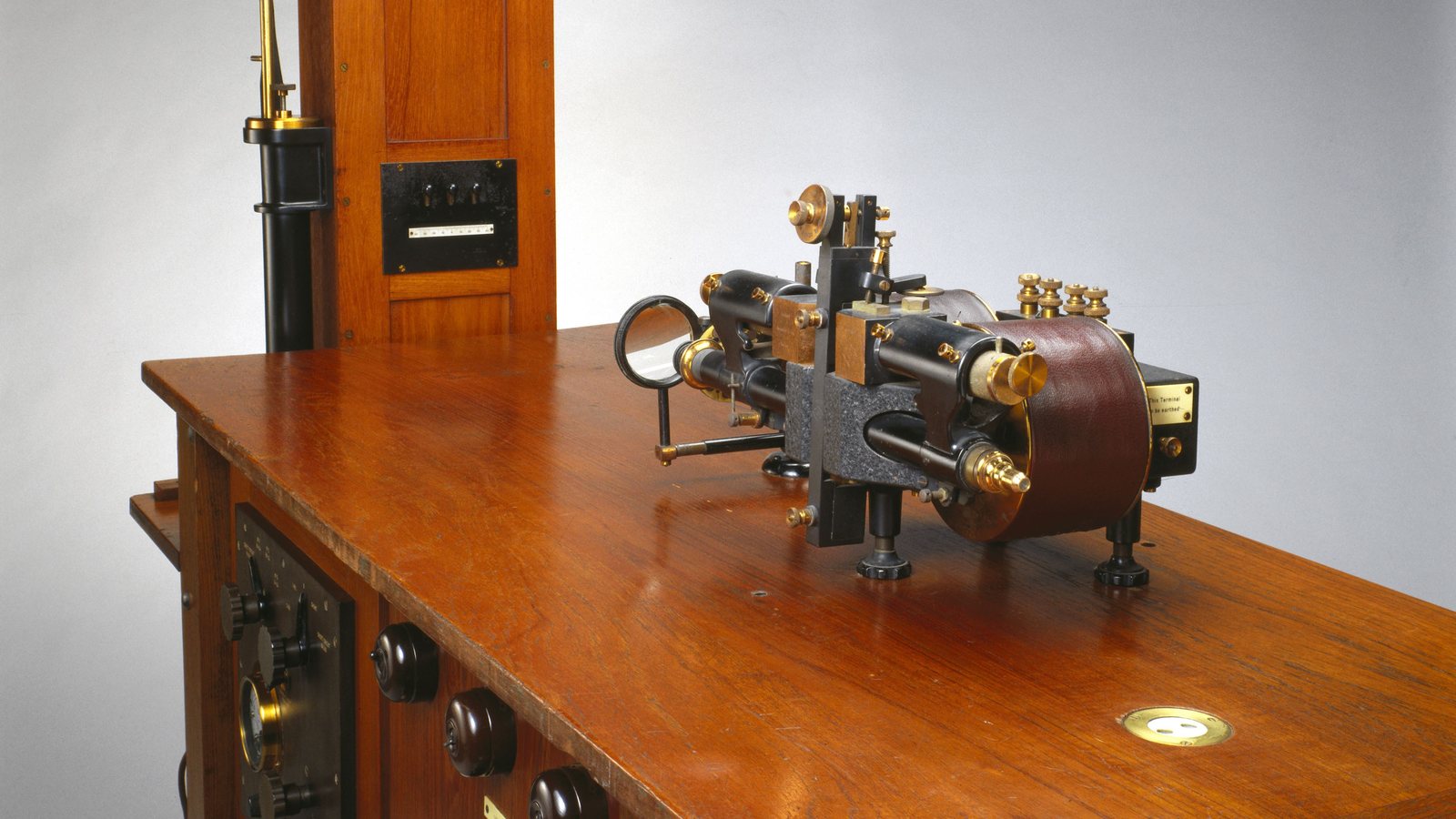
Image context: the cover uses a real museum photograph of Thomas Lewis's electrocardiograph apparatus from Cambridge, England, via Wikimedia Commons and Wellcome.[5] The apparatus looks more like industrial furniture than bedside medicine. That scale is the point. Before the ECG became small, it had to become trustworthy.
Timeline anchors
- 1894: Einthoven developed a correction method for the capillary electrometer's distorted curve.[1]
- 1895: using that correction, he derived what the Nobel presentation speech later called the "real electrocardiogram" and fixed the letter sequence P, Q, R, S, T that still structures ECG reading.[1]
- 1901: according to the European Society of Cardiology's historical review, Einthoven captured the first human PQRST complex with a massive machine that required five operators, while the patient placed two hands and one foot in electrolyte buckets for a three-lead recording.[3]
- 1903: Einthoven constructed the string galvanometer, the instrument that made precise direct recording of tiny cardiac currents practical.[2]
- 1906: in Le télécardiogramme, he showed disease-specific ECG patterns and proposed remote hospital-to-laboratory recording.[1]
- 1913: he demonstrated how simultaneous information from three leads could be used to calculate the direction and magnitude of the heart's electrical activity.[1]
- 1924: the Nobel Prize in Physiology or Medicine recognized him "for his discovery of the mechanism of the electrocardiogram."[2]
Before the stable trace, cardiac electricity was real but clinically slippery
The central difficulty before Einthoven was not imagination. It was instrumentation. The Nobel ceremony speech preserves the problem in unusually clear language. Earlier investigators could register potential changes with the Lippmann capillary electrometer, but the instrument adjusted too slowly, so its curve did not directly reflect the actual timing of electrical changes in the heart muscle during a beat.[1]
Einthoven's first move was therefore mathematical and interpretive before it was mechanical. In 1894, he built a correction method for the capillary electrometer, and by 1895 he could derive the actual electrocardiogram from that distorted curve.[1] This is also where the familiar alphabet settled in. The letters P, Q, R, S, T were not decoration. They were a way of making repeating electrical events legible enough to compare from one tracing to another.[1]
Yet this early route was too laborious for ordinary clinical work. The Nobel speech is blunt on that point: the corrected electrometer method would never have practical significance in reproducing the human electrocardiogram at scale because it was simply too cumbersome.[1] The event reconstruction therefore changes direction here. If the ECG was going to become medicine rather than a difficult physiological curiosity, the signal had to be recorded directly.
The string galvanometer solved the recording problem by brute precision
That is where the machine enters. The Nobel facts page states the core claim simply: one key to ECG progress was the string galvanometer, constructed by Einthoven in 1903, which could precisely measure tiny currents.[2] The 1924 presentation speech explains why it mattered. Einthoven replaced the moving parts of older galvanometers with a fine silver-plated quartz wire stretched in a magnetic field, reducing mass enough to gain both high sensitivity and rapid response.[1]
In practical terms, that meant the heart's electrical fluctuations could be written directly rather than reconstructed after the fact. The ESC history article restores the physical absurdity of the early setup. Around 1901, the machine weighed about 600 pounds, needed five operators, and required the patient to place both hands and one foot in buckets of electrolyte solution for a three-lead ECG.[3] This was not yet a convenient bedside test. It was a laboratory infrastructure.
But the scale of the apparatus should not obscure the achievement. The point of the string galvanometer was not elegance. It was trust. Once the recording became fast and sensitive enough, the ECG stopped being a suspicious artifact of sluggish instrumentation and started to look like a faithful time-series of the heartbeat itself.[1][2][3]
1906 is when the ECG truly crossed into clinical medicine
The decisive historical turn came when the stable trace began sorting disease. The Nobel ceremony speech treats 1906 as the critical year. In Le télécardiogramme, Einthoven showed that different forms of heart disease revealed themselves characteristically in the electrocardiogram.[1] The speech lists concrete examples: ventricular hypertrophy, auricular enlargement, degeneration of heart muscle, various degrees of heart block, extrasystoles, and irregular rhythms later described with more specialized names.[1]
That shift is the real heart of the event. Before this point, the ECG could still have remained a technical triumph in search of a clinical purpose. After 1906, it had a sorting function. It could distinguish not just that a heart was electrically active, but that different cardiac disorders bent the trace in different ways.[1]
Einthoven also proposed telecardiograms in the same period: recording a patient's signal in a hospital several kilometers away on a galvanometer housed in a physiological laboratory.[1] Today that sounds quaint because every hospital can make an ECG locally, and remote rhythm capture now happens on patches, watches, and phones. Historically, though, the proposal matters because it shows what Einthoven understood the ECG to be. He did not treat it as a one-off laboratory spectacle. He treated it as information that could move.
Standard leads turned one machine reading into a common language
A clinically useful test needs more than signal capture. It also needs comparability. The Nobel speech notes that every individual has a characteristic electrocardiogram, but that these traces also conform to a general type.[1] That sentence captures the balance the ECG had to achieve: personal enough to reflect pathology, standardized enough to support interpretation.
The later step in 1913 sharpened that common language. Einthoven showed how simultaneous deflections at three leads could be used to calculate the direction and amount of the resulting electrical activity.[1] The speech frames this as a refinement of earlier visual reading. In effect, standard leads gave the clinician a geometry of the heartbeat rather than a single mysterious line.[1]
The result was that the ECG could travel beyond the room where Einthoven stood. Once the trace had named waves, timed intervals, and standard lead relationships, later clinicians could compare blocks, ectopic beats, chamber strain, and rhythm disturbances without rebuilding the whole instrument logic every time.[1][3]
Why this event still matters in 2026
The Nobel educational page calls the ECG a relatively simple way of diagnosing heart conditions used worldwide today.[4] That simplicity is earned rather than natural. It rests on the early twentieth-century conversion of faint body-surface current into a stable, repeatable, comparable trace.[1][2][4]
The strongest way to remember the ECG is therefore narrower than "electricity was discovered in the heart" and stronger than "Einthoven invented a machine." What changed was the evidentiary form of the heartbeat. The pulse had long been felt. Cardiac motion had long been inferred. The ECG made cardiac timing and conduction writable in a way that held still long enough for medicine to argue over it, classify it, teach it, and eventually miniaturize it.[1][2][3][4]
That is why the event still reads clearly in 2026. Our devices are smaller, faster, and digital. The underlying medical victory is still the one Einthoven forced into existence: a heartbeat trace stable enough to become a shared clinical language.
Sources
- Nobel Prize Outreach, "Physiology or Medicine 1924 - Presentation Speech" - Nobel ceremony speech describing Einthoven's 1894 correction method, 1895 derivation of the real electrocardiogram, the 1903 string galvanometer, the 1906 disease-pattern turn, telecardiograms, and the later three-lead refinement.
- Nobel Prize Outreach, "Willem Einthoven - Facts" - official Nobel biographical summary stating the 1924 prize motivation and the central role of the 1903 string galvanometer in making ECGs clinically useful.
- Petra M. J. C. Kuijpers, "History in medicine: the road to clinical electrophysiology" (European Society of Cardiology) - historical review covering the 1901 human PQRST recording, the machine's scale, the electrolyte-bucket setup, and the later clinical reading of conduction disorders.
- Nobel Prize Outreach, "The electrocardiogram, ECG" - background explainer on how ECG records the heart's electric waves and why Einthoven's early-twentieth-century work still defines the test's core function.
- Wikimedia Commons, "File:Thomas Lewis’ electrocardiograph, Cambridge, England Wellcome L0057898.jpg" - source page for a real-world photograph of an early Cambridge electrocardiograph apparatus associated with Thomas Lewis.