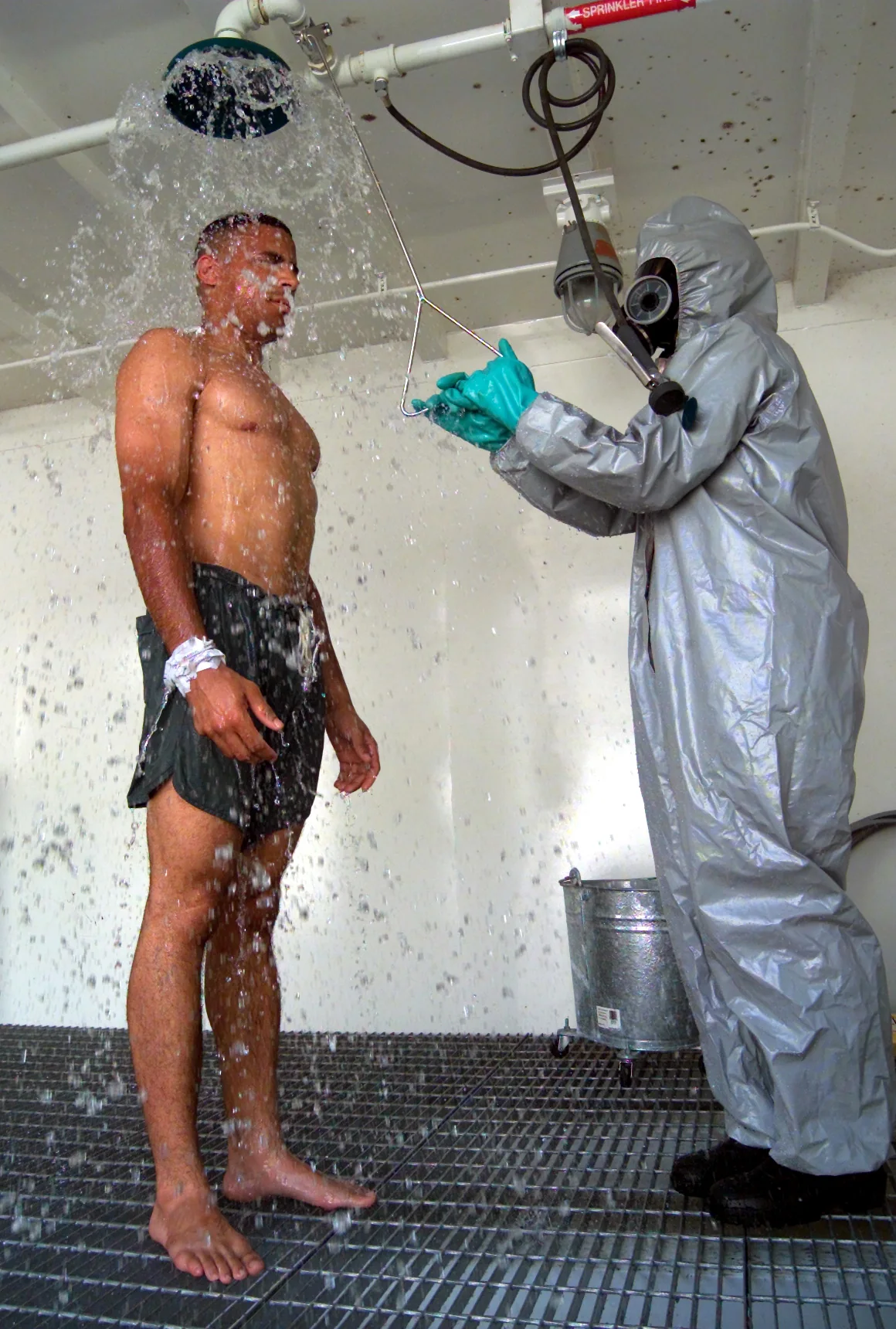


One chemical splash can begin in two very different rooms. At home, the nearest useful equipment may be a kitchen faucet and a plastic cup. In a laboratory, a plumbed eyewash and overhead shower should already stand within the work area. The water looks ordinary in both settings. The difference is how much of the response had to be designed before anyone was hurt.
The two short videos below hold those rooms side by side. Missouri Poison Center shows how to improvise an eye rinse and bring the product container into a call for expert advice.[1] The University of Southern California's Environmental Health and Safety office demonstrates the dedicated fixtures a laboratory worker is meant to find and activate without delay.[2] One clip begins with whatever is at hand; the other begins with architecture, maintenance, and training.
Neither video is a complete treatment protocol. Chemical injuries vary by substance, concentration, route, and body site. Inhalation, swallowing, extensive skin exposure, severe pain, breathing trouble, or impaired vision can require emergency care; in USC's laboratory protocol, the substance's safety data sheet goes to the attending physician.[3][10] What the clips can teach together is the first principle shared across those differences: reducing contact time comes before a perfect explanation of what the chemical has done.
Video 1: a cup turns the faucet into an eye rinse
Missouri Poison Center stages its demonstration in an ordinary room. A helper fills a cup with lukewarm water, holds it a short distance from the exposed eye, pours, and encourages blinking. The clip warns against forcing the eyelids open, then shifts to the next task: call the poison center with the product available so the specialist can ask what entered the eye.[1]
That small sequence is valuable because it lowers the equipment threshold. Someone does not need to locate sterile saline before starting. A 2021 review of workplace chemical eye-burn guidance found broad agreement on immediate, copious rinsing and concluded that ordinary tap water is a practical first-line fluid in places where it is clean and readily available. The authors found no compelling evidence for recommending a specialty solution in every case, especially when searching for it would add delay.[6]
The clip's brevity also creates a boundary worth making explicit. Its narrated demonstration uses a five-minute first rinse before the call.[1] National Capital Poison Center's written guidance is more conservative: begin immediately, remove contact lenses, use abundant room-temperature water, and irrigate for at least 15 to 20 minutes before pausing to seek further direction.[4] CDC's broader chemical-emergency page gives another scope-specific range—10 to 15 minutes for eyes that burn or cannot see normally.[3] Five minutes should therefore be read as the beginning of the response shown in the video, not as a universal finish line.
Why do reputable instructions use different clocks? They are addressing different situations. A poison specialist who knows the exact household product can refine advice. A clinician treating a true corrosive injury may continue irrigation as part of care aimed at restoring physiologic pH, then assess damage that a home timer cannot measure.[6] A public-emergency page has to give one usable script before the chemical is known. Duration is a floor for action, not a remote diagnosis of severity.
The video's best detail is the product container waiting beside the phone. Identification matters, but it does not have to precede water. The two tasks can overlap: keep the rinse going while another person finds the label and calls. In the United States, Poison Help is reached at 1-800-222-1222; elsewhere, the equivalent is the local poison-information or emergency service.[3][4] Severe symptoms should not wait for a routine callback. National Capital Poison Center advises urgent eye assessment after irrigation when pain, visual problems, redness, swelling, or tearing persist, and immediate emergency evaluation when symptoms are severe.[4]
Video 2: the laboratory has already made choices for the injured worker
USC's April 2023 video moves the same exposure clock into a research laboratory. Its subject is not a bottle of medication or a clever neutralizer. It is the route to an eyewash, the control that starts the flow, and the safety shower available when contamination extends beyond the eyes.[2] The fixtures are deliberately conspicuous because a person in pain, with vision compromised and hands occupied, should not have to assemble a solution.
That expectation is older than the clip. In a February 2007 interpretation of 29 CFR 1910.151(c), the Occupational Safety and Health Administration restated that workplaces where eyes or bodies may meet injurious corrosives must provide suitable quick-drenching or flushing facilities within the work area for immediate emergency use. OSHA separated their purpose from personal protective equipment: PPE is meant to prevent exposure; the eyewash or shower is there to limit injury after that defense fails.[5]
Watch this clip as a room-design lesson as much as an operating lesson. A useful station is visible, reachable, and ready to stay on while the exposed person uses both hands to hold the eyes in the stream or remove contaminated clothing. A shower blocked by a cart, an eyewash reached through a locked door, or a fixture nobody has practiced activating meets the eye only as an object, not as emergency capacity. In February 2025, USC turned that distinction into a staff challenge: close your eyes and describe the route from your work position to the nearest eyewash or shower.[7]
The shower also exposes the part of decontamination that a face-only demonstration cannot show. Clothing can hold liquid or particles against the skin and carry contamination into another room. CDC's June 2026 public guidance says that removing clothes can eliminate an estimated 80% to 90% of chemical contamination. It advises getting clothes off and showering ideally within 10 minutes, cutting garments away rather than dragging them over the face when possible, bagging contaminated items, and washing from head to feet with lukewarm water and mild soap without scrubbing.[3]
Those instructions explain why disrobing is treatment rather than an afterthought. It shortens contact and reduces the chance that a helper, hallway, vehicle, or emergency department becomes the next exposure site. It also makes privacy, clean replacement clothing, warmth, drainage, and a protected helper part of preparedness. The 2002 training photograph above captures that larger apparatus: one person is under the water, but another person in protective gear is managing the station.[8]
Again, the generic script has limits. The CDC page is written for an unidentified chemical emergency, not every reagent-specific laboratory accident. It distinguishes splashes from inhalation and ingestion, and it directs people to poison specialists, emergency services, or a hospital after getting clean when symptoms remain or the chemical cannot be removed.[3] In a workplace, the local emergency plan and hazard-specific training govern that escalation; USC's activation guide tells responders to provide the attending physician with the substance's safety data sheet.[5][10] Rinsing starts care; it does not certify that the exposure is over.
Physical form matters, too. This article centers liquid splashes. Northern Ireland's public-services guidance for chemical burns says to remove affected clothing and brush a dry-form chemical off the skin before rinsing; it also warns against improvised neutralization because the reaction may generate more heat.[9] Product-specific advice from a poison specialist may change what happens next.[3][4] “Start the rinse” is useful shorthand for most liquid splashes covered by public first-aid guidance, not a claim that water is always correct. It is not permission to turn dry material into a slurry or overrule a documented response plan.
What the two rooms reveal
At the household sink, resilience means being able to start with common water and imperfect equipment. In the laboratory, safety means making improvisation less necessary. The first video teaches a low-tech physical act; the second shows the institutional promise that the act will be easier to perform under pressure. Put together, they shift chemical first aid from a memory test to an environment test.[1][2][5]
They also clarify the order of certainty. Water can move while the label is being found. Contaminated clothes can come off while someone calls for help. Expert assessment can become more specific without pretending that the first rinse was sufficient. The exposure clock does not pause for identification, but identification still matters for what happens next.[3][4][6]
That is the durable lesson across the cup, the plumbed station, and the field shower: prompt dilution and physical removal buy distance from the chemical. A well-prepared room buys something just as important—the chance to begin those actions without searching, unlocking, assembling, or guessing.
Sources
- Missouri Poison Center, “Eye Exposure First Aid — What To Do” (YouTube, published October 27, 2021) — the embedded household eye-rinsing demonstration and poison-center call prompt.
- USC Environmental Health and Safety, “How to Use the Emergency Eyewash and Safety Shower in a Laboratory at USC” (YouTube, published April 18, 2023) — the embedded laboratory-equipment demonstration.
- U.S. Centers for Disease Control and Prevention, “About Getting Clean” (updated June 10, 2026) — public guidance on rapid disrobing, washing, eye flushing, contaminated belongings, and escalation after a chemical emergency.
- National Capital Poison Center, “Splashed a poison in your eye?” — immediate irrigation technique, duration, contact-lens removal, and symptom-based follow-up.
- U.S. Occupational Safety and Health Administration, “Requirement to provide accessible quick drenching and flushing facilities where there is exposure to corrosive materials” (interpretation letter, February 27, 2007) — the workplace-access rule and the prevention-versus-injury-minimization boundary.
- Kevin Claassen, Dominique Rodil Dos Anjos, and Horst Christoph Broding, “Current status of emergency treatment of chemical eye burns in workplaces,” International Journal of Ophthalmology 14(2), 2021 — review of immediate irrigation and the evidence boundary around specialty rinsing solutions.
- USC Environmental Health and Safety, “Lab Safety Awareness Week” (February 10, 2025) — the eyes-closed route exercise and institutional preparation context for the embedded laboratory video.
- U.S. Marine Corps photograph by Sgt. J. A. Lee II, “Decontamination exercise” (July 9, 2002), via Wikimedia Commons — source page for the documentary training photograph.
- nidirect, “Burns and scalds” — Northern Ireland public guidance on clothing removal, dry-form chemical brush-off, rinsing, and the risk of improvised neutralization.
- USC Environmental Health and Safety, “Emergency Eyewash & Shower Activation” (GuideSheet, November 2022) — equipment activation, 15-minute flushing, contaminated-clothing removal, assistance, medical escalation, and transfer of the substance's safety data sheet.