The pandemic made mRNA look sudden. In public memory, the platform seemed to appear in 2020 fully formed, with clinical scale, global urgency, and a direct line to life-saving vaccines.[1][4][5] That is not how the history reads at close range. The harder story sits earlier, in a period when synthetic mRNA was less a triumph than a problem. Cells read it as danger. The molecule that was supposed to instruct protein production also triggered inflammatory alarms that made therapeutic use difficult.[3][4][5]
Katalin Karikó's place in that history is often told as a morality tale about persistence. Persistence mattered. It does not explain enough. The decisive part of her biography is more technical and therefore more interesting. She kept pushing mRNA because she believed the molecule could be turned into medicine, and the critical turn came when she and collaborators helped show that a specific nucleoside substitution, replacing uridine with pseudouridine, could sharply reduce the innate immune response to synthetic RNA while making the message more usable inside cells.[1][3][4][5] The platform did not become practical because the world finally learned to admire stubbornness. It became practical because the message stopped sounding, biologically, like pure alarm.
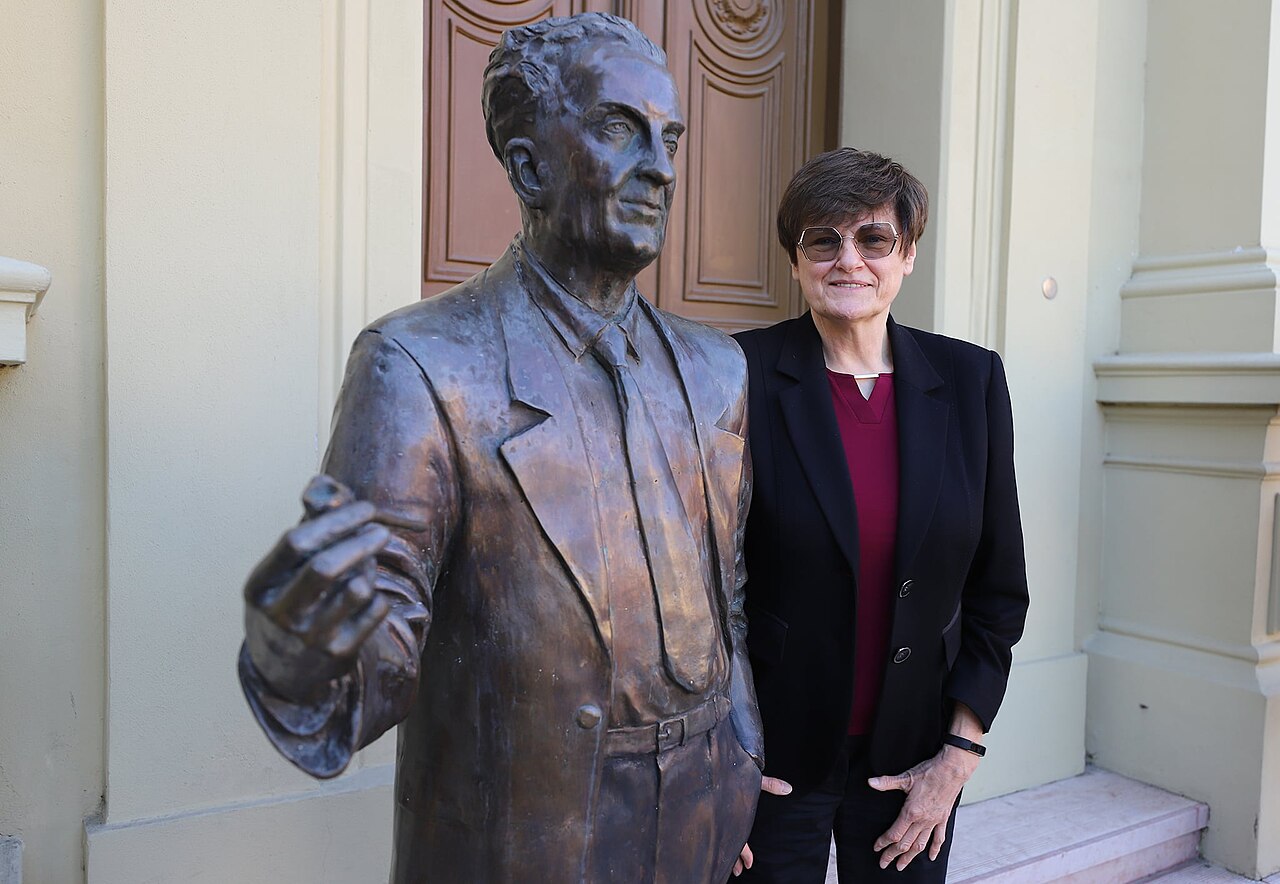
Image context: the cover uses a real 2021 photograph of Karikó at the University of Szeged. That choice matters because this is not an abstract article about "the rise of mRNA." It is a microhistory of one researcher's long argument with a molecule, and the photograph keeps that argument attached to a real person rather than to a retroactive victory myth.[6]
Timeline anchors before the breakthrough looks inevitable
- 1985: Karikó leaves Hungary for the United States to continue RNA research after support dries up at home.[2]
- 1989: she lands at the University of Pennsylvania in a non-tenured research role, still committed to mRNA as a therapeutic route even though the field is not rewarding that bet.[2]
- 2005: Karikó, Michael Buckstein, Houping Ni, and Drew Weissman publish the Immunity paper showing that modified nucleosides, including pseudouridine, can ablate RNA's activation of human Toll-like receptors and dendritic-cell inflammatory signaling.[3][4][5]
- 2008: later work shows pseudouridine-containing mRNA is not only less immunogenic, but also more highly translated in vitro and in mice.[5]
- 2020: effective COVID-19 mRNA vaccines make the platform visible at global scale.[1][4][5]
- 2023: the Nobel Prize in Physiology or Medicine goes to Karikó and Weissman for discoveries concerning nucleoside base modifications that enabled effective mRNA vaccines.[1]
That sequence matters because it keeps the article from collapsing into hindsight. The world-changing part of the story was not the pandemic sprint by itself. The platform had to survive a much less glamorous phase first, when the work was still mostly about getting RNA to stop provoking the wrong kind of reaction.
Before pseudouridine, mRNA carried too much immunologic noise
Karikó's biographical arc makes sense only if the technical problem is placed first. Rockefeller's account of her career is useful on this point. After arriving in Philadelphia, and later moving into a research position at Penn, she kept returning to the same ambition: use mRNA as a therapeutic tool rather than treat it as a merely transient laboratory molecule.[2] That goal kept running into a brutal practical limit. Synthetic mRNA could make cells behave as if they were under attack.
The Nobel committee's summary describes the turning point in plain language: the prize recognized discoveries about the importance of base modifications in mRNA for the development of effective vaccines.[1] That wording matters because it moves the story away from personality cult and toward mechanism. If unmodified RNA trips innate immune sensors too aggressively, then the problem is not only delivery or funding or public imagination. The message itself is being misread.
The 2005 Immunity paper gives the laboratory version of that problem. Karikó and colleagues showed that RNA signaled through human TLR3, TLR7, and TLR8, but that incorporation of modified nucleosides such as m5C, m6A, m5U, s2U, or pseudouridine ablated that activity.[3] In other words, the body was not reacting to synthetic RNA as a neutral courier. It was reacting to it as something suspicious. The result was not a gentle side effect. It was a foundational obstacle to using mRNA as therapy.
This is the point at which the microhistory gets sharper than the legend. Karikó's key contribution was not that she kept believing in mRNA in the abstract. It was that she stayed close enough to the molecule to help identify the exact feature that had to change if the platform was going to survive.
The breakthrough was small in chemistry and large in consequence
Pseudouridine is not a theatrical intervention. It does not sound like a manifesto. That is part of why the story took time to travel. The platform turned not on a cinematic reversal, but on a substitution inside the message. The 2021 Immunity review "From mRNA sensing to vaccines" describes the significance cleanly: in 2005, Karikó and collaborators showed that the inflammatory response to in vitro-transcribed mRNA could largely be preempted by modifying an mRNA nucleotide from uridine to pseudouridine.[4]
The paired review "Delivering the message" makes the practical consequence even clearer. It notes that uridine derivatives such as pseudouridine abolished the ability of mRNA to activate primary blood-derived dendritic cells, and that later work demonstrated something even more valuable: pseudouridine incorporation not only reduced immunogenicity but significantly increased translation of synthetic mRNAs both in vitro and in mice.[5] That is the hinge. The message became quieter and stronger at the same time.
This two-part effect is what turned a niche technical fix into platform medicine. A merely less inflammatory molecule would still be limited if it remained weak at making protein. A merely more expressive molecule would still be a problem if it kept setting off innate immune defenses. Karikó's work mattered because it helped shift both constraints at once.[1][3][4][5]
The contrast with the public version of her story is instructive. Popular retellings often linger on the years of neglect, the grant disappointments, the low institutional status. Those facts are real and worth remembering.[2] But they become analytically useful only when tied to the molecular issue. The field did not overlook a ready-made platform out of sheer blindness. The platform had a real biologic problem, and Karikó's achievement was to keep working until the problem became chemically tractable.
Recognition lag was part of the story, not an afterthought
Rockefeller's profile includes one detail that captures the strange tempo of the whole episode. After the 2005 breakthrough, it says, Karikó and Weissman waited for the conference invitations to come, and none did.[2] That detail lands because it prevents a false rhythm from taking over. Important biomedical work is often narrated as if decisive findings immediately produce institutional celebration. Here the finding arrived well before the public world knew what it was looking at.
That lag matters for health history because it tells us what kind of innovation this really was. Karikó was not polishing an already fashionable technology. She was helping make a dismissed one less biologically self-defeating. The payoff therefore depended on later advances too, especially delivery systems and vaccine development pipelines.[4][5] But without the nucleoside-modification turn, those later advances would have had a weaker foundation. The platform would still have been shouting at the immune system when it needed to deliver a controlled message.
This is why the Nobel framing is correct to emphasize "discoveries concerning nucleoside base modifications" rather than offering a vague salute to perseverance.[1] The award was not for wanting mRNA badly enough. It was for helping change what synthetic mRNA did in the body.
Why Karikó's biography still matters in 2026
Karikó's life now risks being flattened into a neat prologue to pandemic victory. That does her work a disservice. The real lesson is harder and more durable. In health research, platform shifts often begin as arguments over one stubborn failure mode. A therapy candidate does not work. The immune system reads the signal the wrong way. A molecule that looks elegant on paper behaves badly in tissue. The breakthrough comes when somebody keeps the ambition but changes the chemistry.
That is the strongest way to read Karikó's biography. She left Hungary in 1985, kept pursuing RNA through years when the field offered little glamour, stayed with the problem long enough to help identify a molecular solution in 2005, and lived to see that solution made visible to the world in 2020 and formally canonized in 2023.[1][2][4][5] The long wait matters. But the wait is not the point. The point is that the long wait ended in a specific answer.
By 2026, mRNA is no longer a curiosity attached only to COVID memory. It is a platform with expanding therapeutic ambitions.[4][5] Karikó's historical importance therefore sits in a boundary condition that still matters now: medicine needed mRNA to become less inflammatory before it could become widely useful. The quiet nucleotide, not the inspirational poster, is what changed the future.
Sources
- Nobel Prize Outreach, "Press release: The Nobel Prize in Physiology or Medicine 2023" - official prize framing for Karikó and Weissman and the claim that base modifications in mRNA enabled effective vaccines.
- The Rockefeller University, "Katalin Karikó" - biographical overview covering her move to the United States, University of Pennsylvania years, and the delayed reception of the 2005 breakthrough.
- Karikó K, Buckstein M, Ni H, Weissman D. "Suppression of RNA recognition by Toll-like receptors: the impact of nucleoside modification and the evolutionary origin of RNA" (Immunity, 2005) - PubMed record for the paper showing modified nucleosides including pseudouridine could ablate TLR-mediated activation.
- Fauci AS et al. "From mRNA sensing to vaccines" (Immunity, 2021) - review linking the 2005 pseudouridine insight to later vaccine-platform development.
- Pardi N, Hogan MJ, Weissman D. "Delivering the message: How a novel technology enabled the rapid development of effective vaccines" (Molecular Therapy, 2021) - review explaining that pseudouridine reduced immunogenicity and later increased translation in vitro and in mice.
- Wikimedia Commons, "File:Karikó Katalin.jpg" - source page for the 2021 documentary photograph used as the article image.