
As of 2026-04-25 UTC, the most useful way to watch the American Red Cross's 3:12 video "What to Do When an Adult is Choking (Responsive)," published on August 12, 2024, is not as a generic Heimlich demonstration but as a threshold test for how much airflow is still left.[1] The clip begins before the first blow or thrust. It asks a more basic question: can the person still cough or speak? If the answer is yes, the body may still be moving enough air to expel the obstruction on its own. If the answer has collapsed into weak cough, squeaking, or silence, the rescue sequence changes immediately.[1][2][3]
That distinction matters because choking is a timing problem, not just a technique problem. MedlinePlus states that when not enough oxygen reaches the lungs, brain damage can begin in as little as 4 minutes.[4] Mayo Clinic's current first-aid page, updated on August 25, 2025, says that if a person cannot talk, cry, or laugh forcefully, the responder should give five back blows and then five abdominal thrusts.[3] The American Heart Association's choking demo page ties the same physical sequence to its 2025 CPR Guidelines.[5] Read together, those sources clarify what the Red Cross video is doing. It is teaching the public where observation ends and forced airway rescue begins.
That is why the video deserves a closer reading.[1] Many people think choking first aid begins with the thrust. The clip argues for a narrower and more useful story. First identify whether the obstruction is partial or severe by listening to the person's cough, speech, and breathing. Then position the body correctly, use separate back blows, switch to abdominal thrusts if needed, and keep alternating until the person can cough or speak again or becomes unresponsive.[1][2][3] The rescue is built around a change in sound.
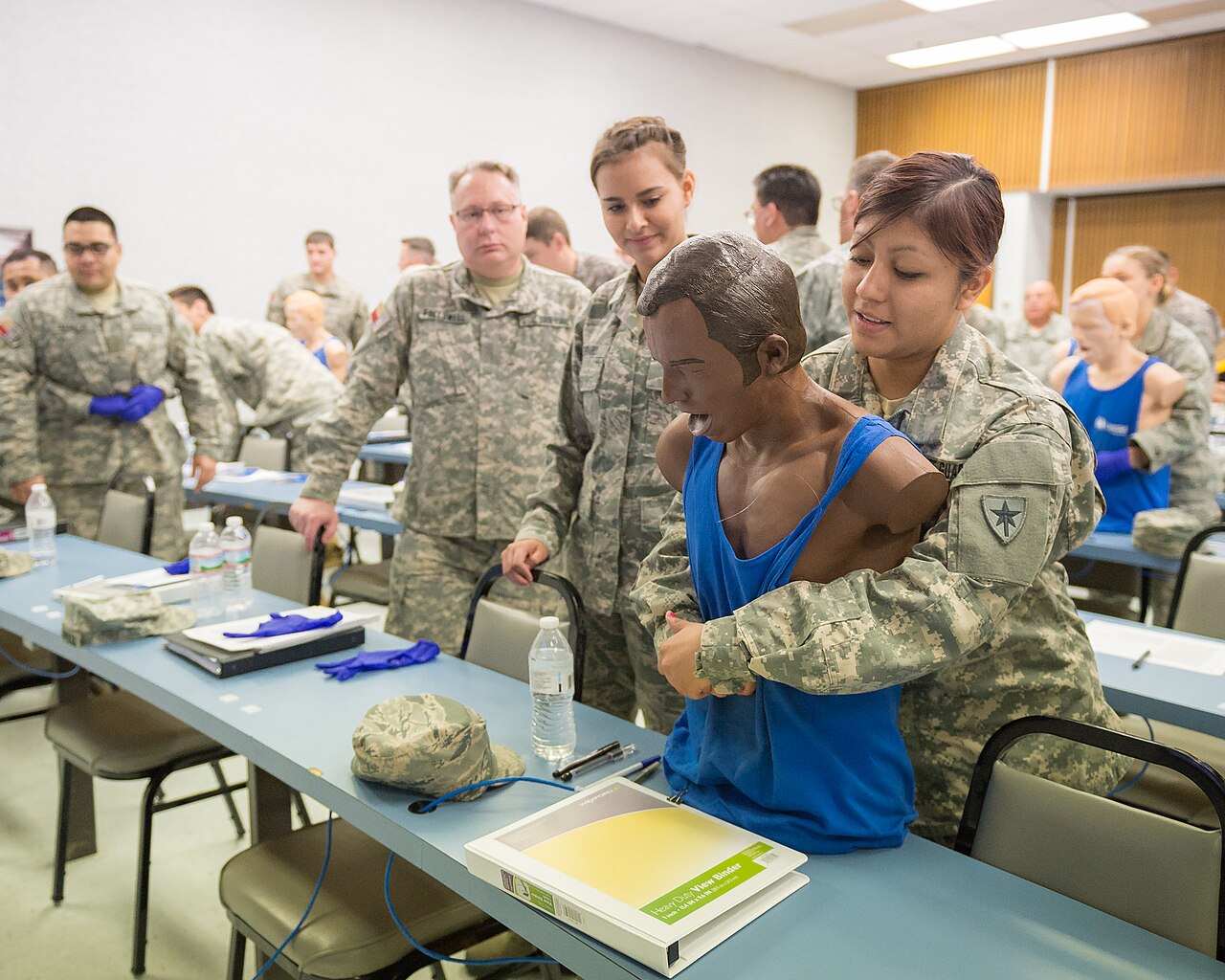
Image context: the cover uses a real 2015 training photograph from Wikimedia Commons showing a Heimlich-maneuver drill on a dummy. That image belongs here because adult choking rescue is about practiced geometry under pressure: where to stand, how far to bend the torso, where the fist lands, and how quickly a helper recognizes that a cough has stopped doing useful work.[6]
The opening question is a severity test, not a courtesy
The strongest thing in the video is that it begins by checking what the person can still do with air.[1] Red Cross's written choking page lists the same danger signs the clip is built around: weak or no cough, high-pitched squeaking noises or no sound, pale or blue skin, and inability to cough, speak, or cry.[2] MedlinePlus makes the same threshold explicit in even plainer language: first ask, "Are you choking? Can you speak?" and do not start first aid if the person is coughing forcefully and able to speak.[4]
That opening can sound almost too simple, but it carries the entire logic of the rescue. A forceful cough is not a sign that nothing is wrong. It is a sign that airflow still exists and may be strong enough to eject the object without a rescuer striking or compressing the body.[3][4] The dangerous transition comes when the cough is weak, speech disappears, or breathing turns squeaky and ineffective. At that point the goal is no longer to preserve a working cough. The goal is to replace failing airflow with external force before oxygen debt deepens.[2][4]
This is where the article's title matters. Adult choking first aid begins with sound because sound is the public clue to airway function. Ordinary bystanders cannot see the obstruction directly, and they should not waste time pretending they can diagnose it anatomically. What they can do is listen. A loud, productive cough buys observation time. Silence, squeaking, or inability to speak moves the scene into emergency treatment.[1][2][4]
Back blows come first because position and direction matter
The video's next useful decision is positional rather than dramatic.[1] Red Cross instructs the rescuer to move to the side and slightly behind the person, support the chest, and bend the body forward before delivering five distinct back blows between the shoulder blades.[2] Mayo Clinic describes the same geometry: stand just behind the choking adult, bend the person over at the waist so the torso faces the ground, and strike five separate times with the heel of the hand.[3]
That forward angle is easy to overlook, but it explains why the rescue is not just random hitting. Once the torso is pitched forward, gravity and the force of each blow are working in the same general direction: out of the airway rather than deeper into it.[2][3] The video's value lies in making that body arrangement legible enough for a non-clinician to copy under stress.[1] It turns a frightening emergency into a few visible relationships between hands, shoulders, and torso.
It also avoids a common public mistake, which is to imagine that the Heimlich maneuver is the whole of choking care. Mayo's page notes that some sources teach abdominal thrusts alone, but the Red Cross sequence uses back blows first and alternates the two methods.[3] AHA's current choking-demo page confirms that this is not an outdated quirk from an old manual; it remains part of the modern training picture under the 2025 guideline set.[5] The Red Cross video therefore is not teaching a legendary one-move rescue. It is teaching an ordered sequence.
The five-and-five pattern is built to continue until airflow returns or the scene changes
Once the video reaches abdominal thrusts, the point is not theatrical force. It is repetition with a stopping rule.[1] Red Cross's step list says to give five abdominal thrusts after the back blows, pulling inward and upward each time, then continue alternating five back blows and five abdominal thrusts until the person can cough, cry, or speak, or becomes unresponsive.[2] Mayo Clinic uses the same alternation and adds a systems instruction that matters in real life: if another person is present, that person should call 911 while first aid is underway; if you are alone, give the rescue attempts first and then call for help.[3]
This is what makes the video more sophisticated than it first appears. It is not teaching "do one thrust and hope." It is teaching a rescue loop with clear exit conditions.[1][2][3] Either the obstruction clears and the person regains effective cough or speech, or the scene deteriorates into unresponsiveness and the algorithm changes. MedlinePlus states that once the person loses consciousness, abdominal thrusts stop and CPR begins, with checks for a visible object but no blind finger sweeps.[4] Red Cross gives the same warning: remove an object only if you actually see it.[2]
There is also an important boundary the video implies rather than dwelling on. The responsive-adult scenario is only one branch of choking care.[1] Mayo Clinic and MedlinePlus both note that chest thrusts are used instead of abdominal thrusts in pregnancy or when the rescuer cannot get their arms around the person's abdomen.[3][4] Infant choking follows a different sequence altogether.[3][5] The Red Cross clip works because it narrows itself to one scene and teaches that scene cleanly. Its strength comes from refusing to become a universal first-aid encyclopedia.
What the video leaves outside the frame is part of the lesson
The responsible way to use this video is to notice its omissions.[1] It does not spend much time on aftercare, but the written sources do. MedlinePlus advises that anyone who has been choking should get a medical exam after the object is removed because complications may come not only from the obstruction but also from the rescue itself.[4] The same page adds warning signs in the following days, including persistent cough, wheezing, fever, difficulty swallowing, or shortness of breath, any of which can suggest aspiration or airway injury.[4]
That aftercare point changes how the video should be understood. The rescue sequence is the first victory, not the whole event. The object leaving the airway is the end of the acute crisis, but it may not be the end of the medical problem.[3][4] This is another reason the Red Cross video works best when read as a threshold lesson. It teaches the public when to cross from watchful observation into forceful intervention, then hands the rest of the problem back to emergency care, formal evaluation, or CPR if the scene worsens.[1][2][3][4]
Seen that way, the clip is doing exactly what good public health instruction should do. It is not trying to make the public into airway specialists. It is narrowing one dangerous interval so that bystanders can act correctly before oxygen runs out.[1][2][4] Listen for whether the cough is still doing work. If it is, preserve it. If it isn't, move into the five-and-five sequence, call for help, and keep going until sound returns or the rescue changes shape.[1][2][3]
Sources
- American Red Cross, "What to Do When an Adult is Choking (Responsive)," YouTube video, published August 12, 2024.
- American Red Cross, "Adult & Child Choking: Symptoms and First Aid" - danger signs, five back blows, five abdominal thrusts, and escalation to CPR.
- Mayo Clinic, "Choking: First aid" (updated August 25, 2025) - forceful-cough boundary, five-and-five sequence, 911 timing, and special-case chest thrusts.
- MedlinePlus Medical Encyclopedia, "Choking - adult or child over 1 year" - four-minute oxygen warning, first question about speech and cough, CPR transition, and post-event medical follow-up.
- American Heart Association, "Choking - Adult and Child Demos" - adult choking technique video page linked to the 2025 AHA CPR Guidelines.
- Wikimedia Commons, "File: Angeline Sanchez, a newly joined Texas State Guardsman, practices the Heimlich Maneuver on a dummy.jpg" - 2015 training photograph used for the article image.