
As of 2026-04-25 UTC, the most useful way to watch American Red Cross's 28-second video "How do you care for a burn", published on June 11, 2014, is as an argument for subtraction.[1] Burn folklore is crowded: ice, butter, ointments, adhesive dressings, heroic tolerance, and the temptation to keep checking the wound instead of doing one useful thing well. The video strips all of that down to a narrower sequence. Stop the burning process. Cool the tissue under water. Do the simple things early enough that swelling, contamination, and depth do not get extra time to build.[1][2][3][4][5]
That compression is why the clip still works, but it also needs annotation. The narrator says to use cold water.[1] The current written guidance is a little more precise and a little less slogan-like. British Red Cross tells readers to cool the burn under cold running water for at least 20 minutes.[2] NHS says cool running water for at least 15 minutes, or until the pain feels better.[4] Mayo Clinic says cool, not cold, water for about 10 minutes and explicitly says not to use cold water or ice.[5] The American Burn Association's patient page is shorter and more conservative for minor burns, advising running water for at least 5 minutes and avoidance of ice.[3] Inference from these sources: the exact minute count and wording vary by institution, but the shared principle is stable. The first job is sustained running-water cooling, not freezing, greasing, or improvising.
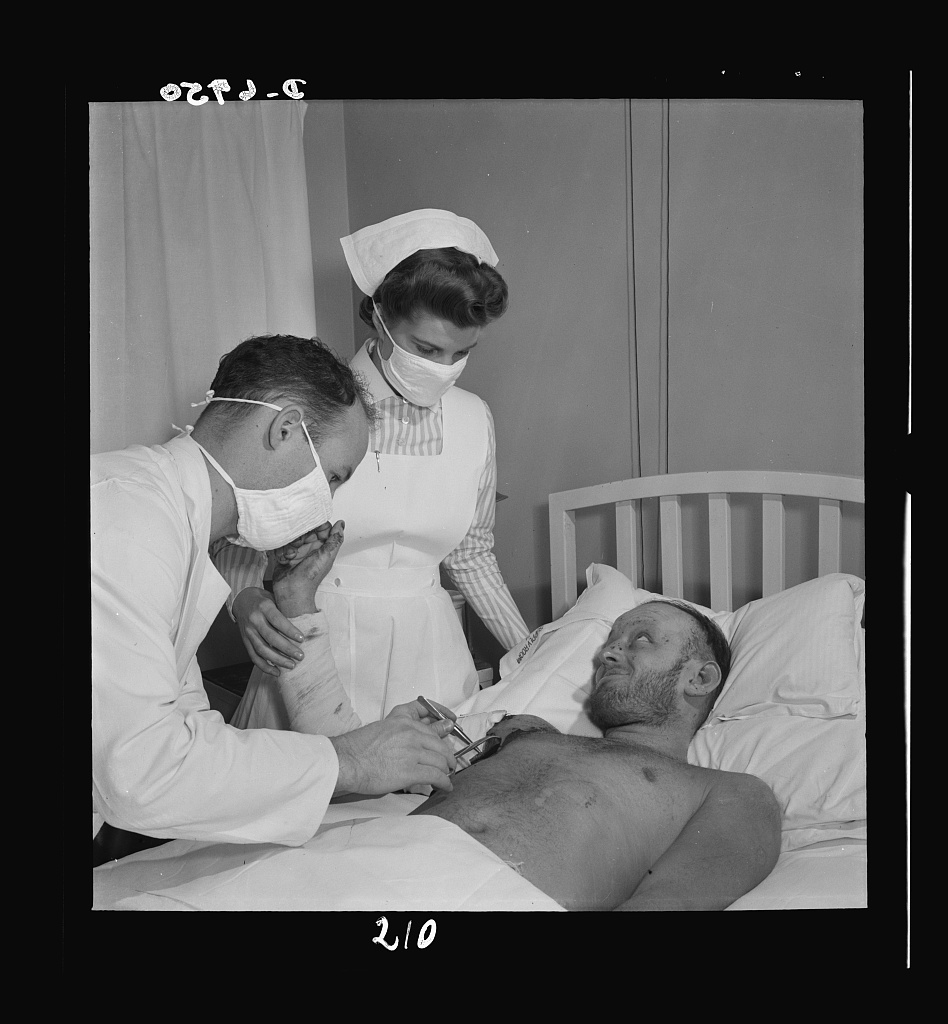
The archival image used here helps keep the stakes visible.[6] Burn first aid often looks so plain that people mistake it for low importance. Yet plainness is the point. A burn is one of those injuries where a disciplined early response can keep a thermal event from becoming a deeper tissue event. The Red Cross video works because it stays inside that early window.[1]
Around 0:09, the clip gets the physiology right by refusing theatrics
The central move arrives almost immediately. After telling viewers to stop the burning process, the video says the most effective treatment is water cooling because it limits further damage, reduces pain, and promotes healing.[1] That is exactly the level on which good public first aid should work. It does not need a long lecture on protein denaturation or burn depth classification. It needs to teach that tissue can keep taking heat injury after the original contact ends, and that the helper's first task is to pull that heat back out.
The written sources support that reading strongly. British Red Cross says the sooner and longer the burn is cooled under running water, the less the impact of the injury.[2] NHS tells readers to treat all burns and scalds straight away.[4] Mayo Clinic keeps the same core sequence but adds the important correction that water should cool rather than freeze the tissue, which is why it says cool, not cold, and warns against ice and butter-like home remedies.[5] The American Burn Association likewise says to avoid ice and to start with running water.[3]
What the short video does well, then, is not exhaustive instruction but priority sorting.[1] It pushes the viewer away from cosmetics and toward energy transfer. That is the right public-health instinct. Burns often get misread as surface messes, when the real early question is whether heat is still being allowed to sit in the tissue.
The next action is easy to forget because swelling does not wait for permission
What the 28-second clip cannot really dwell on is the speed at which swelling can take an initially small-looking burn and make nearby objects into a second problem. This is where the written sources add necessary depth. The American Burn Association says to remove jewelry, rings, watches, and any clothing near the burn.[3] NHS says to remove clothing or jewellery near the area, while leaving anything stuck to the burn in place.[4] Mayo Clinic gives the same warning in more clinical language: gently remove belts, rings, or tight items before swelling starts, but do not pull off material stuck to burned skin.[5]
That detail matters more than it sounds. People often treat ring removal as tidy-up work, something to do after pain control. In practice it belongs inside the first-aid window, especially on fingers, wrists, and hands. Once swelling rises, a small object turns into a constricting one. The public script therefore has to be sequenced correctly: cool promptly, but while the area is still manageable, clear off the things that the swelling curve will make harder to remove later.[3][4][5]
This is one reason burn first aid belongs in a video-curation format at all. The video gives the viewer the emotional permission to act simply.[1] The annotation has to add the boundaries the clip leaves unsaid. A short, competent intervention is still a chain, not one gesture.
After cooling, the wound needs protection, not folklore and not sticky improvisation
The next major boundary is what happens once the water step has done its work. British Red Cross says that after cooling, the burn should be loosely covered with cling film or a clean plastic bag to help reduce infection and keep air off the skin.[2] NHS says similarly that once the burn has cooled, cling film can be laid over it, but not wrapped around it, and it explicitly says not to use creams, oils, butter, plasters, or sticky dressings.[4] The American Burn Association recommends loose sterile gauze or a clean cloth for minor burns.[3] Mayo Clinic advises a clean, loose bandage and gives the clearest anti-folklore list: no butter, toothpaste, or oil, and no ice.[5]
Read together, these sources explain something the short Red Cross clip only implies.[1] First aid for burns is not an invitation to add soothing substances. It is an exercise in avoiding extra injury. Ice can overcool and worsen tissue damage.[3][5] Greasy home remedies trap heat or irritate the wound.[4][5] Adhesive or tight dressings convert a tender surface into a removal problem.[4] A good covering step therefore stays humble: loose, clean, and nonadherent.
That humility is important because burns trigger an understandable urge to do more. The better reading of the evidence is often to do less, but do the less in the right order. Cool. Remove constricting items. Cover loosely. Then decide whether this is still home care or no longer home care.
The home-care boundary arrives earlier than many people think
The last thing the written sources do better than a tiny video is define when the scene has already crossed out of the household lane. The American Burn Association says serious burns include those that are large, deep, or located on the face, hands, feet, or genitals, and also burns caused by chemicals, electricity, or inhalation.[3] NHS tells readers to call emergency services or go to A&E for large or deep burns, facial or genital burns, and chemical or electrical burns.[4] Mayo Clinic adds the same emergency categories and notes that even some smaller burns need escalation when they involve high-risk sites or vulnerable patients.[5]
That matters because first aid can accidentally become a confidence trick. Once someone learns one sequence, they can start applying it too long. The more disciplined reading is the opposite. Good first aid creates a cleaner handoff. If the burn is serious, cooling and loose covering do not replace emergency care; they buy time and reduce avoidable extra damage on the way there.[3][4][5]
This is why the Red Cross video deserves embedding now.[1] It is short enough to survive panic and correct enough to anchor the first move. Its value lies in what it excludes. It excludes butter. It excludes ice cubes as folk heroics. It excludes the idea that pain relief equals finished care. What remains is a more durable public script: remove the person from the heat source, cool the tissue under running water, get rings and watches off before swelling claims them, cover the area without sticking new trouble to it, and recognize quickly when the injury has already crossed into professional care.[1][2][3][4][5]
Sources
- American Red Cross, "How do you care for a burn," YouTube video, published June 11, 2014.
- British Red Cross, "Learn first aid for burns" - running-water cooling for at least 20 minutes, loose cling-film covering, and escalation guidance.
- American Burn Association, "Burn First Aid" - minor-burn water cooling, jewelry removal, loose covering, and serious-burn referral boundaries.
- NHS, "Burns and scalds" - immediate cooling under running water, removal of nearby jewellery and clothing, cling-film covering, and emergency thresholds.
- Mayo Clinic, "Burns: First aid" - cool-not-cold water, removal of tight items, loose covering, and things to avoid such as ice, butter, toothpaste, and oil.
- Wikimedia Commons, "File: A torpedoed sailor receives burn treatment from a doctor 8b07718v.jpg" - Library of Congress archival photograph used as the article image source.