
UNICEF East Asia & Pacific's film on early essential newborn care and kangaroo mother care looks gentle enough to be mistaken for a bedside etiquette lesson. Its real subject is stricter than that.[1] The video is about the order of operations in the first minutes and hours after birth: dry the baby well, move immediately into skin-to-skin contact, delay cord clamping, watch for feeding cues, and keep routine tasks from pulling mother and infant apart too early.[1][5] Once the piece shifts toward preterm and low-birth-weight babies, that same logic hardens into kangaroo mother care, where warmth, feeding, and contact are treated as one clinical package rather than separate tasks.[1][6]
That sequencing matters because for years the dominant pathway for many small or premature babies began with separation. Before the November 2022 WHO recommendation update, the usual pattern was to stabilize the infant first in a warmer or incubator, which often meant keeping the baby away from the primary caregiver for around 3 to 7 days.[2] WHO's revised guidance flipped that default after evidence showed that immediate kangaroo mother care after birth saves more lives, reduces infection and hypothermia, and improves feeding.[2][3] The current WHO practice guide defines kangaroo mother care as prolonged skin-to-skin contact plus breast milk feeding, which is another way of saying that the unit of care is no longer the baby alone on a machine trolley, but the mother-baby pair kept together whenever clinically possible.[6]
That is why this video is worth annotating. It translates a guideline shift into visible choreography. It also lets the reader keep two evidence levels separate. The hospital statistics cited inside the film are local implementation results, useful because they show what a ward changed after reorganizing its routines.[1] The broader claims about mortality, hypothermia, breastfeeding, and infection come from WHO reviews and recommendations, not from one testimonial clip.[2][3][4][5][6] Put differently, the film is persuasive because the writing around it can restore the evidence hierarchy the camera alone cannot carry.
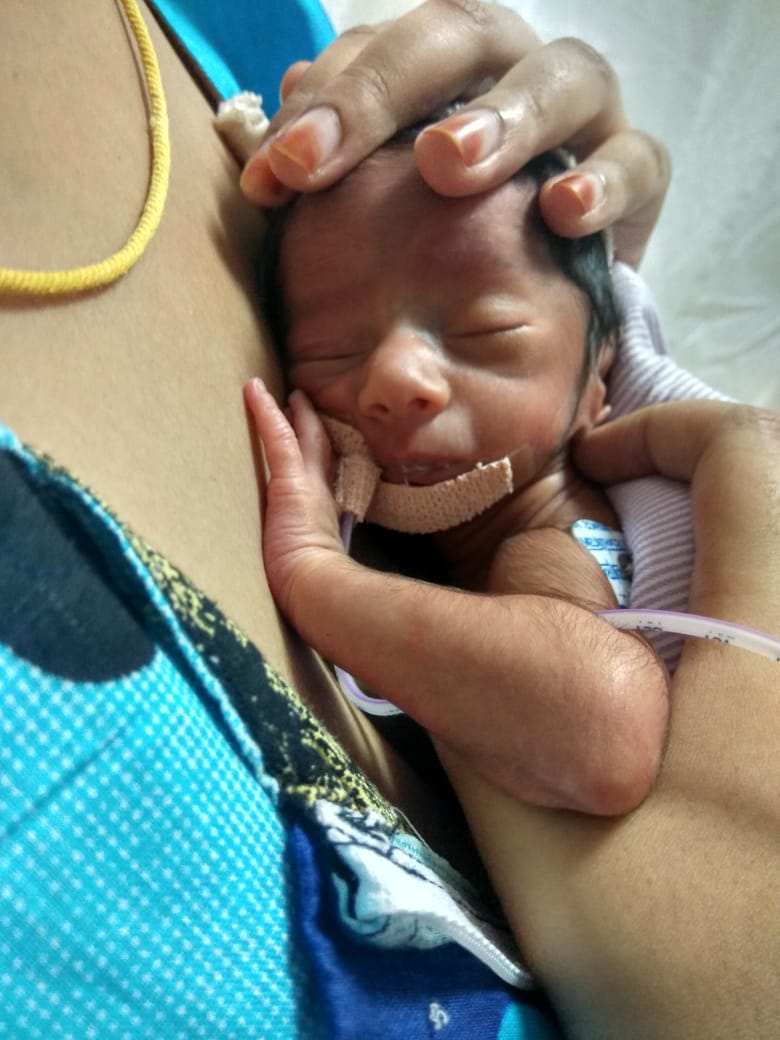
Image context: the cover uses a real Wikimedia Commons photograph of kangaroo mother care. That choice matters because the intervention works in contact space, not in abstract policy language. The posture of chest-to-chest holding tells the story more honestly than any schematic could.[7]
Around 1:00, the video turns the first hour into one continuous chain instead of a series of separate chores
Early in the film, the language of "early essential newborn care" sounds almost administrative.[1] Yet the package it describes is conceptually sharp. Instead of thinking of warming, feeding, cord care, and observation as separate stations, the video presents them as one unbroken first-hour sequence.[1][5] That is close to the way WHO's Western Pacific office explains the model: immediate skin-to-skin contact transfers warmth, placental blood, and protective bacteria, helps start exclusive breastfeeding, and should continue for no less than 90 minutes.[5]
The importance of that 90-minute window is easy to miss if one reads the practice as sentimental bonding alone. The video's logic is more clinical. Immediate contact helps stabilize temperature, keeps the infant calmer, and makes the first feeding cues legible before the birth setting has started scattering attention across weighing, bathing, or routine movement to another surface.[1][5] In that sense, the intervention does not add one more step to delivery-room work. It removes a habit of interruption.
That distinction becomes crucial later when the film moves from all newborns to preterm and low-birth-weight infants. The same first-hour chain is still there, but the stakes rise. For a small baby, warmth is not cosmetic comfort, and access to the breast is not a lifestyle preference. The sequence is part of survival medicine.[1][2][3]
Around 2:03, kangaroo mother care is presented as physiology in plain sight, not as a soft-focus parenting philosophy
The video's direct definition of kangaroo mother care is one of its strongest moments: the mother wraps the preterm or low-birth-weight baby skin-to-skin on her chest so the newborn stays warm, can breastfeed, and is protected from infection.[1] What makes this useful is its refusal to divide those outcomes into unrelated boxes. Thermal regulation, feeding, infection risk, and maternal contact arrive together in one body position.
WHO's written evidence summaries help explain why that body position matters. In the review summary on early skin-to-skin contact for healthy newborn infants, babies placed skin-to-skin had higher blood glucose in the first hours after birth, axillary temperatures about 0.30°C higher at 90 minutes to 2.5 hours, and improved breastfeeding outcomes including longer duration and better exclusivity signals.[4] Those figures come from healthy mother-infant dyads rather than the smaller, riskier babies highlighted later in the video, so they should not be stretched beyond their lane.[4] But they do clarify the mechanism: keeping mother and baby together changes metabolic and thermal stability almost immediately.
For preterm and low-birth-weight infants, WHO treats kangaroo mother care as a distinct clinical strategy rather than a wellness preference.[2][3][6] The 2022 recommendation change matters precisely because it rejected the old assumption that incubation and separation must come first by default.[2] The film's calm images therefore carry a hard claim underneath them. Chest contact is doing work that the previous pathway often postponed.
Around 4:03, the most radical move in the video is the refusal to let routine separation masquerade as ordinary care
The checklist section is where the film becomes most disciplined.[1] Dry the newborn carefully. Start skin-to-skin contact immediately after drying. Delay cord clamping until pulsation stops for 1 to 3 minutes. Cut the cord with a sterile instrument. Begin exclusive breastfeeding when cues appear. Give routine care. Initiate kangaroo mother care even shortly after caesarean birth.[1] Read quickly, that can look like a standard delivery-room protocol. Read closely, it is a deliberate narrowing of all the moments when mother and infant used to be pulled apart out of habit.
This is the real editorial lesson of the clip. The argument is not that incubators, antibiotics, resuscitation, or neonatal intensive care have ceased to matter. The film itself mentions suspected infection and resuscitation when needed.[1] The intervention sits elsewhere. It asks whether the system has allowed "stabilization" to become a reflexive reason for separation even when the dyad could safely remain together.[1][2][6]
Seen that way, kangaroo mother care is less a boutique newborn technique than a threshold rule. The threshold is the first decision after birth: does the baby go away first and return later, or does care begin on the parent's chest and escalate outward only when clinical instability truly demands it?[1][2] Once that question is asked clearly, a surprising amount of routine looks historically contingent rather than medically inevitable.
Around 4:51 and after, the hospital metrics matter because they show a ward being reorganized, not because one site can settle the whole evidence base
The hospital voiceovers later in the video report outcomes such as about 30% fewer neonatal intensive care admissions, markedly higher breastfeeding rates, and lower infection or antibiotic use after adopting the approach.[1] Those figures should be read with discipline. They are implementation claims from one local setting, not universal pooled estimates.[1] Their value lies elsewhere. They show that kangaroo mother care is not only a counseling message for mothers. It is a systems change that alters where babies are placed, what nurses do first, and how maternity and neonatal teams decide whether contact or separation is the default.
That is also why WHO's written materials keep pairing recommendation changes with practical guidance.[2][3][6] A hospital cannot realize the benefit of skin-to-skin contact if its room design, staffing patterns, or documentation routines keep breaking the contact window. The video's closing insistence that more work remains is not rhetorical filler.[1] It is a reminder that this is an implementation problem as much as an evidence problem. A recommendation on paper does not hold a baby warm. A reorganized ward can.
Why this annotated viewing matters
The strongest thing about this film is its refusal to romanticize contact while still trusting contact as medicine.[1] It does not tell the viewer to choose touch over technology in some vague philosophical way. It shows that for many newborns, especially small and preterm ones, the earliest clinically meaningful technology may be a better sequence: faster drying, immediate skin-to-skin placement, delayed clamping, earlier feeding, and far less automatic separation.[1][2][5][6]
That is a harder and more useful message than "cuddling is good for babies." Kangaroo mother care begins by changing the first institutional reflex. The first move is no longer to split mother and infant into separate care tracks unless instability forces that split. Once that threshold changes, warmth, feeding, infection protection, and parental presence stop competing with one another and start acting like the same intervention viewed from different angles.[1][2][3][4][5][6]
Sources
- UNICEF East Asia & Pacific, "Early Essential Newborn Care and Kangaroo Mother Care (Long Version)," YouTube video.
- World Health Organization, "WHO advises immediate skin-to-skin care for survival of small and preterm babies" (15 November 2022).
- World Health Organization ELENA, "Kangaroo mother care for infants" - intervention summary and recommendation context.
- World Health Organization ELENA, "Early skin-to-skin contact for mothers and their healthy newborn infants immediately after birth" - evidence review summary.
- World Health Organization Western Pacific, "Early Essential Newborn Care" - public Q&A on immediate skin-to-skin contact, warmth, and the 90-minute window.
- World Health Organization, "Kangaroo mother care practice guide" - current implementation guide defining KMC as prolonged skin-to-skin contact plus breast milk feeding.
- Wikimedia Commons, "File:MotherKMC.jpg" - source page for the lead photograph used in this article.