Joseph Lister is often reduced to a single museum sentence: he told surgeons to spray carbolic acid, infection fell, modern surgery began. The real story is tighter and more useful. Lister's decisive move was not merely to prefer one chemical over another. It was to redefine what counted as the operation. For him, the job no longer ended when a limb was set or an abscess was opened. The procedure had to include the management of contamination before putrefaction could take hold.[1][2]
That sounds obvious now because later bacteriology made the logic legible. In the mid-1860s it was a live practical problem inside crowded wards where surgeons could operate skillfully and still lose patients to sepsis, pyaemia, erysipelas, and hospital gangrene. At Glasgow Royal Infirmary, Lister worked in a setting where compound fractures were especially dangerous because broken skin turned an injury into an open doorway for decay and infection.[2][4] His contribution was to treat that doorway as a controllable variable.
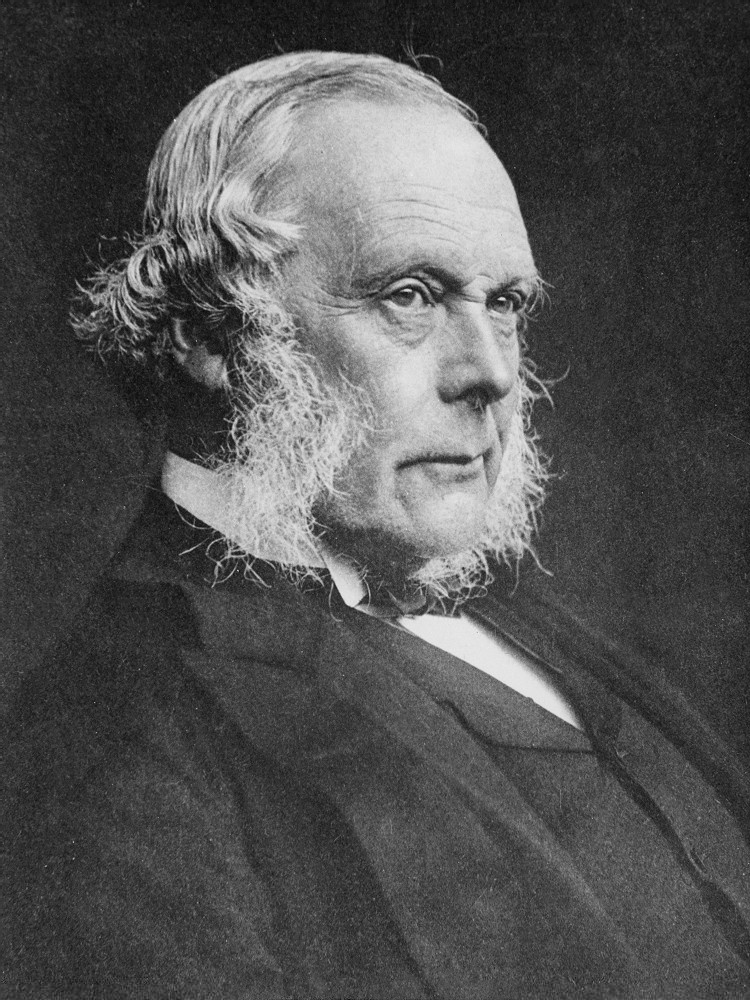
Image context: this archival late-life photograph of Lister is used because the article is a biography / microhistory. The image anchors the essay in the surgeon who helped turn infection control from a matter of ward smell and fatalism into an explicit part of operative method.[5]
Before antisepsis, speed and anatomy were not enough
Lister had trained in a surgical culture that prized dexterity, speed, and anatomical precision. Those skills still mattered, but they did not answer the central ward problem. As the Royal College of Surgeons notes, roughly one in four patients on surgical wards died from infection, and postoperative putrefaction was so common that it shaped the atmosphere of the hospital itself.[4] A technically successful operation could still end in death because the real failure arrived later, after the wound had begun to rot.
This is why Lister matters as a systems thinker before he matters as a hero. He did not simply ask which operation to perform. He asked what sequence of conditions allowed a wound to stay clean long enough to heal.
The Glasgow clue: a wound is not just damaged tissue, but an exposed environment
The 2013 historical analysis of Lister's work is useful because it restores the chronology.[2] Lister's first famous antiseptic case, the eleven-year-old James Greenlees, entered Glasgow Royal Infirmary on 12 August 1865 with a compound fracture. Lister did not rush the case into print. He spent the next two years refining a broader practice and only published the first major Lancet series in 1867, once he believed the method had enough repetition behind it to count as more than an anecdote.[2]
That sequence matters. It shows that Lister was not selling an isolated miracle. He was building an operational argument.
His interpretive bridge came from Louis Pasteur's work on fermentation and putrefaction. If microscopic life could spoil wine and milk, Lister reasoned, then wound putrefaction might also depend on living agents entering vulnerable tissue.[2][4] The implication was radical for surgery: contamination was not an unfortunate after-effect but part of the procedure's causal chain. Once framed that way, the surgeon's task expanded. Dressing choice, instrument cleanliness, wound coverage, drainage, and hand contact all entered the same field of responsibility.
Why carbolic acid mattered, and why it was not the whole point
Lister turned to carbolic acid after hearing that related compounds were being used around sewage to reduce foulness and disease.[4] In the 1867 BMJ article often cited as his foundational statement, he laid out what he called the "antiseptic principle": protect the wound from the external causes of putrefaction and healing could proceed without the usual cascade of septic complications.[1]
It is tempting to read that paper as a chemistry story. It is better read as a workflow story. Carbolic acid mattered because it gave Lister a workable way to operationalize a new idea of the wound:
- cover exposed tissue rather than leaving it passively vulnerable;
- treat dressings as active barriers;
- handle openings, drainage, and abscesses as contamination-control problems, not merely mechanical ones;
- and keep technique consistent enough that outcomes could be compared across cases.[1][2]
That is why the specific spray, paste, or dressing formula changed over time without collapsing the larger method. The durable innovation was not one bottle. It was the insistence that infection prevention belonged inside surgical practice rather than outside it.
Publication in 1867: the argument becomes public
The six Lancet papers Lister published from March to July 1867 made his claims visible to the profession.[2][4] They focused on two situations where sepsis routinely destroyed good surgical work: compound fractures and abscesses. Lister argued that, handled antiseptically, compound fractures could begin to resemble simple fractures in their clinical course because the exposed tissues no longer had to pass through the expected ordeal of putrefaction.[2]
That was an enormous claim. It changed not only prognosis but triage logic. If infection risk could be reduced reliably, surgeons no longer had to treat many open injuries as near-automatic routes to suppuration, amputation, or death. This is one reason Lister's work marks a threshold in the history of surgery. It widened the set of injuries and operations that could be attempted with realistic hope.
The 1870 mortality argument: ward salubrity as a measurable outcome
Lister strengthened his case by shifting from individual cases to hospital-level performance. In his 1870 Lancet paper on the "salubrity of a surgical hospital," preserved and contextualized by the James Lind Library, he argued that an antiseptic system changed not only selected wounds but the broader infectious climate of the ward.[3] This was the stronger claim because it tested whether the method could alter the denominator that haunted nineteenth-century surgery: the whole population of surgical patients exposed to hospital infection.
The Royal College of Surgeons summary captures the scale of the reported change. Before antiseptic treatment, between 1864 and 1866, about 46% of Lister's surgical patients died. From 1867 to 1870, after antiseptic practice was introduced, the figure fell to about 15%.[3][4] Different historians parse those numbers carefully because nineteenth-century denominators are never as clean as modern trial tables. Even so, the direction of change is too large to dismiss as noise. Lister's case for antisepsis did not rest on rhetoric alone. It rested on a ward whose death pattern moved.
Why acceptance was slow even when the results were strong
The standard popular story says Lister was right and everyone else was foolish. The evidence supports a harder and more historical reading.
First, Lister's method was demanding. It required discipline, repetition, and tolerance for cumbersome materials. Surgeons had to change habits, not merely opinions. Second, the underlying germ explanation was still gaining ground; not everyone accepted the same causal model at the same speed.[2][4] Third, antiseptic surgery could look fussy, theatrical, or excessive when seen only from the surface. The method asked surgeons to admit that invisible contamination, often transmitted by their own hands and instruments, mattered as much as the bold operative gesture.
That is a professional insult as much as a scientific correction. Resistance, in that light, becomes easier to understand.
Why Lister's legacy is bigger than the spray
Lister later moved to Edinburgh in 1869 and then to London, carrying the method into larger professional audiences.[4] Over time the visible choreography of carbolic spray lost ground, while sterilization, aseptic technique, cleaner instruments, gowns, and more standardized operating-room discipline rose. That later evolution can make Lister look transitional or obsolete. In fact it proves the opposite. Once surgeons accepted that infection control had to be built into the procedure, the exact tools could evolve without sacrificing the principle.
This is the most durable way to read Lister in 2026. He helped move surgery from heroic intervention plus hopeful aftermath to intervention plus managed microbial risk. He did not complete modern infection control by himself, and he did not work in a finished bacteriological world. But he supplied a crucial operational bridge: treat contamination as part of the case while the case is still in your hands.[1][2][3]
That is why Lister remains more than a commemorative name attached to institutes and prizes. He made the invisible interval after incision clinically governable.
Sources
- Joseph Lister, On the Antiseptic Principle in the Practice of Surgery (British Medical Journal, 1867) — Lister's foundational public statement of the antiseptic principle, via PMC.
- Claire L. Jones, Joseph Lister and the performance of antiseptic surgery (Notes and Records of the Royal Society, 2013) — chronology from the 1865 James Greenlees case to the 1867 Lancet series, via PMC.
- Joseph Lister, Effects of the antiseptic system of treatment upon the salubrity of a surgical hospital (Lancet, 1870) — hospital-level mortality argument, via the James Lind Library.
- Royal College of Surgeons, "Lord Joseph Lister of Lyme Regis (1827-1912): the father of modern surgery" — concise professional-history summary of Glasgow context, Pasteur influence, and the mortality shift.
- Wikimedia Commons / Wellcome Collection, "File:Lister Joseph.jpg" — archival photograph of Joseph Lister used as the article image.