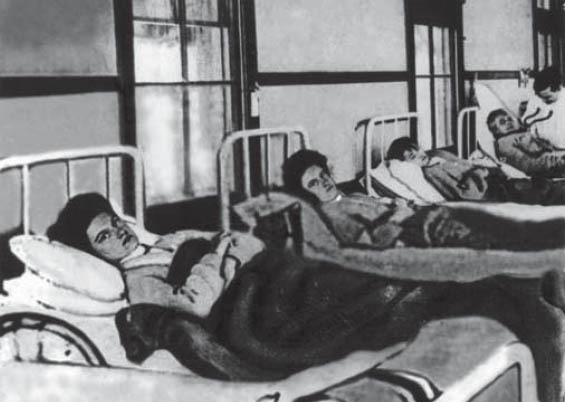
Typhoid Mary survives in public memory as a villain nickname, almost a folk demon for contagion. The historical record points somewhere more useful. Mary Mallon mattered because she forced New York to confront a category that early twentieth-century public health did not yet know how to govern well: the apparently healthy worker who could still carry and shed a dangerous pathogen.[2][4][5]
That problem was larger than one cook. Typhoid fever had long been linked to contaminated water, sewage, and visible outbreaks among the urban poor. Mallon's case brought transmission into a different room: the kitchen of wealthy households, carried by a person who looked well, insisted she was well, and could still seed disease through intimate everyday labor.[4][5] Her story became famous because the science was new, the enforcement was coercive, and the social position of the accused made compromise unusually fragile.
Timeline anchors
- August 27 to September 3, 1906: six of the eleven people in Charles Henry Warren's Oyster Bay summer household fell ill with typhoid fever, setting George A. Soper's investigation in motion.[5]
- June 15, 1907: Soper published the case in medical print, helping define the healthy carrier as a public-health category rather than a curiosity.[2][5]
- 1907-1910: Mallon was confined on North Brother Island after stool cultures repeatedly showed Salmonella Typhi shedding.[3][5]
- June 1909: Mallon wrote a furious letter from quarantine describing repeated testing, isolation, and pressure to accept gallbladder surgery.[3]
- February 1910: a new health commissioner released her under the condition that she stop cooking for others.[3][5]
- 1915: after twenty-five cases and two deaths at Sloane Maternity Hospital were traced to a cook working as "Mary Brown," Mallon was returned to North Brother Island for permanent quarantine.[4][5]
- November 1938: she died after spending a total of twenty-six years in isolation.[2][5]
The dates show why her case never stayed inside bacteriology alone. Each step turned a laboratory finding into a question about labor, compliance, and state power.
The discovery was scientific, but the shock was social
What startled investigators in 1906 was not only that typhoid had appeared in an upscale Long Island household. It was that the most plausible link was the cook.[5] Once Soper began tracing Mallon's employment history, the pattern suggested something medicine was only beginning to name clearly: a chronic carrier could move between homes and leave illness behind without ever entering the story as a patient.[2][5]
That finding altered the practical map of disease control. If transmission depended only on visibly sick people, inspectors could isolate the symptomatic and sanitize the environment. If transmission could also move through a person who felt normal, worked normally, and denied illness with complete sincerity, then surveillance had to reach into ordinary work and domestic life. Mallon became the emblem of that shift because she occupied exactly the kind of job where food, touch, trust, and household intimacy met.[4][5]
Modern microbiology explains why the category was so hard to manage. Chronic typhoid carriage can persist in the gallbladder, often in association with gallstones, and infected people may shed organisms intermittently for long periods.[6] From a contemporary perspective, Mallon's refusal to accept the diagnosis does not look like pure irrationality. She was being told that she posed a serious danger while feeling no sickness herself, and the mechanism was not something doctors of 1907 could make intuitively persuasive to a layperson whose body seemed to contradict the claim.[3][6]
North Brother Island: quarantine without a life plan
The usual compressed version of the story makes the state look decisive and Mallon merely obstinate. The sources show a harsher and less tidy arrangement. In quarantine, Mallon underwent repeated stool, urine, and blood testing. She was urged to submit to gallbladder surgery, which she rejected. In her 1909 letter she described the experience as endless examination without any real effort to persuade, educate, or provide an acceptable future.[3]
That complaint matters historically. A carrier policy can only work durably if it offers a path that is both epidemiologically safe and socially livable. New York could forbid Mallon from cooking, but it did not build her a stable alternative that matched the wages, status, and everyday world she had known in domestic service.[3][4] She was an Irish immigrant woman, single, middle-aged, and outside any meaningful welfare system. Public health asked her to give up the one skilled occupation that paid her decently. The state did not pair that demand with durable retraining, income support, or a trusted explanation of the science.[3][4]
That gap helps explain why the case hardened so quickly into mutual disbelief. Officials saw repeated positive cultures and a string of outbreaks. Mallon saw herself taken from work, treated as a specimen, and told that surgery on an organ that did not hurt her might solve a danger she could not feel.[3][5] Once those interpretations locked into place, the room for negotiated compliance narrowed sharply.
Release, return, and the 1915 maternity-hospital outbreak
Her 1910 release briefly suggested another ending. The city agreed to free her on the understanding that she would no longer cook.[3][5] In administrative terms, that was an attempt to move from island quarantine to conditional liberty. In practical terms, it was unstable from the beginning. Laundry and other substitute work paid less, offered less autonomy, and lacked the social standing of kitchen work in private homes and institutions.[4]
Mallon eventually returned to cooking under the name Mary Brown. In 1915, an outbreak at Sloane Maternity Hospital in Manhattan was traced to that kitchen. Twenty-five people were infected and two died.[4][5] The setting magnified the scandal. A maternity hospital placed newborns, mothers, nurses, and physicians inside one concentrated moral frame. To health officials and the press, the episode appeared to prove not only infectious risk but personal untrustworthiness.[4]
Yet even here the symbol can mislead. A recent reassessment argues that Mallon does not fit modern ideas of a super-spreader very well.[4] Her known outbreak record was serious, but it was not uniquely massive for the era, and other carriers existed. What made her unforgettable was not sheer epidemiologic scale. It was narrative concentration: an immigrant cook, a vivid nickname, repeated defiance, and a state dramatic enough to exile her to an island. The case was memorable because it compressed an abstract transmission problem into one face.
Two ways to read the case
The first interpretation is the public-health necessity argument. Mallon repeatedly tested positive, repeatedly shed organisms, and after release returned to the highest-risk work she could choose.[2][4][5] Under that reading, long isolation was brutal but defensible because the city had strong evidence that she could trigger new chains of typhoid transmission.
The second interpretation stresses unequal enforcement. Mallon was not the only carrier known to New York, but she became the exemplary one. Her treatment was shaped by class, gender, immigrant status, and the sensational power of the press.[3][4] A richer or more socially protected person might have received a quieter arrangement; a stronger welfare apparatus might have made compliance less punitive. This reading does not erase the public-health risk. It argues that risk management was applied through a conspicuously unequal apparatus.
The strongest assessment holds both lines together. Mallon was genuinely dangerous as a chronic carrier, and the city was genuinely poor at building a humane policy around that danger. What would change the balance of judgment? Better evidence that comparable carriers were treated similarly would strengthen the necessity case. Better evidence that city officials offered realistic long-term support and transparent explanation would weaken the charge of abandonment. The surviving record leans the other way: coercion arrived faster than persuasion, and confinement proved easier for the state than constructing a durable middle ground.[3][4][5]
Why Typhoid Mary still matters
Mary Mallon's case remains alive because it sits at a frontier public health keeps revisiting. The problem is never only the pathogen. It is the combination of silent risk, uneven evidence legibility, and work that places one person's body inside other people's vulnerability. Tuberculosis, HIV criminalization debates, asymptomatic viral transmission, and occupational exclusion arguments all return in different forms to the same governing question: when a person feels well yet may still transmit harm, what kind of restriction is justified, and what does the state owe in exchange?[4][6]
Her story also warns against letting one person absorb the meaning of a whole system failure. "Typhoid Mary" became a durable insult because it personalized contagion so efficiently. The deeper lesson runs in the opposite direction. Mallon exposed the limits of an early bacteriological state that could detect a carrier more readily than it could build a life around that detection. The enduring historical fact is not just that she spread disease. It is that her case showed how thin the line could be between public-health protection and socially selective punishment.[2][3][4]
Sources
- George A. Soper, "The Work of a Chronic Typhoid Germ Distributor." Journal of the American Medical Association 48(24), 1907 — first medical publication of the Oyster Bay investigation.
- George A. Soper, "The Curious Career of Typhoid Mary." Bulletin of the New York Academy of Medicine 15(10), 1939 — retrospective account by the original investigator.
- Mary Mallon, "In Her Own Words." PBS NOVA — edited transcription of Mallon's 1909 quarantine letter.
- Ari Teicher, "Typhoid Mary Was Not a Super-Spreader (and Super-Spreaders Are Not 'Typhoid Marys')." American Journal of Public Health 113(12), 2023 — reinterpretation of Mallon's case and later mythmaking.
- Filio Marineli, Constantinos Tsoucalas, Marianna Karamanou, and George Androutsos, "Mary Mallon (1869-1938) and the history of typhoid fever." Annals of Gastroenterology 26(2), 2013 — concise historical review with timeline, quarantine details, and archival photo context.
- John S. Gunn, Sharon Marshall, Mark A. Baker, Zheng Cao, and M. Stephen Tsolis, "Salmonella chronic carriage: epidemiology, diagnosis and gallbladder persistence." Trends in Microbiology 22(11), 2014 — mechanism review on chronic carriage and gallbladder colonization.