DCCT is often remembered through a flattened lesson: lower glucose is better. The trial itself made a more precise and more demanding claim. It showed that, in type 1 diabetes, a whole care package aimed at near-normal glycemia could materially delay eye, kidney, and nerve complications, while also increasing the risk of severe hypoglycemia.[1][2] Read that way, DCCT matters less as a morality tale about discipline and more as an operating manual for what intensive control actually costs.
The distinction matters because the original paper did not compare good patients with careless ones. It compared two different treatment systems. One system accepted the early-1980s standard of one or two insulin injections a day plus daily urine or blood testing. The other required three or more injections or an insulin pump, frequent self-monitoring, monthly contact with the care team, and a standing goal of keeping glucose as close to normal as safely possible.[1][2] The intervention was therefore not a number by itself. It was a workload.
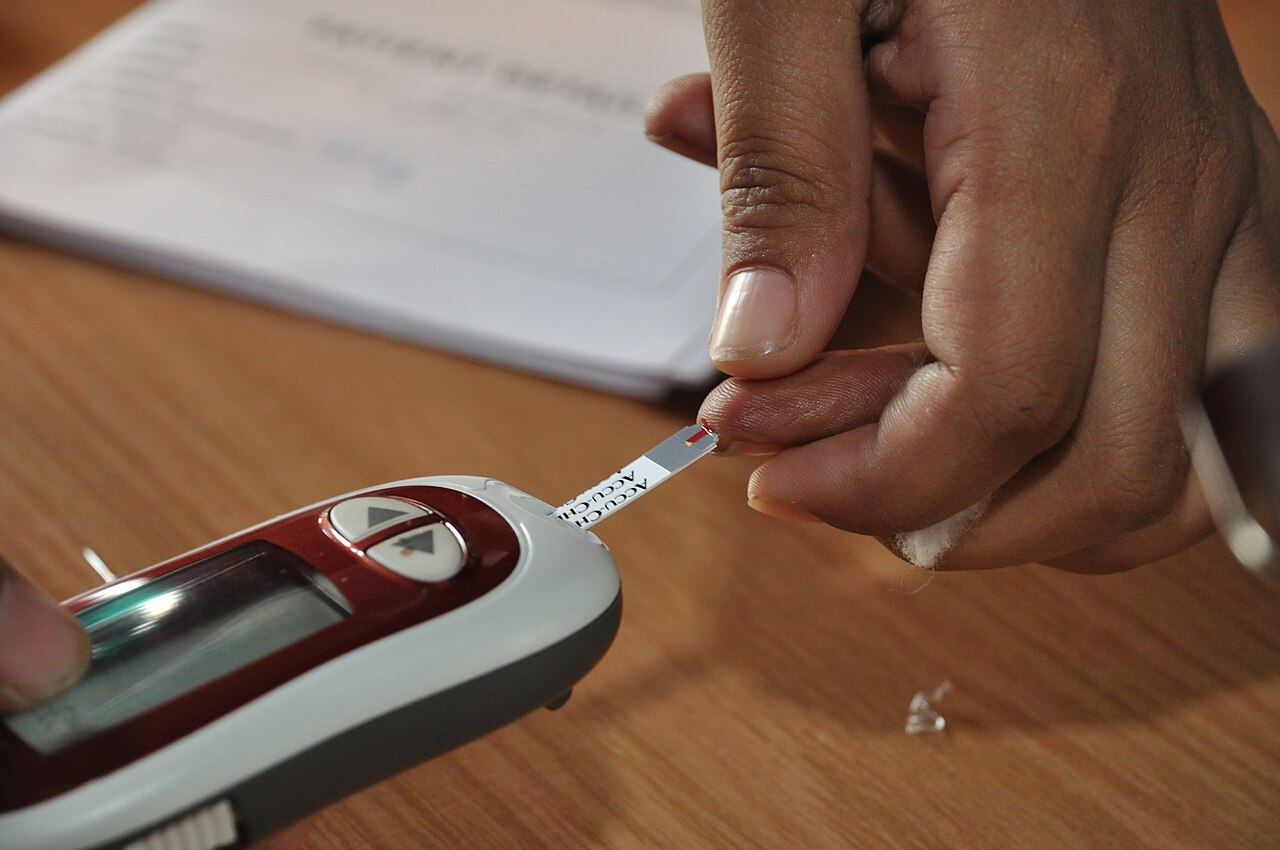
Image context: the cover photo shows real blood-glucose testing in a clinical setting. It fits this article because DCCT's central intervention was not an abstract HbA1c target. It was repeated measurement tied to treatment adjustment in everyday care.[5]
Timeline anchors before interpretation
- 1983: DCCT begins enrollment across 29 centers in the United States and Canada, recruiting people aged 13 to 39 with type 1 diabetes.[2]
- 1993: after a mean follow-up of 6.5 years, the trial is stopped early because the intensive-treatment advantage on microvascular outcomes is already clear.[1][2]
- 1994: the observational EDIC follow-up begins, with most surviving DCCT participants continuing in long-term study.[2]
- 2005: EDIC reports that the earlier period of intensive treatment is associated with a 42% lower risk of any cardiovascular event and a 57% lower risk of nonfatal myocardial infarction, stroke, or cardiovascular death.[3]
- 2015: after about 27 years of total follow-up, the original intensive-treatment group shows lower all-cause mortality, with 43 deaths versus 64 in the former conventional group.[4]
What the original trial actually compared
The 1993 New England Journal of Medicine paper enrolled 1,441 participants with insulin-dependent diabetes mellitus, divided between a primary-prevention cohort with no retinopathy at baseline and a secondary-intervention cohort with mild retinopathy already present.[1] That design choice is easy to skip past, but it is one reason the paper stayed influential. DCCT was not asking only whether complications could be slowed after damage had begun. It also asked whether a more intensive regimen could postpone the first visible injury.
The two treatment arms were also deliberately unequal in effort. Intensive therapy meant either an insulin pump or at least three daily injections, guided by frequent blood-glucose monitoring.[1][2] Conventional therapy meant what was then standard practice: one or two injections per day with daily urine or blood glucose testing and less frequent clinical contact.[1][2] This is the first close-reading correction worth keeping. DCCT did not prove that willing harder leads to better outcomes. It proved that a more saturated treatment-and-monitoring system changes complication trajectories.
What DCCT proved in 1993
On its primary terms, the trial was decisive. In the primary-prevention cohort, intensive therapy reduced the adjusted mean risk of developing retinopathy by 76%.[1] In the secondary-intervention cohort, it slowed progression of retinopathy by 54% and reduced proliferative or severe nonproliferative retinopathy by 47%.[1] Across both cohorts combined, intensive therapy reduced microalbuminuria by 39%, albuminuria by 54%, and clinical neuropathy by 60%.[1]
These numbers explain why the trial was stopped early and why practice changed. The effect was not cosmetic. It was large enough to reset the standard for type 1 diabetes care.[1][2]
But the paper was equally explicit about the cost. Its chief adverse event was a two-to-threefold increase in severe hypoglycemia in the intensive-treatment arm.[1] That line is not a footnote. It is the boundary condition that keeps DCCT from being misread as a simple mandate to push every patient toward the lowest attainable glucose at any operational cost. The trial showed benefit, but it also showed that benefit arrived through a narrow corridor that required education, monitoring, fast response to low glucose, and a care team able to keep adjusting therapy.
What the original paper did not prove
DCCT left three important questions open in 1993.
First, it did not show a cardiovascular benefit inside the trial window. NIDDK's long-run summary states this plainly: there were too few heart-disease events during the trial itself to settle that question.[2] Second, it did not prove that near-normal glycemia could be pursued without tradeoffs in ordinary practice. The trial infrastructure was unusually dense, with monthly follow-up in the intensive arm and highly selected volunteers willing to sustain heavy treatment work.[2][4] Third, it did not establish that the same balance of benefit and burden would transfer automatically to every diabetes population. DCCT was a type 1 diabetes trial with specific eligibility boundaries.[1][2]
Those limits do not weaken the paper. They clarify it.
Why EDIC changed the meaning of the trial
The most interesting part of the DCCT story arrived after the randomized phase ended. Once EDIC began in 1994, the former conventional-treatment participants were taught intensive therapy, and average glycemic control between groups converged within about five years.[2] If short-run HbA1c differences were the whole story, one might expect the earlier randomization effect to fade away. It did not.
The 2005 NEJM follow-up showed that the group originally assigned to intensive therapy still carried a marked cardiovascular advantage over a mean 17 years of follow-up: 46 cardiovascular events in 31 former intensive-therapy participants versus 98 events in 52 former conventional-therapy participants.[3] The 2015 mortality paper then extended the same logic. After about 27 years of follow-up, the hazard ratio for all-cause mortality was 0.67, with lower death risk in the original intensive arm.[4]
My inference from these sources is that DCCT should be read as a trial about timing as much as intensity. Early control changed the future risk surface even after later treatment patterns became more similar. That is why the phrase "metabolic memory" or "legacy effect" entered the field. The follow-up studies did not erase the original paper's tradeoff; they made the tradeoff look more consequential over time.[2][3][4]
The two strongest readings, and which one holds
Reading A: DCCT proved tight control should always be pushed as far as possible
This reading captures the strength of the microvascular signal, but it overruns the source. The original paper did not offer limitless intensification. It described a specific high-support regime and named severe hypoglycemia as the major adverse event.[1]
Reading B: DCCT proved that early intensive control works, but only when the support system can carry the burden safely
This reading fits the documents better. It explains why the trial changed practice, why later follow-up strengthened the long-run case, and why the operational load of type 1 diabetes care never disappeared from the story.[1][2][3][4]
Why the trial still matters in 2026
DCCT remains one of the clearest examples in health history of a trial that was both transformative and bounded. It transformed care because the reductions in retinopathy, nephropathy, and neuropathy were too large to ignore.[1] It stayed bounded because the treatment model asked for constant measurement, repeated adjustment, and tolerance for a real hypoglycemia hazard.[1][2]
That is the most useful sentence to keep from a close reading. DCCT did not prove that glucose control is a virtue in the abstract. It proved that an intensive treatment system, started early and sustained carefully, can buy years of microvascular protection and later cardiovascular advantage in type 1 diabetes. The price was extra work, more monitoring, and more risk from lows. The science was strong. The workload was part of the science.
Sources
- The Diabetes Control and Complications Trial Research Group, "The effect of intensive treatment of diabetes on the development and progression of long-term complications in insulin-dependent diabetes mellitus" (New England Journal of Medicine, 1993; PubMed abstract with trial design, effect sizes, and hypoglycemia boundary).
- NIDDK, "Blood Glucose Control Studies for Type 1 Diabetes: DCCT and EDIC" (official study summary, design, A1C separation, EDIC follow-up, and long-run implications).
- Nathan DM, et al., "Intensive diabetes treatment and cardiovascular disease in patients with type 1 diabetes" (New England Journal of Medicine, 2005; PubMed abstract on EDIC cardiovascular outcomes).
- Writing Group for the DCCT/EDIC Research Group, "Association between 7 years of intensive treatment of type 1 diabetes and long-term mortality" (JAMA, 2015; PubMed abstract on 27-year follow-up mortality).
- Wikimedia Commons, "Blood Glucose Testing - Kolkata 2011-07-25 3982.JPG" (photographic source for the article image).