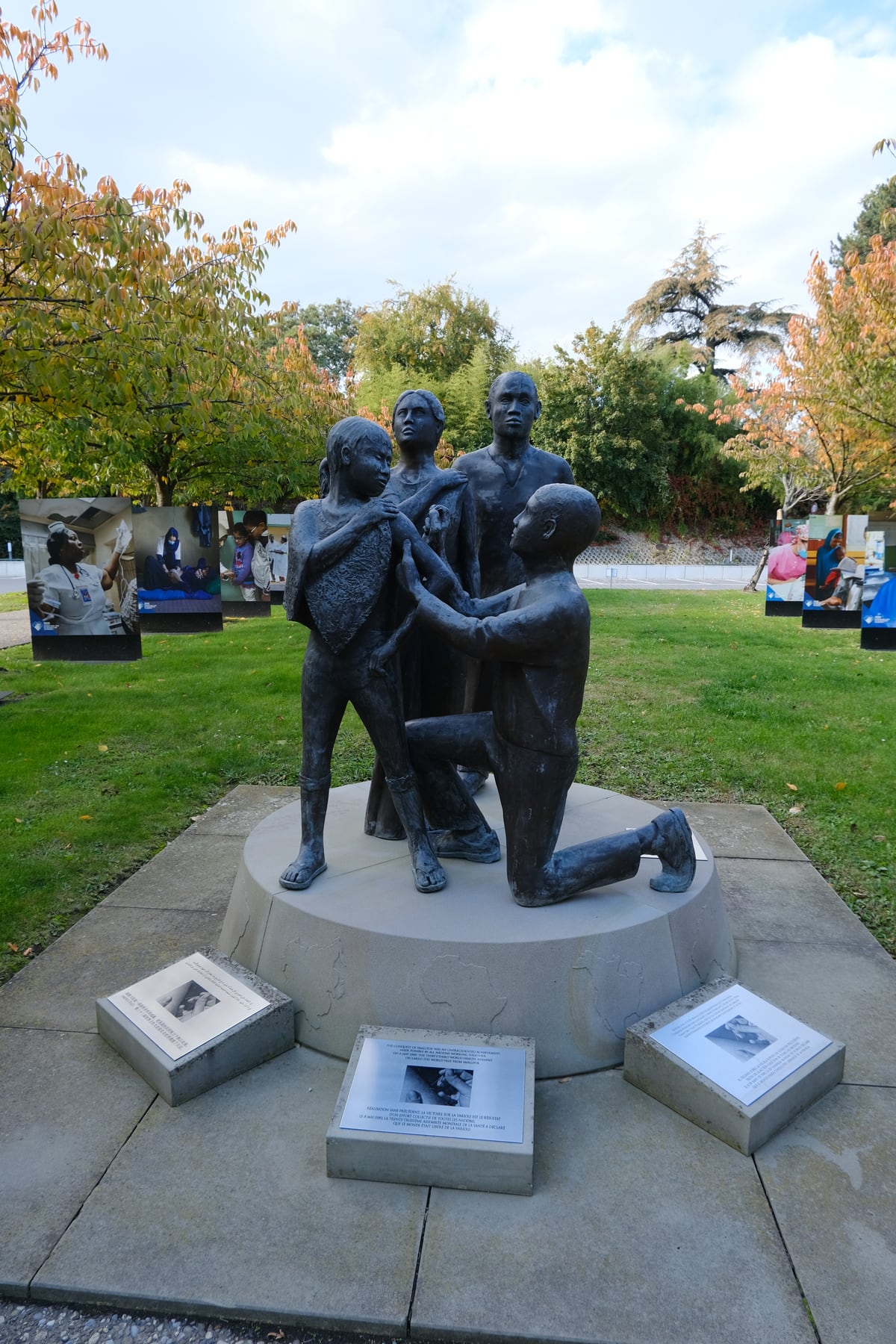
At the World Health Organization's headquarters near Geneva, a bronze health worker steadies a child's arm and brings a bifurcated needle to the skin. The memorial makes the decisive gesture in smallpox eradication visible: one trained hand, one dose of vaccine, one more person removed from the virus's path. WHO's account of the statue says its focus is the vaccinator's hand and that it honors the field workers, governments, village leaders, and others who made eradication possible.[4]
It is a deserved victory image. It is also an incomplete ending.
On September 11, 1978, Janet Parker, a 40-year-old medical photographer at the University of Birmingham, died of smallpox. The last known natural case had occurred in Somalia in 1977; Parker's infection came from variola virus kept for research in the medical school below her workplace. She became the last person known to die of the disease.[1][2]
Parker belongs inside the eradication story not as a cynical footnote that cancels the achievement, and not as a neat cautionary tale whose every detail has been solved. She belongs there because her death reveals what eradication changed. Once person-to-person transmission in the wild had been stopped, the remaining danger moved indoors. Victory created a new public-health obligation: the virus still held by institutions had to be inventoried, consolidated, inspected, and governed with the same seriousness that field teams had brought to finding the final cases.
Smallpox had two endings
The familiar chronology has the clarity of a monument. Ali Maow Maalin developed the world's last naturally acquired case of variola minor in Somalia in October 1977 and recovered. A global commission certified eradication on December 9, 1979. On May 8, 1980, the World Health Assembly formally declared the world free of smallpox.[1][5]
That sequence answers an epidemiological question: when did sustained natural transmission end? It does not answer a custodial one: what happened to live variola after the final chain of transmission was broken?
Birmingham sits between those questions. Parker first felt headache and muscle pain on August 11, 1978. A rash followed several days later and was initially treated as something other than smallpox. On August 24 she entered an isolation cubicle in Ward 32 at East Birmingham Hospital. That evening, electron microscopy of fluid from her lesions showed poxvirus-like particles, and she was transferred to Catherine-de-Barnes Isolation Hospital. She died eighteen days later.[2]
Her mother, Hilda Whitcomb, was vaccinated on August 24 but developed smallpox on September 7 after caring for her daughter; she recovered. Eight other people with fever or rash were admitted as precautions, but none was confirmed as another case. The official inquiry credited rapid contact tracing, isolation, vaccination, and disinfection with preventing wider spread. Even so, more than 300 people had their lives disrupted by quarantine.[2]
These numbers make the boundary precise. Eradication was real: the outbreak did not restart endemic transmission. Laboratory risk was real too: a virus already removed from ordinary circulation found one more human route.
A telephone room above a virus laboratory
The official investigation, chaired by R. A. Shooter, established a strong source claim but could not close every causal gap. Parker had not traveled abroad in the previous year. Virus isolated from Parker and her mother was variola major, and the inquiry concluded that the Birmingham smallpox laboratory was the source. It examined three possible routes from the laboratory to Parker: an air current, personal contact, or contaminated equipment or material.[2]
Its most vivid reconstruction centered on an unoccupied room in the anatomy department above the animal-pox room. Parker regularly used the telephone there to order photographic supplies. The two rooms were connected by a service duct. The inquiry found that on July 24 and 25, while the relevant Abid strain of variola was being handled below, Parker was making frequent calls; tracer tests later showed that particles released in the laboratory could reach the telephone room. The panel therefore considered airborne transfer there the likeliest route.[2]
But “likeliest” is not “proved.” The report itself recorded expert doubt about whether virus from laboratory cultures could travel that way. It also retained direct contact and contaminated material as possibilities. More importantly, the report was published in July 1980 with a government foreword written after a prosecution of the university had been dismissed. The foreword said the precise route remained unexplained, noted that the university contested much of the assessment, and instructed readers to hold the inquiry's findings alongside that unresolved legal and evidentiary record.[2]
That tension is not a nuisance to edit out of commemoration. It is the point. One reading emphasizes the physical reconstruction: unsafe practices created opportunities for virus to leave containment, a duct carried tracer toward a room Parker used, and the timing aligned. The counter-reading emphasizes the missing link: a later simulation was not direct observation of Parker's exposure, other routes were not eliminated, and a court did not accept the case brought against the university. The evidence supports confidence about the laboratory source and far less confidence about the final path or legal blame.[2]
Good public-health memory can hold both conclusions. It does not need to invent certainty to preserve responsibility.
The lesson survived the disputed route
The Shooter report described failures larger than a single crack or door. Open work with smallpox was not always confined to the safety cabinet. Infected material moved between rooms. Equipment checks, staff training, supervision, accident records, and institutional oversight did not consistently form one auditable system. The panel's closing lesson was that a written code cannot create safety by itself; containment depends on trained practice, supervision, functioning equipment, and administration that verifies what it has been told.[2]
That systems finding mattered even while the exact route was contested. In Parliament on January 24, 1979, the government accepted the substance of the report's general recommendations. It announced plans to replace voluntary arrangements with stronger legal controls: laboratories intending to handle the most dangerous pathogens would notify authorities, approval would move toward licensing, and Category A laboratories would face annual review. The same statement said work with smallpox should leave densely populated settings and noted that WHO was trying to reduce the number of laboratories holding variola to three or four.[3]
It would be too simple to attribute the entire modern smallpox-security system to Parker's death. Stock consolidation was already part of the eradication endgame, and today's regime developed through later World Health Assembly decisions. But Birmingham made the residual hazard concrete. A laboratory stock was not merely an archive of a defeated disease. It was still infectious material with a route, a workforce, neighbors, ventilation, maintenance schedules, and consequences outside the laboratory door.
The present arrangement embodies that distinction. Only two authorized repositories hold live variola virus, at the U.S. Centers for Disease Control and Prevention in Atlanta and at VECTOR in Russia. WHO coordinates permitted research, requires annual reporting, and conducts biosafety and biosecurity inspections of the repositories every two years. It also maintains emergency vaccine capacity and preserves the eradication programme's archives.[1][6]
Those are not ceremonial afterthoughts. They are what eradication looks like after the case count reaches zero: fewer sites, named custody, independent inspection, public reporting, retained expertise, and preparation for an event the world is committed to preventing.
What the victory monument should carry
WHO's modern commemorations understandably center collective possibility. At the eradication programme's 40th anniversary in 2019, a plaque was unveiled in the room where the 19-member certification commission had met. The ceremony honored the people who fought smallpox and connected their success to surveillance, ring vaccination, stronger immunization systems, and shared responsibility for epidemic threats.[5]
Parker's inclusion would not make that celebration smaller. It would make its meaning more exact.
The bronze vaccinator represents the labor required to stop a virus moving between people.[4][7] Parker represents the obligation that begins once that movement stops. Her story prevents “eradicated” from being misheard as “gone,” and “victory” from being mistaken for permission to relax custody. It also keeps an ordinary worker in view. Parker was not conducting variola research. She was a photographer in another department, using a telephone to buy supplies. Laboratory safety failed, or was alleged to have failed, beyond the circle of people who had chosen to work with the pathogen.[2]
This is why the unresolved route should remain visible too. A memorial lesson built on false certainty is brittle. The durable lesson rests on what the record can support: Parker acquired smallpox from virus held at her workplace; the pathway was never conclusively proved; the investigation exposed serious weaknesses; and policy moved toward notification, licensing, review, consolidation, and international oversight.[2][3][6]
Smallpox eradication remains one of public health's greatest achievements. Its fullest memory has room for both endings: the final natural case that proved humanity could stop transmission, and the final death that showed stopping transmission was not the same as extinguishing risk. Janet Parker belongs inside the victory story because she tells us what victory requires next.
Sources
- Centers for Disease Control and Prevention, “History of Smallpox” — chronology of the last natural cases, Janet Parker's illness and death, the 1980 declaration, and consolidation of official variola stocks.
- R. A. Shooter et al., Report of the Investigation into the Cause of the 1978 Birmingham Smallpox Occurrence, published by the UK government in 1980 — case timeline, outbreak containment, source and route analysis, disputed findings, and recommendations.
- UK Parliament, Hansard, “Smallpox (Birmingham),” January 24, 1979 — government response on notification, licensing, annual review, laboratory inspections, and consolidation of smallpox-virus work.
- World Health Organization, “Statue commemorates smallpox eradication,” May 17, 2010 — the memorial's emphasis on the vaccinator's hand and the collective eradication effort.
- World Health Organization, “WHO commemorates the 40th anniversary of smallpox eradication,” December 13, 2019 — certification, the commemorative plaque, the last endemic case, and the programme's legacy.
- World Health Organization, “Smallpox” — current post-eradication responsibilities, the two authorized variola repositories, biennial inspections, annual reporting, emergency preparedness, and archival preservation.
- Guilhem Vellut, “Smallpox vaccine memorial statue at World Health Organization,” Wikimedia Commons — source page for the 2020 photograph used as the article image.