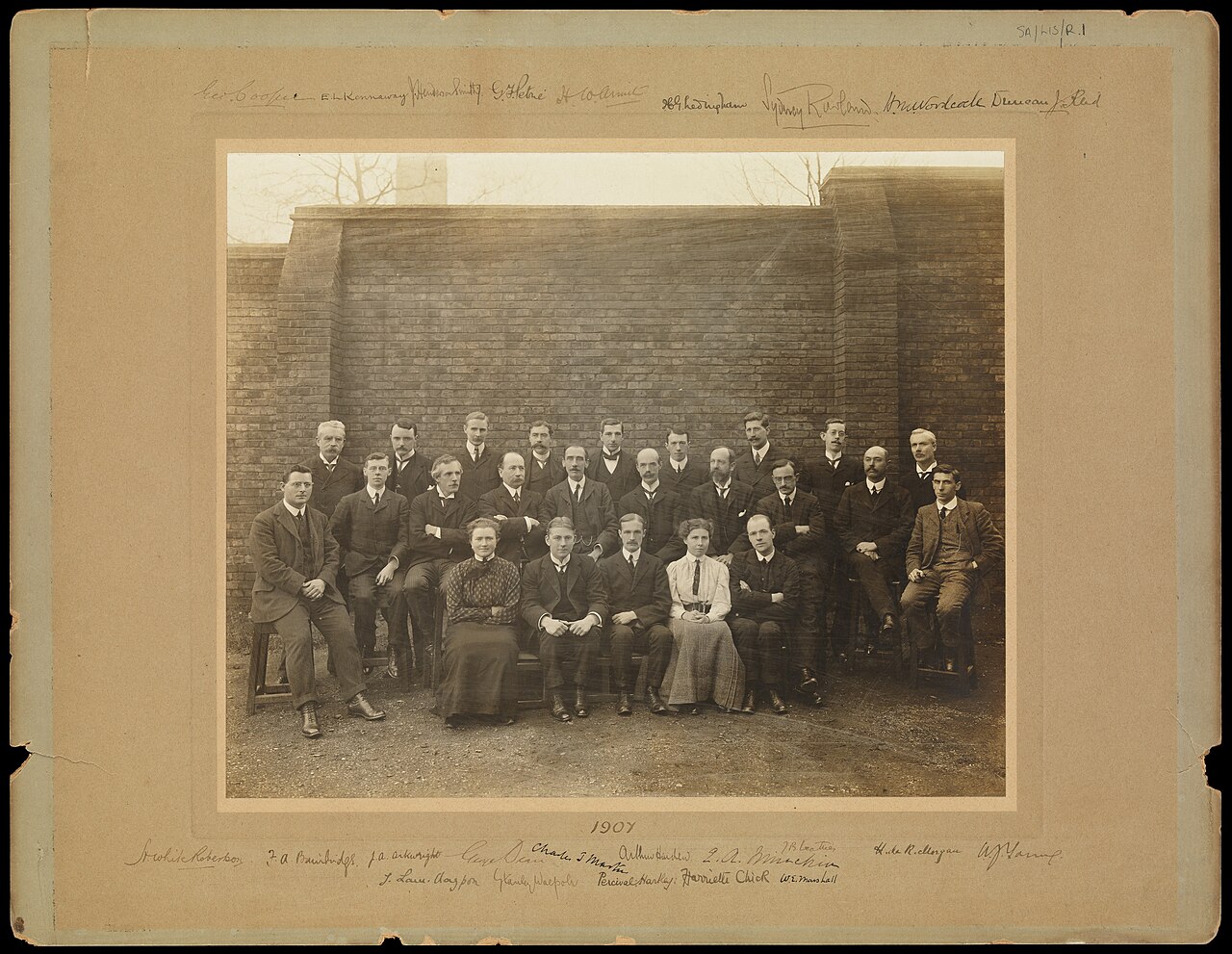
The photograph does not announce its future pioneer. In 1907, the Lister Institute staff arranged themselves in three rows, signed their names beneath the print, and faced the camera. Men fill nearly every position. Two women sit in front. Janet Lane-Claypon is at the left end of the front bench, a young physician and laboratory researcher whose most consequential instrument would not be a microscope or a culture flask. It would be another group of women.[2][6]
That sounds ordinary now because comparison groups are built into the grammar of medical evidence. In the 1920s, it was not ordinary at all. Breast cancer presented physicians with women who were already ill, each carrying a dense history of age, work, marriage, pregnancy, menstruation, breastfeeding, and family disease. A case series could describe those histories. It could not show which details were unusual. Without women who did not have breast cancer, the investigator had stories but no contrast.
Lane-Claypon's sharp question was therefore methodological: what becomes visible when a patient is compared with someone drawn from the same clinical world who does not have her disease? Her 1926 answer—500 women with breast cancer and 500 hospital controls interviewed in London and Glasgow—helped establish the modern case–control study. It also established the design's permanent tension. Looking backward can expose a pattern efficiently, but the result is only as trustworthy as the controls, questions, memories, and rival explanations that construct the comparison.[1][4][7]
Before cancer, she learned to distrust the obvious contrast
Lane-Claypon did not arrive at breast-cancer epidemiology as a collector of biographies. She trained in physiology and medicine, worked on reproductive biology and the bacteriology and chemistry of milk, and learned to make measurements answer questions about bodies outside the laboratory.[2]
Her 1912 infant-feeding report already contained the habits that would define her later work. She reconstructed two historical cohorts: 204 infants fed boiled cows' milk and 300 fed human milk. Breastfed infants gained more weight up to 208 days, after which the groups' weight gain was similar. More important than the headline was the discipline around it. Lane-Claypon considered sampling variation and confounding, examined smaller subgroups, and used Student's t test to ask whether observed differences could plausibly be noise. Historian Warren Winkelstein later identified the study as an early, perhaps first, epidemiological use of both the retrospective cohort design and the t test.[2]
That episode matters because it prevents a tidy origin myth. Lane-Claypon did not suddenly invent comparison in 1926. She had spent years learning that the apparent exposure—here, the kind of milk—sat among other differences that might distort an outcome. Her method grew from a practical suspicion: two groups may look comparable until the investigator asks how they were assembled.
The 1,000 interviews changed the unit of evidence
The Ministry of Health published A Further Report on Cancer of the Breast in 1926 as a 189-page government report.[1] Its scale was substantial for the time. Lane-Claypon assembled 500 hospitalized breast-cancer cases and 500 controls with non-cancer illnesses from inpatient and outpatient settings in London and Glasgow. A small number of interviewers used methods discussed with her in advance. The groups were not individually matched, although later histories note that they proved broadly similar in age and social class.[5][7]
The controls were not healthy volunteers. That distinction is central. They were women receiving hospital care for other conditions, chosen to approximate the population from which a woman might have entered the study as a breast-cancer case. Modern readers can see the bargain immediately. Hospital controls make interviewing feasible and may make access to care more comparable. They can also carry illnesses related to the very reproductive or social histories under investigation. If that happens, the control group's exposure pattern is not neutral; it bends the contrast.[4][7]
Still, the basic move was powerful. Lane-Claypon asked cases and controls about the same antecedent conditions and then compared their distributions. Being unmarried was more common among cases. Among married women, fertility was lower in the breast-cancer group; a later history of the design reports a 22% lower fertility estimate after the analysis was refined to reduce the chance that illness itself had curtailed childbearing. Age at marriage served as an imperfect proxy for age at first birth. Menstrual history and duration of lactation entered the same comparative frame.[3][5][7]
This did not prove that any one reproductive event caused breast cancer. It did something both smaller and more durable: it showed that reproductive histories were distributed differently among women with and without the disease. That was enough to move breast cancer from a collection of surgical cases toward an epidemiology of risk.
Why the control group did the real conceptual work
A case–control study begins at the outcome and looks backward. That reversal is especially useful for a disease with long latency. Instead of enrolling a huge healthy population and waiting years for enough cancers to occur, an investigator begins with people who already have the disease, selects people who could plausibly have become cases but did not, and compares earlier exposures.[4]
The design's efficiency can make it look mechanically simple. It is not. The control group is a claim about an invisible population: the people whose exposure histories represent what the cases might have looked like without the outcome. Choose controls from a different referral system, social class, age structure, or geography, and the apparent risk pattern may be an artifact. Ask cases to search their memories more intensely than controls, and recall may manufacture a difference. Interview after diagnosis, and illness may alter both memory and the life history being measured.
Lane-Claypon could see parts of this problem before the vocabulary of selection bias and recall bias was standardized. Uniform interviewing, attention to age and social class, and refinement of the fertility analysis were attempts to keep comparison from collapsing into coincidence.[2][7] Yet her report also retained period limitations. The women were not individually matched. Age at marriage was only a proxy for reproductive timing. Hospital controls could not guarantee a population baseline. The study compared associations; it could not produce a clean causal verdict or tell an individual woman what would happen to her.
That boundary matters beyond historical etiquette. Reproductive risk factors are easily translated into blame, as if an observational association were a judgment on whether a woman married, had children, breastfed, or reached menopause at a particular age. Lane-Claypon's design identified population patterns. It did not turn life histories into prescriptions, and it did not make breast cancer the moral consequence of a choice.
A modern reanalysis found signal, not perfection
The strongest test of the old report is not ceremonial praise but reanalysis. In 2010, David Press and Paul Pharoah abstracted Lane-Claypon's published tables and calculated study-specific odds ratios with 95% confidence intervals—tools the original report had not used. They examined age at menarche, age at menopause, parity, age at marriage as a proxy for first birth, and lactation duration. Their conclusion was bounded: the 1926 results were consistent with contemporary epidemiological evidence for age at menopause, parity, age at first birth, and duration of lactation.[3]
“Consistent with” is the right phrase. The reanalysis did not retroactively make the study randomized, erase the weaknesses of hospital controls, or recover information that the original interviews never collected. It showed that useful structure survived inside an early design. The exposure categories and tables were sufficiently clear that later investigators could ask modern statistical questions of them more than eight decades later.
The same restraint applies to the claim of priority. IARC's methodological history calls Lane-Claypon's report apparently the first case–control study of cancer—and possibly of any disease—to meet a modern definition, while noting that she did not explain how or why she adopted the approach.[4] Earlier physicians had compared sick and well people, and later investigators would formalize matching, odds ratios, stratification, and bias analysis. Her achievement was not creation from nothing. It was bringing the essential pieces together in a study that looks recognizably modern.
The method waited 24 years for its moment
The report did not immediately inaugurate an age of cancer case–control research. IARC's history notes that no cancer study of similar quality appeared again until about 1950, a 24-year gap. Then case–control studies linking smoking and lung cancer demonstrated how forcefully the design could investigate a chronic disease with a long induction period. Statistical methods and explicit rules for selecting controls developed rapidly afterward.[4][7]
That delay makes Lane-Claypon's microhistory more revealing than a simple “first woman to” story. A method can exist before a field is ready to recognize its general use. Her 1926 study sat between laboratory medicine, public-health administration, statistics, and clinical interviewing. Cancer epidemiology had not yet fully become a discipline, so the work was easier to cite as a valuable breast-cancer report than to see as a portable research architecture.
It also explains why the 1907 photograph is the right image for this story. Lane-Claypon is neither isolated nor centered. She appears inside an institution whose hierarchy is visible, one of two women in the front row of a staff dominated by men.[6] Her later contribution likewise depended on institutions: hospitals supplied cases and controls, interviewers turned life histories into comparable records, the Ministry of Health published the tables, and later epidemiologists supplied the vocabulary that made the design's importance legible.
The lasting insight is plain enough to hide in routine practice: a disease history cannot tell you what is distinctive about itself. It needs a credible counterhistory. Lane-Claypon made that counterhistory operational. She began with 1,000 women, asked the same questions on both sides of a diagnosis, and let the differences—not the drama of any single case—become the evidence.
Sources
- Wellcome Collection, A Further Report on Cancer of the Breast, with Special Reference to Its Associated Antecedent Conditions by Janet E. Lane-Claypon (H.M.S.O., 1926) — institutional catalogue record for the 189-page Ministry of Health report.
- Warren Winkelstein Jr., “Vignettes of the History of Epidemiology: Three Firsts by Janet Elizabeth Lane-Claypon,” American Journal of Epidemiology 160(2), 2004 — PubMed record and abstract for the biographical and methodological history of the 1912 infant study and Lane-Claypon's early use of cohort comparison, confounding analysis, and the t test.
- David J. Press and Paul Pharoah, “Risk Factors for Breast Cancer: A Reanalysis of Two Case-Control Studies From 1926 and 1931,” Epidemiology 21(4), 2010 — PubMed record and abstract for the odds-ratio reanalysis of Lane-Claypon's published tables.
- Norman E. Breslow and Nicholas E. Day, Statistical Methods in Cancer Research, Volume I: The Analysis of Case-Control Studies, IARC Scientific Publication No. 32 (1980) — the introduction's methodological history identifies Lane-Claypon's study as an early modern case–control design and explains the design's uses and limits.
- Julie Horn and Lars J. Vatten, “Reproductive and Hormonal Risk Factors of Breast Cancer: A Historical Perspective,” International Journal of Women's Health 9 (2017) — review of Lane-Claypon's recruitment, comparison groups, and place in breast-cancer epidemiology.
- Wikimedia Commons, “File:Lister Institute Group Photograph with names Wellcome L0068570.jpg” — source page for the 1907 Wellcome Library archival photograph used as the article image, with Lane-Claypon identified at the far left of the front row.
- Biljana Kocic, Snezana Filipovic, Branislav Petrovic, and Milan Nikolic, “Case-Control Design as Investigative Approach to Assessing Cancer Etiology: Development and Future Perspectives,” Journal of BUON 17(3), 2012 — historical review of Lane-Claypon's 500-case/500-control design, interviewing protocol, fertility analysis, and the method's later adoption.