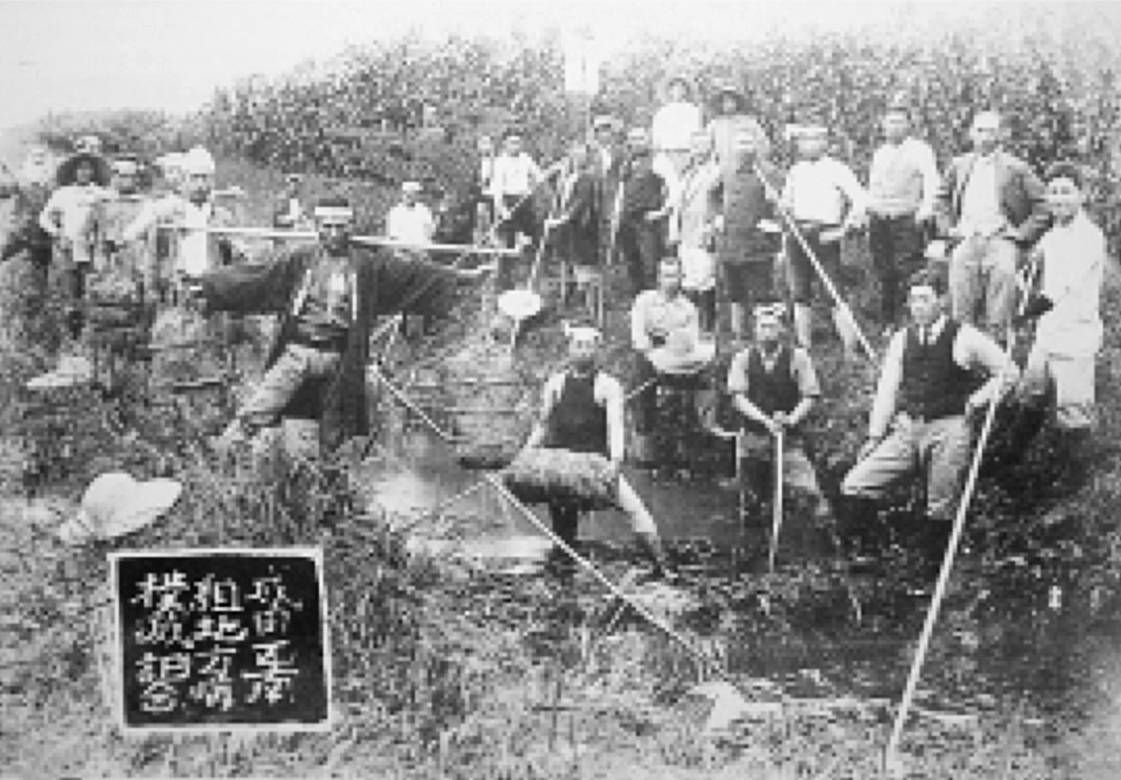
The crew has assembled inside the intervention. In a black-and-white photograph taken in Yamanashi between 1928 and 1930, men stand along a wet agricultural channel with baskets and long-handled tools. One worker tips a container toward the water. They are spreading quicklime to kill the tiny amphibious snails that carried Schistosoma japonicum. No patient appears in the frame, yet almost everything in it belongs to medicine: organized labor, a mapped habitat, a chemical, and the decision to change a working landscape.[1]
Japan and China confronted the same blood fluke, closely related Oncomelania snail hosts, and the same basic chain of infection. Both mobilized communities, treated infected people, attacked snails, and altered farms and waterways. Their campaigns nevertheless developed along different paths. Japan eventually broke transmission by concentrating extraordinary effort on a few bounded endemic landscapes while industrial and agricultural change steadily reduced exposure. China faced a continental problem across lake shores, marshes, mountains, floodplains, fishing communities, and animal reservoirs; its program had to change strategy repeatedly as one form of control revealed the limits of another.[1][3][4]
The comparison begins where a winner-loser account ends: with what a control measure becomes when it meets a particular ecology. The parasite supplied the lifecycle. Landscape, scale, technology, and political capacity determined which link could realistically be broken—and how long it would stay broken.
One Lifecycle, Several Places to Intervene
Schistosomiasis begins at the water's edge. An infected person or mammal releases parasite eggs in feces; when the eggs reach freshwater, larvae emerge and infect suitable Oncomelania snails. A later larval form, the cercaria, leaves the snail and penetrates human skin during contact with contaminated water. Adult worms live in blood vessels. The body's reaction to eggs that lodge in tissues, rather than the worms alone, produces much of the chronic damage.[4][6]
That cycle offers several control points. A program can treat infected people and animals, keep feces out of water, reduce risky water contact, remove animal reservoirs, kill snails, destroy or redesign snail habitat, or detect new infections quickly enough to stop a rebound. Praziquantel, the standard medicine today, is highly effective against adult worms. It does not prevent a treated farmer, fisher, or child from being infected again at the same shore. The World Health Organization therefore describes control as a package that may include treatment, safe water and sanitation, behavior change, veterinary measures, and snail control.[6]
The package is easy to list and hard to assemble. A concrete-lined ditch may permanently dry the margins where snails survive; it cannot be poured around a vast seasonal lake. Treating one village can sharply reduce illness; it may not stop transmission if cattle or water buffalo continue depositing eggs in snail habitat. A molluscicide can clear a channel and also kill fish or contaminate the environment. Each intervention changes both a parasite cycle and a human system.
Japan: Compress the Habitat
The Japanese campaign began with discovery. The parasite was identified in 1904, and in 1913 Keinosuke Miyairi and Minoru Suzuki demonstrated that a small snail was its intermediate host. That finding converted a mysterious regional illness into a spatial problem: find the snail colonies, then separate them from infected humans and animals.[1]
Early efforts showed how difficult that was. From 1917 to 1924, residents in one Yamanashi campaign collected roughly 900 liters of snails a year. The harvest made almost no measurable dent in snail density. Beginning in 1925, communities spread quicklime in infested waterways—the activity recorded in the photograph—but reinvasion remained possible wherever suitable wet ground survived.[1]
After the Second World War, the program became more infrastructural. Sodium pentachlorophenate, or NaPCP, killed snails efficiently, but it also killed fish and raised wider concerns about environmental toxicity; its use ended in the early 1970s. Concrete irrigation channels offered a more durable barrier. Construction in Yamanashi began in 1950, and national funding accelerated the work from 1957. Smooth-sided canals reduced the muddy, vegetated edges snails needed and made any survivors easier to detect.[1][2]
The canals did not act alone. Rice fields gave way in some endemic areas to orchards and other land uses less hospitable to snails. Tractors replaced draft animals, reducing the role of cattle as reservoirs. Chemical fertilizer reduced reliance on manure, while mechanization changed how often people and animals entered wet fields. Public-health surveillance, treatment, molluscicides, and economic transformation converged on the same lifecycle from different directions.[1][2]
The numerical sequence shows accumulation rather than a single breakthrough. Cattle infection in the Kofu Basin had disappeared by 1964. Human egg positivity fell below 1 percent by 1971. Yamanashi recorded its last three new cases in 1977, when the detection rate was 0.03 percent; by 1980, the prefecture had built 2,053 kilometers of concrete canals. Officials continued surveillance before declaring the disease eradicated there in 1996.[1]
Even that success needs careful wording. Snail populations persisted in Japan or returned after active control eased. Transmission ended because the chance that parasite, snail, mammal, and contaminated water would reconnect had been driven exceptionally low and then watched. The endpoint was a maintained ecological separation: enough interruptions, observed long enough, to keep the cycle from closing.[1][2]
Japan's approach also left a complicated environmental inheritance. Historian Alexander Bay describes a doctrine of “total prevention” that made infected terrain itself a target. Concrete channels and chemicals helped suppress a lethal disease, but they also simplified waterways and damaged non-target species. The same works could be remembered as lifesaving sanitation and as lost habitat. A clean success curve can conceal the ecological costs paid underneath it.[2]
China: Control on a Moving Frontier
China began from a different order of magnitude. Surveys in the 1950s estimated that about 12 million people were infected across 450 endemic counties. The affected terrain ranged from densely cultivated irrigation networks to the shifting shores of the Yangtze's lakes and marshes. S. japonicum could also infect many mammals, making cattle and water buffalo important sources of eggs. A campaign aimed only at human patients could reduce disease while leaving the transmission engine running.[3][4]
From the mid-1950s into the early 1980s, mass programs emphasized snail elimination and environmental modification alongside treatment of people and animals. Workers drained or filled ditches, cleared vegetation, applied molluscicides, and transformed farmland. Four provincial-level regions interrupted transmission by 1985. Yet the labor required was immense, and approaches that worked in contained irrigation districts were difficult to sustain across fluctuating marshland or steep mountain habitats.[3]
The arrival of praziquantel changed what seemed feasible. From the mid-1980s, China shifted toward morbidity control: find and treat infections often enough to prevent severe disease and lower the human reservoir, even where snails could not be eliminated. A World Bank-supported program operating from 1992 to 2001 in eight provincial-level areas helped reduce estimated human infections from 1.64 million in 1989 to 820,000 in 2001—a fall of almost 50 percent.[3]
Treatment revealed its own boundary. People returned to infected water and became reinfected. Livestock continued the cycle. The great Yangtze floods of 1998 redistributed snail habitat, while the policy of returning vulnerable farmland to lakes restored wetlands that were ecologically valuable but could also support Oncomelania. Disease control and environmental repair were not always aligned.[3][4]
From 2004, national policy placed greater emphasis on controlling the sources of infection. The measures were deliberately cross-sectoral: treat people and livestock, fence or pen animals, replace bovine farm labor with machinery where possible, improve toilets and water supplies, collect waste from fishers and boat dwellers, and coordinate health work with agriculture, forestry, and water management. This was later described in “One Health” terms because human infection, animal reservoirs, and environmental habitat could not be managed as separate problems.[3]
The contrast with Japan is clearest here. Japan's final endemic areas could be compressed by dense canal engineering while agricultural modernization helped remove exposure and animal hosts. China could not concrete-line Poyang Lake or hold the Yangtze still. It needed recurring surveillance and treatment across environments that floods, livelihoods, livestock, and conservation policy continually remade.
What the Endgame Looks Like
China's 2024 surveillance report captures the paradox of elimination. Of the 450 historically endemic counties, 388 met national elimination criteria and the remaining 62 met transmission-interruption criteria. The program reported more than 4.1 million immunological tests and 169,722 parasitological examinations; one egg-positive infection was found. None of the 167,475 bovines tested was egg-positive, and investigators detected no infected snails.[5]
At the same time, teams recorded about 190,779 hectares of snail habitat, including 59 hectares newly found and 704 hectares where habitat had re-emerged. The pattern joins a very low signal of active infection to an extensive landscape capable of supporting part of the lifecycle. At that stage, surveillance becomes part of elimination itself.[5]
Japan's history sharpens that lesson. The long interval between the last detected local infections in 1977 and Yamanashi's 1996 declaration turned a fragile absence into a credible one. China's geography makes that proof more demanding: more water edges, more animal hosts, more mobility, and more opportunities for a small imported or residual focus to reconnect with snails.[1][3][5]
The comparison also resists nostalgia for mass campaigns. Community mobilization brought enormous surveys and environmental works within reach in both countries. Its achievements sat alongside ecological tradeoffs and continuing infrastructure needs. Modern drugs added a powerful layer without making the others interchangeable.
The workers in the 1928 photograph were attacking one visible link in a chain. Their quicklime was imperfect, their labor had to be repeated, and later technologies would overtake it. Yet the image gets the scale of the problem right. Schistosomiasis is treated in a body, transmitted through a landscape, and eliminated—if it is eliminated—by keeping many systems aligned after the case count approaches zero.
Sources
- Noriaki Kajihara and Kenji Hirayama, “The War against a Regional Disease in Japan: A History of the Eradication of Schistosomiasis Japonica,” Tropical Medicine and Health 39 (2011) — campaign chronology, surveillance results, canal construction, and the article image.
- Alexander R. Bay, “Total Prevention: A History of Schistosomiasis in Japan,” Medical History 66, no. 2 (2022) — environmental history of Japanese control and its ecological costs.
- Zhong Hong et al., “Elimination of Schistosomiasis Japonica in China: From the One Health Perspective,” China CDC Weekly 4, no. 7 (2022) — national strategy shifts, treatment programs, source control, and animal reservoirs.
- Catherine A. Gordon et al., “Asian Schistosomiasis: Current Status and Prospects for Control Leading to Elimination,” Tropical Medicine and Infectious Disease 4, no. 1 (2019) — lifecycle, regional ecology, reinfection, and comparative control context.
- Jiang He et al., “Progress of Schistosomiasis Control in the People's Republic of China in 2024,” Chinese Journal of Schistosomiasis Control 37, no. 3 (2025) — current county, human, bovine, and snail-surveillance results.
- World Health Organization, “Schistosomiasis” fact sheet (February 23, 2026) — transmission, disease mechanism, treatment, and the current integrated-control framework.