The liquid in an antivenom vial did not begin with a recipe for “snake poison.” It began with particular snakes from particular places. Their venoms were collected, identified, pooled, and used to teach horses or sheep to make antibodies. Those antibodies were then separated from the animals’ plasma, purified, tested, and formulated for the species and markets the product is intended to cover.
That round trip explains both the power and the limits of the treatment. Antivenom can bind venom toxins that are still accessible and stop many of them from reaching their targets. It cannot be assumed to fit every snake, and it cannot reliably rebuild tissue, restore dead cells, or erase every effect that began before the infusion. The vial works as a molecular match delivered against a biological clock.
The scale makes that distinction consequential. The World Health Organization estimates 5.4 million snakebites each year, 1.8–2.7 million cases of envenoming, and roughly 81,000–138,000 deaths. “Bite” and “envenoming” are not synonyms: a venomous snake may inject no venom, while an envenoming can produce paralysis, bleeding, kidney injury, or destructive swelling depending on the toxins involved.[1][3]
Manufacturing begins with a map
Venom is not one molecule. It is a mixture of proteins and peptides whose proportions can differ across species and, sometimes, across the age, sex, diet, and geographical range of one species. Some components disrupt clotting; some damage muscle or the walls of small blood vessels; some block communication between nerves and muscles. A product raised against the wrong mixture may contain plenty of antibody and still miss a medically important toxin.[2][5]
Manufacturers therefore begin by defining the snakes a product is meant to cover. A monospecific, or monovalent, antivenom is raised against one species’ venom. A polyspecific, or polyvalent, product uses venoms from several locally important species. Within each choice, representative venom matters: WHO guidance calls for authenticated snakes and carefully characterized pools that account for variation across a target population rather than one convenient captive specimen.[2][3]
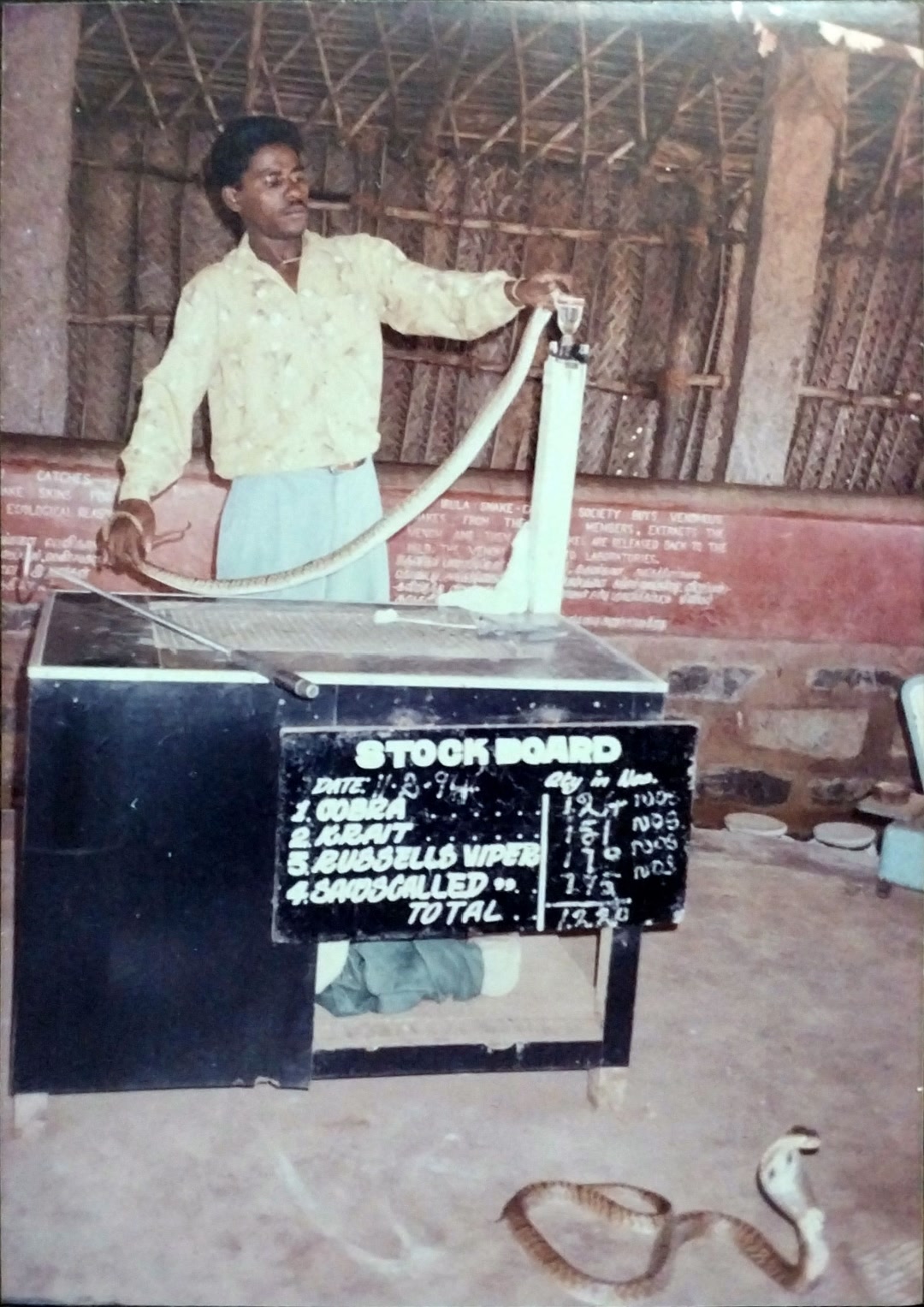
The 1995 Chennai photograph shows one upstream production step in unusually direct form. A handler guides a cobra’s fangs to a collection vessel. The harvested venom is not itself the cure, nor is it simply poured into a vial after processing. Once characterized and selected for an immunizing pool, venom becomes the immunological question posed to a donor animal: make antibodies capable of recognizing these antigens.[2][7]
Horses or sheep receive small, controlled amounts of the selected venom mixture over an immunization schedule. Their adaptive immune systems respond with many B-cell clones, each recognizing a different molecular feature, or epitope. Once antibody levels are sufficient, plasma is collected—preferably in a way that returns the animal’s blood cells—and pooled for fractionation. Manufacturers then remove much of the unrelated plasma protein and prepare intact immunoglobulin G, F(ab’)2 fragments, or smaller Fab fragments. Purification, viral-safety steps, potency testing, sterility control, and stabilization turn an immune animal’s plasma into a regulated medicine.[2]
The enduring idea is passive immunity. The bitten patient does not have time to build a fresh antibody response. Antivenom transfers a ready-made one.
The active ingredient is a crowd
Most conventional antivenom is polyclonal: it contains a population of antibodies rather than one identical antibody aimed at one target. That is a practical response to venom’s complexity. One antibody may recognize a neurotoxin; another may bind an enzyme involved in coagulopathy; many others will bind components that contribute little to the dangerous syndrome. The useful activity of the vial is distributed across that crowd.[2][4]
Binding can neutralize a toxin in several ways. An antibody may cover the surface a toxin needs to attach to a receptor or substrate. It may obstruct an enzyme’s active region. Or it may sequester the toxin in an antibody–toxin complex so that the toxin can no longer reach its biological target and can be cleared. These mechanisms operate only when an antibody recognizes the toxin with enough affinity and encounters it while neutralization still matters.[4][5]
That last condition is easy to miss. A laboratory assay can show that an antivenom antibody binds a venom component without proving that it blocks the component’s harmful action. Researchers distinguish cross-reactivity—recognition of a toxin—from cross-neutralization—prevention of its effect. A related snake’s toxin may look similar enough to attract antibodies but different enough at its working surface to escape useful inhibition. Binding is evidence of contact, not automatically evidence of rescue.[5]
Specificity ended the dream of one serum for every snake
Serum therapy against snake venom was demonstrated independently by Albert Calmette’s group and by Césaire Phisalix and Gabriel Bertrand in 1894. The breakthrough was conceptual: serum from an immunized animal could protect another animal. Calmette’s anti-cobra work encouraged hope that one serum might have broad power against snake venoms.[6]
Work in Brazil exposed the boundary. By 1901, Vital Brazil had published experiments showing that Calmette’s cobra serum did not neutralize the medically important Bothrops venom he was studying, while sera raised against Brazilian Bothrops and Crotalus venoms had their own specific activity. He developed both monospecific products and a mixed, polyvalent serum. Antivenom became not merely a triumph of immunity but a problem of taxonomy, geography, and coverage.[6]
Modern products can cross-neutralize several related venoms, so “specific” does not always mean one species per vial. But coverage must be demonstrated rather than inferred from a label. A broad polyvalent product is useful where the biting snake is uncertain and several species produce overlapping syndromes. Its breadth can also mean that only part of the total antibody protein is relevant to any one bite. A monospecific product concentrates its intended coverage but depends on a sufficiently reliable identification. Neither design abolishes the matching problem; each manages a different version of it.[3][5]
This is also why a photograph of the snake is supporting information, not a complete prescription. Regional distribution, the circumstances of the bite, evolving clinical signs, coagulation tests, and locally validated guidance all contribute to the choice. Chasing or killing the snake creates another exposure risk, and resemblance alone can be misleading.[1][3]
Antibodies race distribution and injury
After a bite, venom moves from the deposit site through tissue, lymph, and blood while its components bind targets at different speeds. Intravenous antivenom rapidly places antibodies in the circulation, where they can meet circulating toxin and help draw down the pool of unbound venom. Large antibody molecules do not necessarily reach every damaged tissue compartment as quickly as small venom components do. Swelling, altered blood flow, and toxin already attached to its target can further narrow the opportunity.[4]
This creates an asymmetry. Antivenom may stop additional toxin from acting and may reverse effects that depend on toxin remaining accessible. It is much less able to undo an anatomical injury already completed. If venom has destroyed local muscle, antivenom cannot regenerate it. If paralysis has already compromised breathing, neutralizing free neurotoxin does not remove the immediate need for airway and ventilatory support. If bleeding, shock, or kidney injury has developed, the patient still needs the corresponding supportive care. The antibody therapy addresses the cause that remains reachable; the hospital must also manage its consequences.[3][4]
Early treatment is therefore valuable, but “early” is not a promise that every effect is reversible, and delay is not a reason to assume treatment is futile. Different toxins, antivenom formats, and syndromes have different kinetics. Recurrent or persistent envenoming can occur when toxin continues to enter the circulation or outlasts the active antibody fragments. Clinical reassessment—not a single dramatic before-and-after moment—shows whether neutralization is holding.[3][4]
The vial has its own risk surface
Conventional antivenom contains antibodies or antibody fragments made in another species. Even after purification, that foreign protein can provoke early reactions, including anaphylaxis, or delayed serum sickness. This does not make antivenom an exotic last resort; it explains why the decision is tied to evidence of clinically significant envenoming and why intravenous administration belongs in a setting prepared to monitor and treat reactions.[2][3]
It also explains why “more” is not a synonym for “safer.” A dose is intended to neutralize an amount of venom, while unnecessary protein adds exposure without a neutralization benefit. WHO clinical guidance therefore treats antivenom as a specific therapy for envenoming, not as automatic insurance for every puncture mark from a suspected venomous snake.[3]
The production system has been refining this bargain for more than a century. WHO’s revised manufacturing guidance, endorsed in 2016 and published in 2017, formalized expectations for venom selection, donor-animal care, plasma processing, potency, and regulatory control. Researchers are now pursuing recombinant and monoclonal mixtures that could make coverage more precisely defined. Yet plasma-derived polyclonal products remain the present foundation of treatment in much of the world.[2][5][6]
An antivenom vial is therefore not a universal erase button. It is a portable immune response assembled against a regional toxin library. Its success depends on choices made long before the bite—collecting the right venoms, eliciting the right antibodies, proving neutralization, maintaining quality, and placing the product where it is needed—and on choices made after it: recognizing envenoming, selecting a validated match, infusing it with monitoring, and supporting the organs that venom has already placed at risk.
The cobra at the collection vessel and the patient at the infusion pump occupy opposite ends of one causal chain. What connects them is not the vague idea of “antidote.” It is fit, access, and time.
Sources
- World Health Organization, “Snakebite envenoming” (fact sheet, 12 September 2023) — global burden estimates and the major clinical effects of envenoming.
- World Health Organization, Guidelines for the Production, Control and Regulation of Snake Antivenom Immunoglobulins, revised second edition, WHO Technical Report Series No. 1004, Annex 5 (2017) — venom selection, donor-animal immunization, plasma fractionation, antibody formats, quality control, and regulation.
- WHO Regional Office for South-East Asia, Guidelines for the Management of Snakebites, second edition (2016) — monovalent and polyvalent coverage, indications, intravenous administration, dosing logic, monitoring, adverse reactions, and supportive care.
- Steven A. Seifert, James O. Armitage, and Elda E. Sanchez, “Snake Envenomation,” New England Journal of Medicine 386 (2022) — toxin syndromes, antibody formats, venom and antivenom kinetics, early treatment, repeat dosing, and the limits of reversing established injury.
- Line Ledsgaard et al., “Antibody Cross-Reactivity in Antivenom Research,” Toxins 10(10), 2018 — antibody–toxin binding, neutralization mechanisms, epitopes, and the difference between cross-reactivity and cross-neutralization.
- Manuela B. Pucca et al., “History of Envenoming Therapy and Current Perspectives,” Frontiers in Immunology 10, 2019 — the 1894 serum experiments, Vital Brazil’s demonstration of specificity, polyvalent antivenom, production history, and newer antibody platforms.
- Rudolph A. Furtado, “Milking of a Cobra at Madras Crocodile park and Herpetology research centre in Chennai” (photographed 19 September 1995), Wikimedia Commons — source page for the documentary photograph used as the article image.