Four extra hours in an eye patch can take up the whole stretch between the end of school and bedtime. What does a child gain for that time? In 2003, children prescribed six hours a day for amblyopia gained, on average, exactly as many lines on an eye chart as children prescribed two. A decade later, the same research group found a benefit to six hours. The clue to reading the two papers together is in the entry criteria. Only the second trial required a child to have already spent months on the shorter schedule. [1][2]
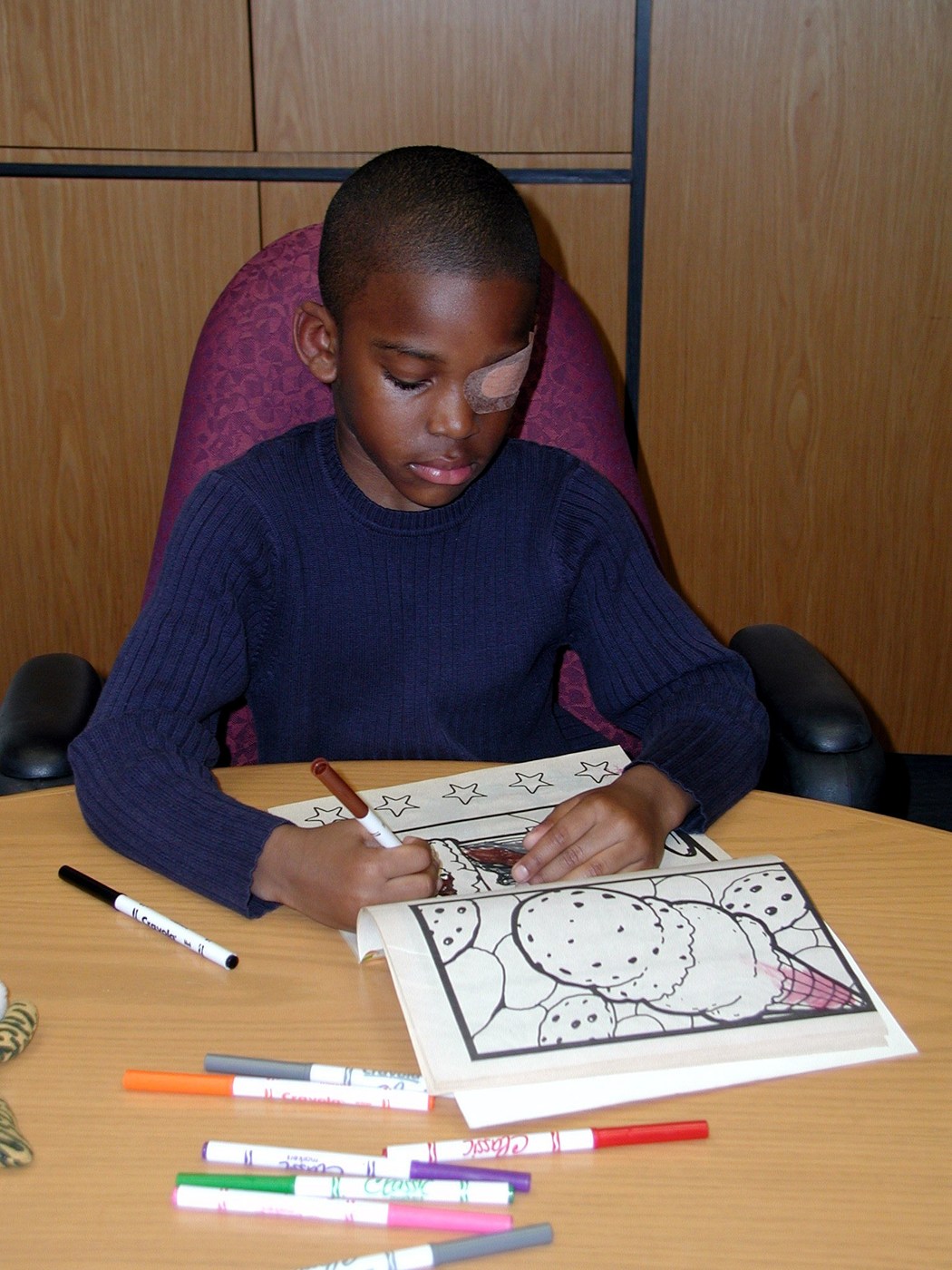
What the first eye chart could tell the family
In May 2003, the Pediatric Eye Disease Investigator Group reported results from 189 children aged three to six with moderate amblyopia. Even with optical correction, the affected eye could resolve only relatively large letters or symbols, with acuity ranging from 20/40 to 20/80. The investigators randomly assigned each family a patching schedule. Both schedules included at least an hour of close-up activity while wearing the patch. Four months later, 181 children returned for the outcome exam. The average gain in each group was 2.4 chart lines, meaning the children could pick out smaller symbols with the affected eye. [1]
One detail of the design is easy to overlook. Every family went home with instructions to patch. To find out how much patching added to glasses, the researchers needed a different comparison. In a study published in 2006, they assigned children who had already had a period of optical correction either to continue with glasses as needed or to add two hours of patching with close-up activity. At five weeks, the patching group had gained 1.1 lines on average. The comparison group had gained half a line. Counting the entire gain in the first group as a benefit of patching would give the patch credit for improvement also seen in children who continued without it. [4]
There is another reason to read the word prescribed carefully. In a separate 2007 British study, researchers fitted patches with electrodes that logged how long children actually wore them. Children assigned six hours received about two-thirds of that time on average. Those assigned twelve received about half. A trial that assigns families a schedule can tell us what happened when clinicians asked for that schedule. Working out what each extra hour of wear does to vision requires knowing when the patch was on. [5]
What a string of eye charts could tell the family
For the 2013 trial, a single eye chart could never qualify a child for enrollment. The 169 children, aged three to under eight, had residual amblyopia after at least twelve weeks of two-hour patching. Their acuity had stopped improving on that schedule. Only then did the investigators randomly assign families either to keep going at two hours or to increase patching to an average of six hours a day. The question begins at a visit many families in the earlier study might never have needed. [2]
Ten weeks later, children on the longer schedule had gained an average of 1.2 lines, compared with half a line among those continuing at two hours. The investigators also counted children who could read at least two lines farther down the chart. That happened for 40 percent of children assigned longer patching and 18 percent of those who stayed at two hours. Even among children selected because progress had stalled, some made substantial gains on their existing schedule. A plateau described what the clinician had measured so far. It could not predict the next chart with certainty. [2]
Put the two papers side by side and the value of saving those earlier eye charts becomes clear. A child starting treatment and a child returning after months of patching might read the same row today. For the first family, the 2003 study found little average return on four extra hours at the outset. For the second, the sequence of earlier readings may put the child in the group for whom those hours improved the odds of reading farther down the chart. The row the child reaches today matters. So does the path to it. [1][2]
Sources
- Pediatric Eye Disease Investigator Group, randomized trial of two patching schedules for moderate amblyopia, 2003.
- Pediatric Eye Disease Investigator Group, randomized trial of increasing patching for residual amblyopia, 2013.
- National Eye Institute, archival photograph AR02, via Wikimedia Commons.
- Pediatric Eye Disease Investigator Group, trial of adding two hours of patching after optical correction, 2006.
- Catherine E. Stewart and colleagues, objectively monitored patching regimens for amblyopia, BMJ, 2007.