An insecticide-treated bed net is easy to underestimate because it looks like a household object. It hangs over a bed, crib, mat, or sleeping space. It keeps insects away from skin. That first job matters, but it is only half the mechanism. The stronger public-health claim is that a treated net changes the night for both sides of malaria transmission: it protects the person sleeping underneath and it makes the mosquito's search for a blood meal more dangerous.[1][2]
That dual function is why treated nets became a core malaria intervention rather than just travel gear. CDC describes insecticide-treated nets as both personal protection and mosquito control, reducing malaria illness, severe disease, and death in endemic regions.[1] WHO's malaria fact sheet still lists insecticide-treated nets and indoor residual spraying as the two core vector-control interventions, even as vaccines, chemoprevention, diagnostics, and treatment have become more important parts of the malaria toolkit.[3] The net is not a cure and it is not a vaccine. It is a nightly interruption of contact between Anopheles mosquitoes, human blood, and Plasmodium parasites.
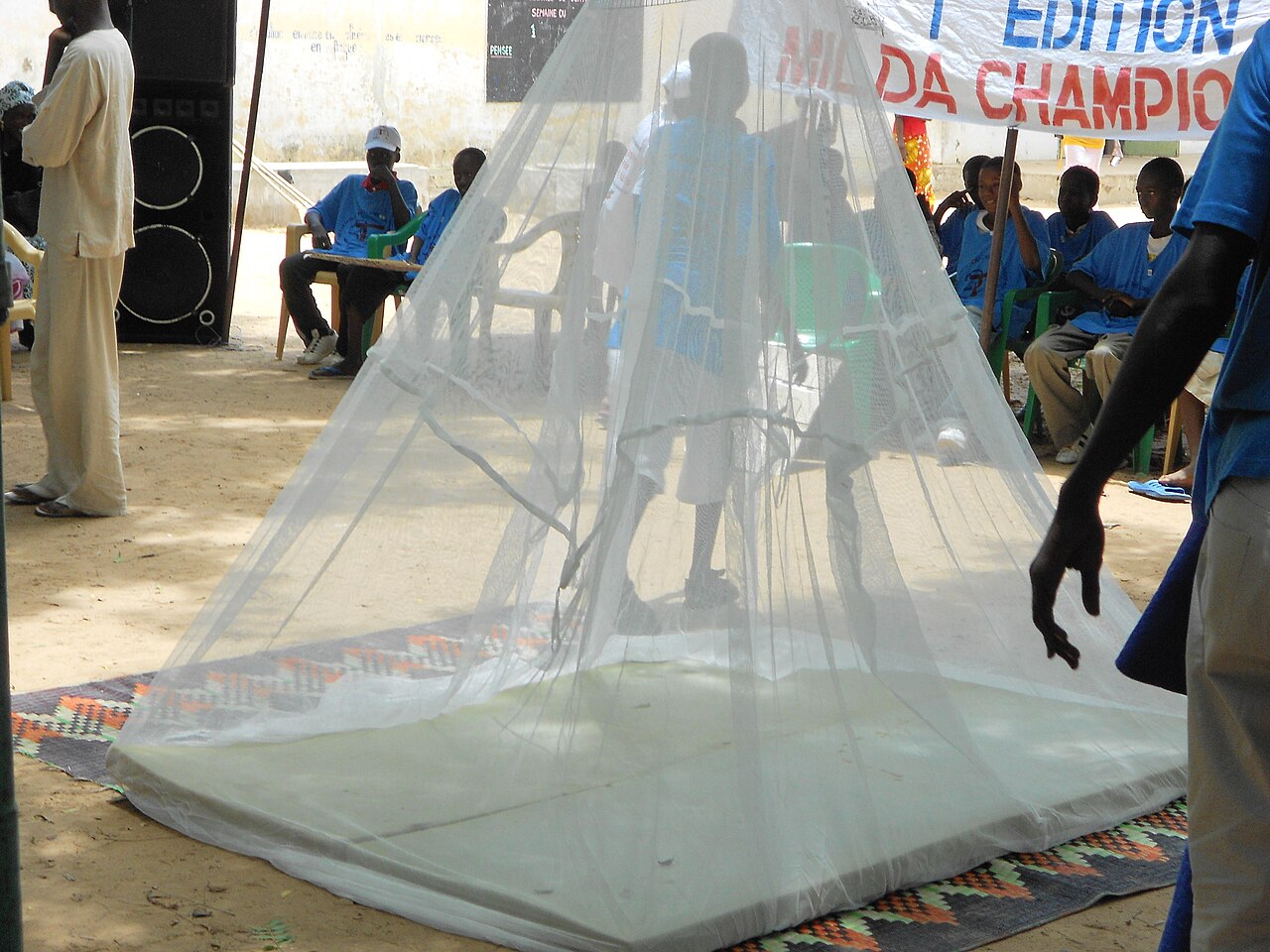
Image context: the photograph shows children in Mbacke, Senegal, demonstrating how to hang a long-lasting insecticide-treated net. The detail matters because the intervention is physical before it is statistical. A net has to be present, intact, correctly hung, and used during the mosquito's biting window before the trial result can become protection in a room.[5]
Timeline anchors
- 1987-2001: the randomized and cluster-randomized trials in the Cochrane review were conducted across Africa, Asia, and Latin America, before today's resistance environment became the default concern.[2]
- 2007: WHO shifted global guidance toward long-lasting insecticidal nets distributed free or highly subsidized and used by all community members in targeted areas.[7]
- 2017: WHO's universal-coverage guidance defined the goal as access to and use of appropriate vector-control interventions by all populations at risk.[4]
- 2024: WHO estimated 282 million malaria cases and 610,000 malaria deaths globally, with the African Region carrying about 95% of cases and deaths.[3]
- 2026 practice: treated nets remain central, but pyrethroid resistance and the need for newer net chemistries mean "a net" is no longer a single technical category.[1][3]
1. The first mechanism is simple contact prevention
Malaria transmission begins with a bite. An infected female Anopheles mosquito injects parasites while feeding; later mosquitoes can pick up parasites from infected people and continue the cycle. A net changes the geometry of that encounter. It makes the sleeping person harder to reach during the hours when many malaria vectors feed, especially for children and pregnant people who spend long nights in one protected space.
Untreated nets can reduce biting by acting as a physical barrier, but the evidence base for insecticide-treated nets is stronger because treatment adds a second layer. CDC explains that the insecticides on treated nets kill and repel mosquitoes, reducing the number that enter the house and attempt to feed on people inside.[1] WHO's pregnancy guidance states that sleeping under treated nets in malaria-endemic areas benefits pregnant women, fetuses, and newborn infants, and says long-lasting insecticidal nets are designed to maintain mosquito effectiveness for at least three years.[6]
That distinction matters for behavior. A torn or poorly tucked net can still block some contact, but gaps weaken the barrier. A net that is stored, too hot to sleep under, saved for guests, used only during a campaign visit, or hung over the wrong sleeping place is not delivering the same intervention the evidence tested. The technology depends on nightly use, and nightly use depends on comfort, household trust, replacement cycles, and whether the net fits the way people actually sleep.
2. The second mechanism is mosquito survival
The treated net is not just armor. It is also a trap placed at the mosquito's preferred destination. Malaria parasites need time inside the mosquito before that mosquito becomes infectious. If an insecticide-treated net kills or disables enough host-seeking mosquitoes, it does not merely prevent tonight's bite. It shortens the average life of the vector population and reduces the share of mosquitoes that survive long enough to transmit parasites.
This is the mechanism behind community protection. CDC notes that when community coverage is high, mosquito numbers and lifespan can fall, protecting even people who are not under a net.[1] That does not mean a household can ignore its own net because neighbors use theirs. It means the intervention has a population threshold logic: the more human-biting attempts that end at treated fabric, the harder it is for the parasite to keep moving through the local mosquito population.
Cochrane's review gives the clinical signal behind that mechanism. Across 23 trials with more than 275,000 adults and children, insecticide-treated nets continued to reduce malaria illness and child mortality. Compared with no nets, they reduced all-cause child mortality by 17% and were estimated to save 5.6 lives each year for every 1,000 children protected. They also cut uncomplicated Plasmodium falciparum episodes by almost half in the pooled trial evidence.[2] Those are not magic-fabric effects. They are the outcome of fewer infectious bites, fewer surviving mosquitoes, and fewer infected people available to sustain transmission.
3. Long-lasting nets solved one delivery problem and exposed another
Early treated nets required periodic retreatment. That made the intervention fragile: households had to obtain insecticide, mix and apply it properly, dry nets safely, and repeat the process every 6 to 12 months.[1] Long-lasting insecticidal nets changed the delivery problem by embedding or coating insecticide into net fibers so the protective effect could persist for years without household retreatment.[1][6]
That was a major public-health simplification. WHO's 2007 guidance emphasized long-lasting nets, free or highly subsidized distribution, and use by all community members in targeted areas. The same release described a Kenya scale-up in which young-child net use rose nearly tenfold from 2004 to 2006, supported by free distribution of 3.4 million long-lasting nets in selected districts.[7] The lesson was not just that nets worked. It was that access design worked: price, supply, campaigns, routine health services, and political commitment determined whether the object reached the bed.
But long-lasting does not mean permanent. Nets wear out, tear, lose insecticide potency, or disappear from households. CDC cites manufacturer delivery data showing more than 2.9 billion insecticide-treated nets supplied globally from 2004 to 2022, most of them to sub-Saharan Africa, while also warning that cost, availability, consistent use, and insecticide resistance remain challenges.[1] A net program therefore has to be a replacement program. It cannot be a one-time donation story.
4. Resistance changes the chemistry, not the logic
The classic long-lasting net relied heavily on pyrethroids. Pyrethroids were attractive because they were effective against mosquitoes and had low mammalian toxicity when used as intended on nets.[1] The problem is evolutionary pressure. If mosquitoes repeatedly encounter one insecticide class, populations with resistance mechanisms can survive and spread.
WHO now warns that insecticide resistance among Anopheles mosquitoes threatens malaria-control progress, while newer-generation nets can provide better protection than pyrethroid-only nets in resistant settings.[3] CDC describes newer nets that pair pyrethroids with piperonyl butoxide, a synergist that can reverse some pyrethroid resistance, or combine pyrethroids with additional insecticides such as chlorfenapyr or pyriproxyfen.[1]
The causal lesson is important. Resistance does not prove nets failed. It proves the treated-net mechanism is biological, local, and time-sensitive. The net works by shaping mosquito behavior and survival. If mosquito biology changes, the net chemistry and deployment strategy have to change as well. That is why contemporary malaria control is moving from "distribute nets" toward "distribute the right nets, replace them on time, track resistance, and combine them with diagnosis, treatment, chemoprevention, indoor spraying, and vaccines where appropriate."[1][3]
5. The boundary: a net cannot carry the whole malaria program
The strongest case for treated nets is also a warning against overclaiming them. WHO estimated that in 2024 children under five accounted for about 75% of malaria deaths in the African Region, and that Nigeria, the Democratic Republic of the Congo, and Niger together accounted for more than half of deaths in that region.[3] Those numbers describe delivery geography as much as parasite biology. A net can reduce exposure, but malaria control also needs rapid diagnosis, effective antimalarial treatment, pregnancy protection, chemoprevention in high-risk seasons, surveillance, and now vaccine rollout in eligible childhood programs.[3]
The bed net's particular genius is that it turns a vulnerable daily interval into a controllable site. Night arrives whether a clinic is nearby or not. Children sleep whether a laboratory is stocked or not. A properly used treated net moves prevention into that interval, around that body, in that room.
The practical conclusion is precise: an insecticide-treated net works when it is available, acceptable, intact, correctly used, chemically effective against local mosquitoes, and common enough to change mosquito survival beyond one bed. Its value is not that it is low-tech. Its value is that it makes the parasite's most ordinary route - the night-time bite - repeatedly fail.
Sources
- Centers for Disease Control and Prevention, "Insecticide-Treated Nets" (April 2, 2024) - mechanism, long-lasting nets, coverage, delivery data, and resistance challenges.
- Cochrane, "Insecticide-treated nets for preventing malaria" - systematic review summary of 23 trials, mortality effect, malaria episode reductions, and evidence certainty.
- World Health Organization, "Malaria" fact sheet (4 December 2025) - 2024 burden estimates, vector-control role, resistance warning, and prevention/treatment context.
- World Health Organization, "Achieving and maintaining universal coverage with long-lasting insecticidal nets for malaria control" (17 December 2017) - universal-coverage definition and LLIN policy context.
- Wikimedia Commons, "Promoting long-lasting insecticide treated nets (6096699204).jpg" - USAID Africa Bureau photograph from Mbacke, Senegal, used as the article image.
- World Health Organization eLENA, "Insecticide-treated nets to reduce the risk of malaria in pregnant women" (last updated 9 August 2023) - pregnancy-specific benefit, safety framing, and three-year LLIN durability statement.
- World Health Organization, "WHO releases new guidance on insecticide-treated mosquito nets" (15 August 2007) - long-lasting-net policy shift, Kenya distribution example, and cost/access framing.