The Glasgow Coma Scale is often remembered as a number. A patient is "GCS 15" or "GCS 3," and the shorthand moves quickly through an ambulance report, trauma bay, ward round, or research table. The 1974 paper by Graham Teasdale and Bryan Jennett deserves a closer reading because its strongest idea was not the number by itself. Its stronger idea was to make impaired consciousness portable as three visible responses: eye opening, verbal response, and motor response.[1][2]
That distinction still matters. A single total score can compress the patient too aggressively. The scale's design asks the clinician to say what was actually seen, not merely what the arithmetic produced. A person whose eyes open to speech, whose words are confused, and whose hand localizes pain is not clinically identical to another person with the same sum built from a different pattern. The point of the scale is therefore descriptive before it is predictive.[2][3][6]
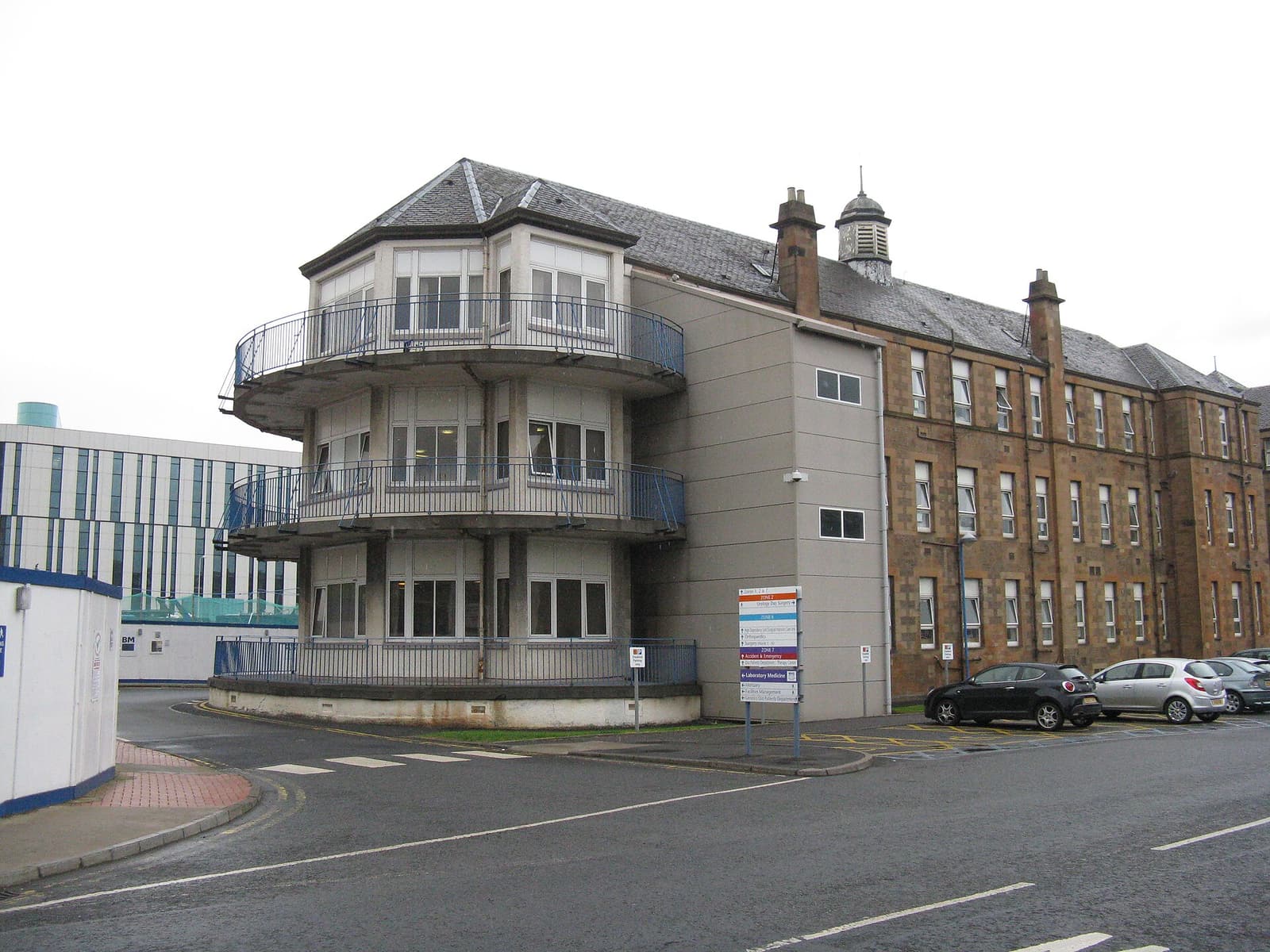
Image context: the cover photograph shows Southern General Hospital in Glasgow. It is a place-specific hospital image rather than a diagram because this article is about a clinical language born from repeated bedside observation, not a chart as an object.[7]
Timeline anchors
- 1974: Teasdale and Jennett published "Assessment of coma and impaired consciousness. A practical scale" in The Lancet, setting out a bedside method for describing the depth and duration of impaired consciousness.[1]
- 1979: the separate observations were formalized further into the added-up Glasgow Coma Score, helping the scale enter data systems and group comparisons.[2]
- 2014: a 40-year review in Lancet Neurology argued that the scale had become integral to clinical practice and research worldwide, while warning that predictions should combine GCS with other variables and that individual patients are best described by the three components.[6]
- 2017: a study of 54,069 adults with traumatic brain injury showed why the component profile matters: the combined three components carried more prognostic information than the sum score alone across TBI severities.[3]
The title says "practical," and that is the argument
The 1974 title is plain in a revealing way: "Assessment of coma and impaired consciousness. A practical scale."[1] "Practical" is doing heavy work. Teasdale and Jennett were not offering a complete theory of consciousness, a full neurological examination, or an outcome guarantee. They were solving a communication problem in acute care: how to describe a patient's conscious level in terms clear enough that another clinician could recognize the state and compare it later.[1][6]
The three chosen domains are clinical because they are observable at the bedside. Eye opening asks whether arousal appears spontaneously, to sound, to pressure, or not at all. Verbal response asks whether speech is oriented, confused, inappropriate, incomprehensible, or absent. Motor response asks how the patient moves in response to command or stimulus, from obeying to localizing, withdrawing, abnormal flexion, extension, or no response.[2][5]
This is a lean architecture. It does not require the examiner to infer motivation, diagnose the cause of coma, or decide whether the brain injury is recoverable. It asks for a disciplined report of response. That is why the scale traveled. A good handoff needs a grammar that survives distance: from scene to ambulance, from emergency department to neurosurgery, from nurse to doctor, from one hospital day to the next.[5][6]
The score came after the scale, and it can mislead when it becomes the whole story
The official Glasgow Coma Scale FAQ makes a crucial historical and practical distinction: the scale describes eye, verbal, and motor responses, while the numeric score is produced by adding those ratings together.[2] The total ranges from 3 to 15, and it became useful because numbers move easily through charts, guidelines, severity bands, and databases.[2][5]
The danger is that arithmetic can look more exact than observation. Source [2] notes that the 11 intermediate scores between 3 and 15 can reflect 118 different combinations of the three responses, not all of them clinically realistic. That fact is the best short argument against saying only "GCS 10" when the component profile is available. The same number can hide different patients.
The 2017 component study sharpens this point with outcome data. In low total-score ranges, motor response dominates because eye and verbal responses hit floor effects. At higher total-score ranges, eye and verbal responses become more informative. The authors found that different component profiles could have significantly different case fatality rates even when the total score was identical, and they recommended multidimensional use of the three-component GCS.[3] That is the modern statistical version of the original close-reading point: the scale's durable unit is the observed response, not just the sum.
The scale works best as a trend, not a one-time verdict
The bedside value of GCS is temporal. It gives a starting point and then a way to notice movement. NCBI's trauma neurological exam chapter describes GCS as a commonly used system for assessing level of consciousness in TBI, usable by relatively inexperienced providers in prehospital and hospital settings, but it also stresses serial assessment after traumatic injury.[5] A single score can be falsely calming; a falling pattern can demand attention.
This is why the phrase "level of consciousness" should not be mistaken for a diagnosis. Sedation, hypoxia, hypotension, hypoglycemia, intoxication, orbital trauma, airway tubes, language barriers, and focal deficits can all distort what can be tested or what a response means.[5][6] The scale standardizes a slice of observation. It does not remove clinical context.
That boundary is not a weakness if the scale is read correctly. A blood pressure number also needs context; so does oxygen saturation, temperature, or creatinine. GCS is useful because it turns a hard-to-describe state into a repeatable observation set. It becomes risky only when the number is asked to answer questions it was not built to answer: cause, reversibility, long-run outcome, or safety of discharge by itself.[5][6]
Reliability depends on standardization, not folklore
The official FAQ summarizes the reliability literature in a way that fits the original design. Consistency improves with training, education, use of the scale rather than only the score, and a standardized approach.[2][4] That last phrase matters because "GCS" can sound self-executing: say the term, write the number, move on. The evidence points the other way. The scale works when examiners use the same criteria and record untestable components honestly rather than forcing them into false arithmetic.[2][5]
The 40-year review makes the same argument from the scale's afterlife. It credits GCS with replacing inconsistent earlier descriptions and becoming common in practice and research, but it also says predictive statements should be made only with other variables in a multivariable model.[6] In plain terms, GCS is a language, not an oracle.
That is the most useful way to remember the 1974 paper. Its achievement was not that it made coma simple. It made one important part of coma assessment shareable. Eye, verbal, and motor responses gave clinicians a compact way to say what they saw, repeat it later, and compare it across settings. The total score helped the language travel further, but the three observations are what keep the language honest.[1][2][3][6]
Sources
- Graham Teasdale and Bryan Jennett, "Assessment of coma and impaired consciousness. A practical scale" (The Lancet, 1974; PubMed record for the original GCS paper).
- GlasgowComaScale.org, "FAQ" - official implementation notes on scale versus score, reliability, timing of observations, component recording, and score limitations.
- Florence C. M. Reith et al., "Differential effects of the Glasgow Coma Scale Score and its Components: An analysis of 54,069 patients with traumatic brain injury" (Injury, 2017; PubMed abstract).
- Florence C. M. Reith et al., "The reliability of the Glasgow Coma Scale: a systematic review" (Intensive Care Medicine, 2016; PubMed abstract).
- Andrew Clark, Joe M. Das, and Fassil B. Mesfin, "Trauma Neurological Exam" (StatPearls, NCBI Bookshelf; updated 2024) - clinical context for GCS use, serial assessment, and confounders.
- Graham Teasdale et al., "The Glasgow Coma Scale at 40 years: standing the test of time" (Lancet Neurology, 2014; PubMed abstract).
- Wikimedia Commons, "File:Southern General Hospital (geograph 3961767).jpg" - photographic source page for the cover image.