Guinea worm disease is a rare eradication story because its central technology is not a vaccine, an antibiotic, or a miracle cure. The parasite is being pushed toward extinction by interrupting a loop: contaminated water enters a person, a worm matures silently for about a year, the emerging worm drives the person toward water for pain relief, larvae enter the pond, copepods ingest the larvae, and the next drink restarts the cycle.[2][3]
That mechanism explains both the campaign's astonishing progress and its stubborn final difficulty. The Carter Center says the disease fell from an estimated 3.5 million human cases a year in 1986 to 10 provisional human cases in 2025.[1][5] WHO's Global Health Observatory reports the same recent scale: 10 cases in 2025, 15 in 2024, 14 in 2023, and 13 in 2022.[3] The remaining problem is not ignorance of the parasite. It is reliability at the last mile, village by village, water source by water source, animal infection by animal infection.
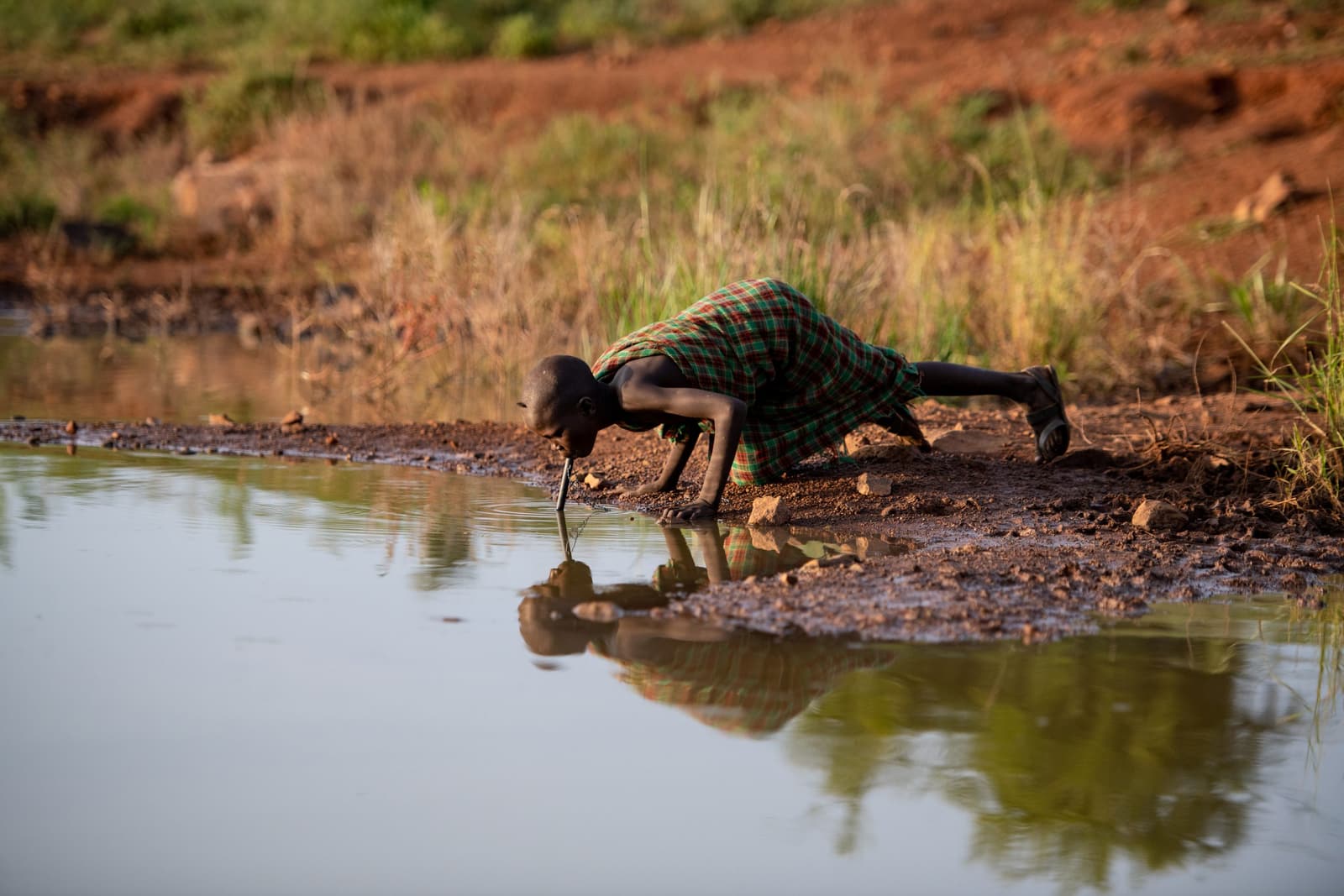
Image context: the cover photograph shows a pipe filter in actual use in South Sudan. That matters because this article's core claim is practical. The eradication program works when ordinary acts - drinking, bathing, washing, handling fish waste, reporting a suspect worm, tethering a dog - are redesigned so the parasite cannot complete its route through water.[1]
Timeline anchors for the mechanism
- 1981: WHO's fact sheet places dracunculiasis elimination inside the International Drinking Water Supply and Sanitation Decade, framing it as a water-and-behavior target before the Carter Center joined the campaign.[3]
- 1986: the Carter Center entered the global campaign; at that point, millions of annual cases occurred across Africa and Asia.[1][5]
- 2012: animal infections became a major complication, especially in dogs in Chad, forcing the program to expand beyond human case containment.[2][4]
- 2024: CDC reported 15 human cases and 664 animal infections worldwide, showing that human incidence was tiny while animal transmission still had scale.[4]
- 2025: the Carter Center announced 10 provisional human cases, the lowest number recorded, with cases in Chad, Ethiopia, and South Sudan.[5]
1. The target is the pond, not only the wound
The clinical drama of Guinea worm happens at the skin. A mature female worm can emerge through a painful blister, often on the leg or foot, and removal can take days to weeks by slow winding and wound care.[2] That image is so memorable that it can distort the public-health logic. Treating the wound matters for the patient, but eradication depends on what happens before and after the wound touches water.
CDC's clinical overview lays out the transmission hinge. People or animals with emerging worms often enter water to relieve pain or to perform ordinary daily tasks. Water contact triggers the worm to release larvae. Copepods in stagnant water swallow the larvae. Humans or animals then consume infected copepods, and the cycle begins again.[2] The program's first move is therefore not to kill the worm inside the body. There is no drug or vaccine that does that job at campaign scale.[1][2] The first move is to keep infected water from becoming the next exposure.
That is why filters are more than a cheap substitute for medicine. A cloth or pipe filter physically removes copepods from drinking water when a safe borehole or protected source is not available.[1][3] The filter works because the parasite uses the copepod as a delivery vehicle. Remove the vehicle from the sip, and the route into the body breaks.
2. Case containment turns a blister into a firewall
Once a worm emerges, the patient still needs care: soaking the limb away from a drinking-water source, cleaning the wound, winding the worm gradually, applying topical antibiotic, bandaging, and repeating the process until removal is complete.[2] These steps relieve suffering and reduce secondary infection. They also serve a population function. If the patient does not enter a pond while the worm can release larvae, one case is less likely to become several future cases.
This is the causal beauty of case containment. It treats the person humanely while treating the water source as the real public-health boundary. WHO lists case containment, surveillance, reporting rewards, safe water, filters, vector control, and community education as linked eradication measures, not separate slogans.[3] They are linked because each measure closes a different opening in the cycle.
The long incubation period makes that containment unforgiving. WHO reports that it takes 10-14 months for the cycle to complete from infection to worm emergence.[3] A village can look quiet for months while exposures from the prior year are still moving through bodies. That delay is why surveillance cannot stop just because cases become rare. By the time an emerging worm proves transmission happened, the mistake is already old.
3. The campaign succeeds by making small behaviors repeatable
Guinea worm eradication is often described as a victory of community education, and that is true, but too soft unless the mechanics are named. The behaviors are specific: filter every drink from unsafe stagnant water, keep a person with an emerging worm out of drinking sources, report suspect cases quickly, apply temephos to selected water bodies, and maintain surveillance even where nobody has seen a case recently.[1][3][4]
The Carter Center's program page emphasizes that the campaign depends on ministries of health, WHO certification, CDC laboratory verification, UNICEF's role in safe water, and community volunteers who keep the work visible locally.[1] That institutional layering matters because no single household behavior is enough. A filter helps only if people have it, trust it, and use it. Reporting rewards help only if people know they exist and the investigation follows quickly. Larvicide helps only if teams can reach the right ponds on schedule. Certification helps only if zero cases are backed by active surveillance rather than by silence.
This is why the decline from millions of cases to double digits is not a simple "technology adoption" curve. It is a reliability curve. The disease falls when ordinary rural systems become precise enough to notice one blister, one dog, one rumor, one unsafe pond, and one broken habit before a chain restarts.
4. Animal infections are the last-cycle problem
The hardest recent lesson is that humans were not the only reservoir that mattered. CDC notes that animal infection has been a challenge since 2012, with attention to possible transmission through fish, frogs, or other aquatic animals carrying larvae, plus control measures such as tethering dogs, fully cooking aquatic animals, and not feeding fish guts to dogs.[2] CDC's 2024-2025 MMWR puts the problem in numbers: 664 animal infections were reported worldwide in 2024, and 550 were reported during January-June 2025 alone.[4]
That changes the eradication endpoint. If infected dogs, cats, baboons, or wild carnivores can contaminate water or sustain transmission, then zero human cases is not enough. The Carter Center's 2026 announcement says eradication requires stopping infections in both humans and animals, and reported 147 animal infections in Chad, 445 in Cameroon, 70 in Angola, 17 in Mali, 3 in South Sudan, and 1 in Ethiopia in 2025.[5] Those animal numbers are the reason the final phase remains technically difficult even when the human case count is historically low.
The mechanism also explains why final eradication is political and logistical, not just biological. CDC identifies civil unrest and insecurity in places such as Mali, South Sudan, and Sudan as threats to access, surveillance, and intervention.[4] A parasite that depends on water can still survive if public-health teams cannot safely reach water sources, villages, animal cases, or cross-border transmission zones.
What Guinea worm teaches
Guinea worm's near-eradication is not a story about medicine being absent. It is a story about medicine being distributed into tools, habits, maps, laboratories, rewards, and village-level trust. The campaign works because it reads the parasite as a route. Each intervention blocks a segment: filters block ingestion, case containment blocks larval release, temephos blocks copepods, education blocks risky water contact, and animal surveillance blocks the newest reservoir problem.[1][2][3][4][5]
That is why the last cases matter so much. At 10 human cases, the disease is no longer a broad epidemic in the old sense. It is a test of whether a global program can keep a microscopic water cycle from hiding inside remote, insecure, or animal-linked transmission. Guinea worm is nearly gone because public health stopped waiting for a cure and made the parasite's route through daily life increasingly impossible.
Sources
- The Carter Center, "Guinea Worm Disease" - program overview, campaign roles, 2025 case count, image caption for the pipe-filter photograph, and summary of filter/community interventions.
- Centers for Disease Control and Prevention, "Clinical Overview of Guinea Worm" - transmission cycle, animal infection challenge, no-drug/no-vaccine boundary, and patient-management steps.
- World Health Organization Global Health Observatory, "Dracunculiasis" - current case counts, 10-14 month cycle, transmission route, and country-level 2025 distribution.
- CDC MMWR, "Progress Toward Eradication of Dracunculiasis (Guinea Worm Disease) - Worldwide, January 2024-June 2025" - recent human and animal infection counts, country details, and final-stage challenges.
- The Carter Center, "Guinea Worm Disease Reaches All-Time Low: Only 10 Human Cases Reported in 2025" (Jan. 30, 2026) - provisional 2025 human and animal case counts, country distribution, and final-stage framing.