The home pregnancy test is easy to flatten into a convenience story. In that version, medicine discovers a hormone, a product reaches the pharmacy shelf, and women simply get the same answer faster. The chronology is more revealing than that. What changed in the 1970s was not only turnaround time. Pregnancy confirmation moved from a physician-controlled sequence of sample collection, laboratory handling, and delayed reporting into domestic space, where the first person to know the answer could now be the person whose body was in question.[1][2][4]
That shift depended on several layers arriving in the right order. Older pregnancy testing was slow, centralized, and often biologically extravagant, relying on animal assays or laboratory immunology that patients could not perform themselves.[1][5] Then hCG testing became more specific. Margaret Crane recognized that the visual logic of the laboratory test could be redesigned into a self-contained kit.[1][3][4] Finally, the new U.S. device regime of the mid-1970s created a regulatory gate through which a home test had to pass before it could become an ordinary retail object.[1][4]
That is why a narrative chronicle fits this history better than a simple invention story. The home pregnancy test was not born in one dramatic instant. It emerged from a relay: laboratory endocrinology, industrial design, device regulation, magazine advertising, and a new social argument about privacy and self-knowledge.[1][2][3][4]
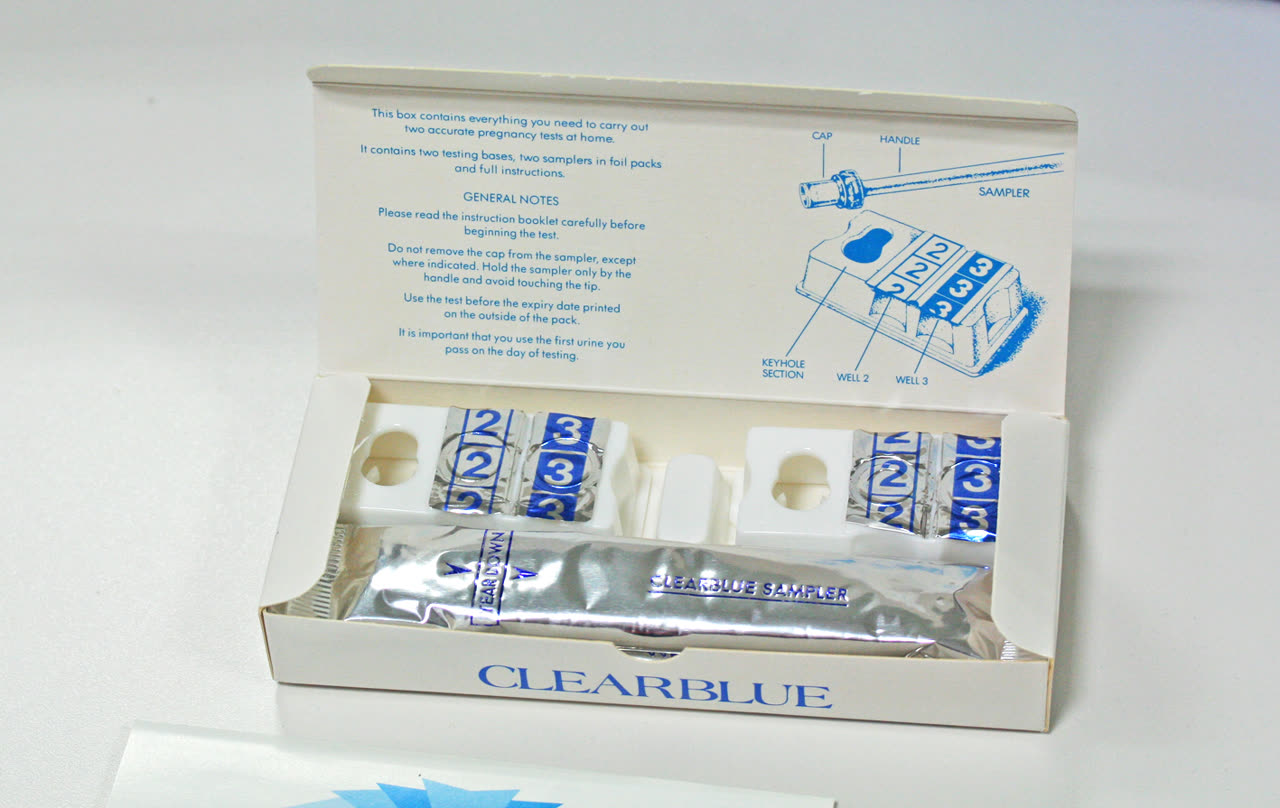
Image context: the cover uses a real product photograph of a Clearblue home pregnancy test system from 1985.[6] It is later than the first American launch, but that is part of why it works here. The article is about the moment pregnancy testing stopped being only a laboratory service and settled into recognizable consumer form: box, instructions, retail branding, and an answer delivered inside the home.
Timeline anchors
- 1927-1934: clinically useful pregnancy bioassays entered practice through animal-based methods associated with Aschheim, Zondek, Friedman, and Xenopus testing.[5]
- 1968: Margaret Crane received a patent on her diagnostic test device, the kit architecture behind Predictor.[3][4]
- 1972: Judith Vaitukaitis, Glenn Braunstein, and Griff Ross published the beta-hCG radioimmunoassay that could distinguish hCG from luteinizing hormone much more specifically.[1][2]
- 1976: FDA approval was sought for
e.p.t.and, according to NIH's history, the first home-use tests had to satisfy the new Medical Device Amendments framework; Predictor, ACU-TEST, and Answer were also treated as substantially equivalent.[1] - Late 1977:
e.p.t.was ready for the American market after packaging and labeling work with FDA.[1] - 1978: major women's magazines began carrying home-pregnancy-test advertisements, and the test's privacy claim became part of the product itself.[1]
Before the box, pregnancy confirmation belonged to the laboratory
The older system did not simply lack miniaturization. It distributed authority differently. FDA's hCG guidance preserves the older lineage in compact form: clinically useful pregnancy bioassays were introduced through methods associated with 1927, 1931, and 1934, before immunoassays took over later.[5] Those methods mattered historically because they made early biologic diagnosis possible, but they also kept diagnosis outside ordinary domestic life. A suspected pregnancy became a specimen problem.
NIH's illustrated history makes the practical burden visible. Even into the early 1970s, women could still be instructed to collect a first-morning urine sample in a clean jar and take it to a laboratory, or mail for a kit and ship the sample out for testing.[1] That is a very different rhythm from the one modern readers assume. The uncertainty interval was not just emotional waiting. It was organizational waiting: appointment, collection, transport, laboratory procedure, and then the return of information from someone else.
This is the first important correction. The home test did not simply improve a piece of chemistry. It interrupted a chain of dependency. Before the home kit, a woman could suspect pregnancy and still have to pass through multiple hands before suspicion hardened into an answer.[1][5]
hCG specificity made home testing technically plausible
The key laboratory turn was not just finding hCG. It was getting specific enough about it. Vaitukaitis's historical summary explains that hCG was initially being studied at NIH as a tumor marker, and that refinement of hCG detection made it readily applicable to pregnancy diagnosis.[2] NIH's own timeline identifies the decisive 1972 publication more sharply: the beta-subunit radioimmunoassay could distinguish hCG from luteinizing hormone, finally making the assay useful for early pregnancy detection rather than for a blur of overlapping endocrine signals.[1]
That specificity mattered because a home test cannot survive on vague signal. A physician or laboratorian can compensate for ambiguity with context, repeat testing, or caution. A retail box cannot. Once a product is intended for use by someone alone in a bathroom or bedroom, the test has to deliver a result architecture that is legible without expert mediation. In that sense, the scientific breakthrough and the consumer breakthrough were inseparable.[1][2]
NICHD's patient information page preserves the long afterlife of that work. It states directly that NICHD research in the 1970s helped lead to the home pregnancy test after researchers studying hCG in cancer care recognized the hormone's value in urine pregnancy detection.[7] That is a revealing route. One of the most intimate home diagnostics in everyday life was enabled by research that was not originally organized around domestic privacy at all.
Margaret Crane turned a bench ritual into a private kit
Science and product design did not meet automatically. The Smithsonian object record for Predictor is unusually helpful because it describes not just the claim but the physical logic of the kit.[4] Crane, working as a graphic designer for Organon, patented a diagnostic test device in 1968.[3][4] The patent itself makes the design problem plain: a transparent container, a supported test vial, a guided dropper, and an angled mirror at the bottom so results could be viewed from outside the vessel.[3]
That mirror matters more than it first appears. It tells you that the challenge was not merely "make a small test." The challenge was to let an untrained user perform a delicate immunologic procedure and then read a sedimentation pattern reliably enough to trust it.[3] Predictor's later museum description keeps the same point in practical language. A woman added a few drops of urine, added solution, shook the tube, let it rest for about two hours, and then looked for a dark brown circle on a yellow field in the bottom mirror.[4]
This is where the article stops being an abstract history of diagnostics and becomes a health history of control. Crane's design did not just package reagents. It packaged interpretive authority. The result could now appear in the user's own line of sight rather than in a phone call or office report delivered later by someone else.[3][4]
The 1976 device gate mattered because pregnancy diagnosis had become a consumer risk
A home pregnancy test is now so ordinary that it is easy to miss how regulatory its birth was. NIH's history says e.p.t. sought FDA approval in 1976 and had to meet the requirements of the 1976 Medical Device Amendments; Predictor, ACU-TEST, and Answer were treated as substantially equivalent products in the same moment.[1] That date matters because it places the home test inside the new American device regime almost immediately.
Why did that matter? Because once the test moved out of the lab, error changed meaning. A wrong answer inside a laboratory is still serious, but it is buffered by professionals, repeat procedures, and institutional review. A wrong answer in the home immediately changes behavior. FDA's current consumer page still reflects that logic decades later: the result depends on hCG level, timing in the cycle, and the user's ability to follow instructions correctly.[8]
The 1976-1977 gate was therefore not bureaucratic scenery. It was the state deciding that pregnancy diagnosis had become a medical device problem rather than only a professional-service problem. That distinction helped determine packaging language, instructions, and the conditions under which uncertainty could be sold to the public as a manageable test rather than an expert monopoly.[1][8]
In 1978, privacy became part of the product
The retail launch changed the emotional and political meaning of the assay. NIH's timeline says that by 1978, e.p.t. advertisements were appearing in Mademoiselle, McCall's, Redbook, Family Circle, Ladies' Home Journal, Good Housekeeping, and Vogue.[1] The same page quotes Mademoiselle's description of the product: for $10, the buyer got pre-measured ingredients, a dropper, and a plastic support with an angled mirror at the bottom; the test took two hours and was more accurate for positive than for negative results, about 97% versus 80% in the magazine's summary.[1]
Those details matter because they show what home diagnosis looked like at birth. It was not yet the near-instant strip that modern users know. It was slow, fiddly, and still partly laboratory-like. Yet it already delivered the decisive social change. NIH's account notes that the advantages cited in consumer writing included privacy and the chance to start taking care of oneself early, or to consider early abortion without waiting for a doctor's confirmation.[1]
That is the deeper public-health turn. The home pregnancy test changed not only when people knew, but what they could do with earlier knowledge. Timing moved closer to behavior: medication avoidance, prenatal planning, abortion decision-making, or simply the psychological fact of knowing before disclosure to family, clinician, or partner.[1][7][8]
Why this chronology still matters
The most useful conclusion is narrower than "technology got better" and stronger than nostalgia about a clever box. The home pregnancy test changed medicine by shifting the first site of confirmation. In the older system, diagnosis flowed outward from lab and doctor toward the patient. By the late 1970s, the answer could originate in the patient's own hands and move outward from there.[1][3][4]
That is why the history still reads clearly in 2026. Home diagnostics are now everywhere, but the pregnancy test was one of the earliest and most culturally consequential examples of a private person running a meaningful medical assay alone. The chemistry mattered. The patent mattered. FDA's device gate mattered. What tied them together was a redistribution of who gets certainty first.
Sources
- Office of NIH History and Stetten Museum, "Thin Blue Line: A History of the Pregnancy Test" - timeline covering the 1972 beta-hCG assay, the 1976 FDA/device gate for
e.p.t., the 1977 market readiness, the 1978 advertising wave, and the privacy argument around home use. - Judith L. Vaitukaitis, "Development of the home pregnancy test" (Annals of the New York Academy of Sciences, 2004) - PubMed record and abstract on NIH hCG research, specificity, and the route from tumor-marker work to pregnancy detection.
- Margaret M. Crane, Diagnostic test device (U.S. Patent 3,579,306) - the 1969 filing / 1971 patent text describing the integrated container, dropper, test vial, and angled mirror used in the home-kit design.
- Smithsonian Institution, "Predictor Pregnancy Test" - museum object record on Margaret Crane's design, the two-hour procedure, the bottom-mirror readout, Canadian sales, and 1976 U.S. FDA approval timing.
- U.S. Food and Drug Administration, "Guidance for Over-the-Counter (OTC) Human Chorionic Gonadotropin (hCG) 510(k)s" - FDA guidance summarizing the older animal bioassays, the shift to immunoassays, and the modern analytical framework for home hCG testing.
- Wikimedia Commons, "File:Clearblue home pregnancy test system 1985.jpg" - documentary product photograph used for the article image.
- Eunice Kennedy Shriver National Institute of Child Health and Human Development, "How do I know if I'm pregnant?" - NICHD page linking 1970s NIH hCG research to the later home pregnancy test and summarizing the modern urine-test principle.
- U.S. Food and Drug Administration, "Pregnancy" - FDA consumer page on what home pregnancy tests measure, why timing matters, and why a negative early result can remain provisional.