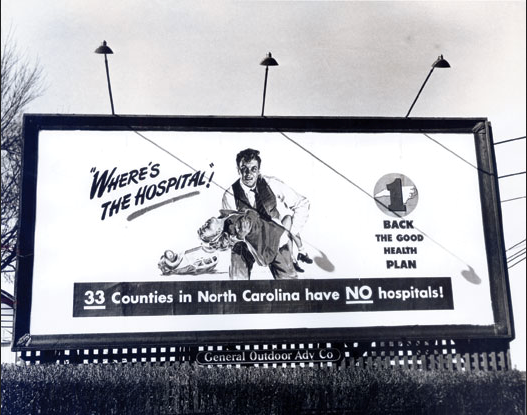
The billboard asks the question in the blunt grammar of a county without a ward: "Where's the hospital?" Its bottom line says that 33 counties in North Carolina had no hospitals, and its answer is to back the Hill-Burton plan.[5] That is the right image for the law because the Hospital Survey and Construction Act of 1946 did not begin by promising a medical card, a treatment guideline, or a new professional specialty. It began with absence. Some communities had no usable hospital at all, and many had facilities too old, too small, too poorly distributed, or too financially weak to make modern care feel physically reachable.[1][2][5]
Reading the statute closely changes the usual memory of postwar health policy. Hill-Burton was not universal health insurance. It was not Medicare before Medicare. It was a public-works approach to health: survey the shortage, rank the need, write a state plan, set construction and equipment standards, send federal matching money, and require public or nonprofit facilities to carry some obligations in return.[1][3] Its deepest assumption was that access to care was partly a geography problem. A hospital bed had to exist somewhere near enough, staffed enough, and stable enough to make medical progress usable.
That assumption came straight out of the postwar moment. In November 1945, President Harry Truman told Congress that about 1,200 counties, covering roughly 15 million people, had either no local hospital or no hospital meeting minimum professional standards.[2] He also warned that buildings would not solve everything by themselves: facilities had to be staffed, and communities needed enough purchasing power to use them.[2] Hill-Burton answered the first half of that warning more directly than the second.
The first important word is "survey"
The statute's formal title is easy to skim, but it names the mechanism: hospital survey and construction.[1] Before a state could build with federal aid, it had to inventory existing hospitals and public health centers, survey the need for construction, designate a single state agency, consult an advisory council, and build a statewide plan.[1] The law treated shortage as something to be made legible before it could be subsidized.
That matters because the policy was not simply "build more hospitals." The law asked states to sort needs by geography, population, financial resources, and underserved areas. It gave special attention to rural communities and places with relatively small financial resources.[1] The Commonwealth Fund's account of pre-Hill-Burton rural hospital work shows why that planning language had force: private demonstration projects had proved useful, but the national shortage was far beyond what philanthropy could build one town at a time.[5]
The federal government also refused to become the direct hospital builder. Truman's 1945 message proposed a division of labor: federal aid and standards, state and local participation, and no federal operation of the hospitals themselves.[2] Hill-Burton follows that federal-state contract logic. States wrote plans; the Surgeon General and Federal Hospital Council reviewed them; public and nonprofit applicants received aid only through an approved planning apparatus.[1]
The law made capacity measurable
Hill-Burton's promise is clearest when the statute turns need into bed capacity. It instructed federal officials to set regulations estimating the beds required for adequate hospital services in each state, with different density formulas for general hospitals and special provisions for tuberculosis beds and public health centers.[1] That language can feel technocratic, but it reveals a crucial premise: health access could be translated into a facility map.
Later evidence suggests the map mattered. A Congressional Research Service report summarized the program as aid for planning, construction, and improvement through grants, loans, and guaranteed loans, and reported that since 1946 it had assisted more than 6,900 hospitals and other health care facilities in more than 4,000 communities.[3] The Commonwealth Fund gives a narrower early-project view, noting that Hill-Burton funded nearly 4,700 projects in its first 20 years.[5]
Economists Andrea Park Chung, Martin Gaynor, and Seth Richards-Shubik found the capacity effect was persistent rather than cosmetic. Using county-level data, they estimated that Hill-Burton accounted for a net increase of more than 70,000 hospital beds nationwide, roughly 17 percent of total U.S. hospital-bed growth from 1948 to 1975.[4] They also found that bed differences across counties fell, including differences between high- and low-income counties, rural and urban counties, and the South and the rest of the country.[4] In other words, the law did not merely announce equity; it moved steel, wards, and institutional location.
The access clause carried both promise and compromise
The most revealing part of the primary text is not the construction language alone. It is the access bargain attached to federal aid. State plans had to provide adequate hospital facilities without discrimination on account of race, creed, or color, and facilities had to make a reasonable volume of services available to people unable to pay.[1]
Those words gave Hill-Burton a moral reach beyond architecture. A publicly aided hospital could not be imagined as a purely local asset serving only the patients a board preferred. The construction subsidy created obligations: serve the area's people, include those unable to pay, and accept some federal oversight in exchange for federal money.[1][3]
But the same statutory passage also shows the boundary. The 1946 law allowed an exception for separate facilities for separate population groups if the plan claimed equivalent need and quality. It also allowed an exception to the free-care requirement if providing such care was not financially feasible.[1] That is the uncomfortable close-reading point. Hill-Burton spoke the language of public access while still carrying the compromises of its time: segregated hospital systems were not broken by the original text, and uncompensated care was framed as a volume obligation with escape hatches rather than as a universal right.[1][3]
The later uncompensated-care rules show how long that bargain lasted. CRS describes grant recipients under Title VI as generally owing free care for 20 years after project completion, while later Title XVI grants carried obligations in perpetuity; the annual minimum was tied to either inflation-adjusted federal assistance or a share of operating costs.[3] That structure made charity care part of the construction contract, but it also made access depend on notices, eligibility determinations, local compliance, and administrative enforcement.[3]
Truman's warning was the flaw inside the success
Truman had already named Hill-Burton's weakness before the law existed. Federal aid for construction, he said, would be futile unless people had the purchasing power to use the hospitals and doctors had reasons to practice where they were needed.[2] The 1946 statute solved the facility problem more cleanly than the payment problem. It could help create a hospital in a county. It could not, by itself, make every patient able to afford care, every hospital financially durable, or every community attractive enough to recruit staff.
That distinction is why Hill-Burton is strongest when read as infrastructure policy, not as complete health policy. Infrastructure can change what is possible. A county without a hospital becomes a county where births, emergencies, surgeries, and inpatient care can plausibly happen nearer home. But infrastructure also inherits the surrounding payment system, labor market, racial order, and local politics.[1][2][3]
The law's achievement and its incompleteness therefore belong together. It helped turn a patchy hospital landscape into a more distributed national hospital system.[3][4] It also left later generations to fight over desegregation, uncompensated-care enforcement, rural hospital finance, and the difference between having a building and having care that is genuinely reachable.[1][2][3]
Why the billboard still reads clearly
The North Carolina billboard is persuasive because it reduces policy to a question a household can understand: if illness comes tonight, where do we go?[5] Hill-Burton's answer was to make that question administrable. Count the absence. Rank the shortage. Build the facility. Attach public obligations to the subsidy. Repeat across states.[1][3]
That is a narrow answer, but not a small one. Modern health systems often speak in payment codes, networks, quality metrics, and coverage design. Hill-Burton reminds us that before any of that can matter, care needs a physical address. The statute's primary-source lesson is not that buildings are enough. It is that access sometimes starts when a missing building becomes a public obligation.
Sources
- U.S. Statutes at Large, "Hospital Survey and Construction Act of 1946," Pub. L. 79-725 - statutory text on state surveys, construction planning, access obligations, and federal review.
- Harry S. Truman Library, "Special Message to the Congress Recommending a Comprehensive Health Program," November 19, 1945 - postwar hospital shortage, rural access, staffing, and payment context.
- Congressional Research Service, "The Hill-Burton Uncompensated Services Program," CRS 98-968, June 13, 2006 - program scale, facility obligations, free-care rules, and later funding history.
- Andrea Park Chung, Martin Gaynor, and Seth Richards-Shubik, "Subsidies and Structure: The Lasting Impact of the Hill-Burton Program on the Hospital Industry," NBER Working Paper 22037, 2016 - county-level capacity and hospital-industry effects.
- The Commonwealth Fund Centennial, "Bridging Gaps in Care" - rural hospital background, early Hill-Burton project context, and source page for the archival billboard photograph.