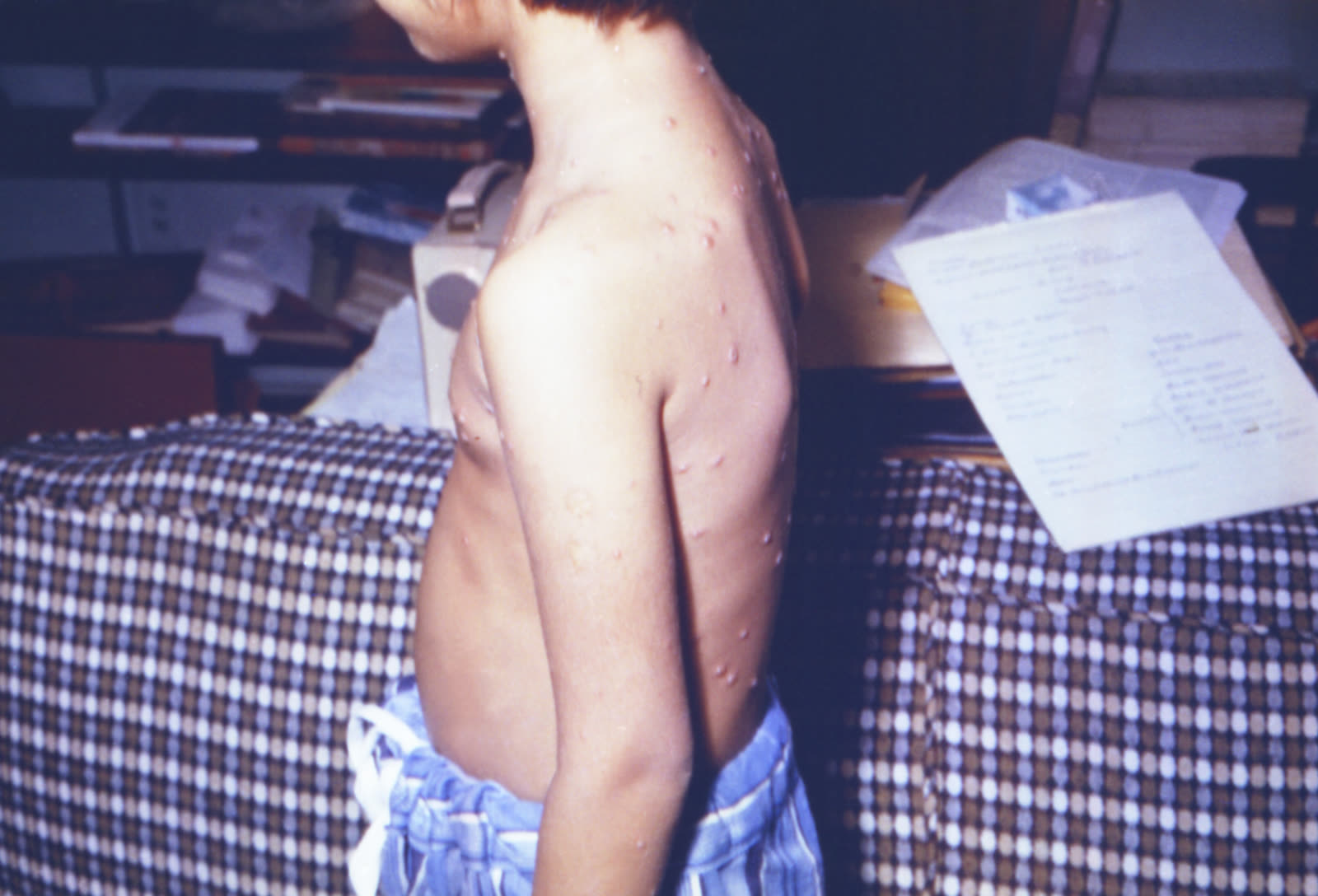
Chickenpox used to be treated as a near-universal childhood passage because the average case often passed without catastrophe. That memory is accurate only at the bedside scale. At population scale, the old chickenpox system was a machine that converted susceptible children into school, household, and child-care outbreaks, with infants, adults, pregnant people, and immunocompromised patients carrying a much higher share of the danger.[1][2]
The vaccine did not make varicella-zoster virus vanish. It changed the mechanism the virus depended on. Before the U.S. program began in 1995, the country saw more than 4 million chickenpox cases in a typical year, with roughly 10,500 to 13,500 hospitalizations and 100 to 150 deaths.[1] By reducing the number of children who could host and pass on wild-type VZV, routine vaccination turned a self-renewing childhood infection into a much thinner transmission problem.[1][2][4]
The causal chain has four links: protect the vaccinated child, reduce the susceptible crowd, prevent enough circulation to protect some people who cannot be vaccinated, and then use the second dose to close the outbreak gap left by one-dose breakthrough cases.[2][3][4] That sequence is why the story is more interesting than "a shot prevents a rash." The public-health success came from changing the social ecology of a virus that had relied on dense childhood contact.
The virus needed a steady supply of first infections
Varicella-zoster virus is a herpesvirus. Primary infection causes varicella, or chickenpox; later reactivation of latent infection can cause herpes zoster, or shingles.[2] That matters because the childhood rash and the older-adult shingles problem are linked by the same virus but governed by different timing. A childhood varicella vaccination program mainly interrupts new primary infections. It does not erase latent wild-type VZV already sitting in adults who had chickenpox decades earlier.[2]
Before vaccination, the United States was close to a default infection model. CDC's Pink Book says virtually all people acquired varicella by adulthood, with about 90% of cases occurring among children younger than 15 in the prevaccine era.[2] The virus spread person to person through direct contact with vesicle fluid, inhalation of aerosols from skin lesions, and respiratory secretions; people could be contagious 1 to 2 days before rash onset until lesions crusted.[2] In households where contacts were susceptible, secondary attack rates could run between 61% and 100%.[2]
That is the first mechanical point. A disease can look mild in many individual children and still be highly efficient as an exposure system. Every classroom and sibling cluster kept replenishing the next wave of susceptible hosts. The average case did not need to be severe for the total burden to be large.
One dose changed severity before it eliminated outbreaks
The United States licensed single-antigen varicella vaccine in 1995 for people at least 12 months old, and the early routine program used one dose for young children.[2][3] The vaccine was live attenuated, derived from the Oka strain; it was not a passive antibody product or a treatment after rash appeared.[2][3] Its job was to induce immunity before exposure, so that wild-type VZV would find fewer fully susceptible hosts.
That first dose did a great deal. The Pink Book summarizes postlicensure estimates as about 82% effective against any clinical varicella and 98% effective against severe disease; the 2007 ACIP report described one dose as roughly 85% effective against varicella and more than 95% effective against severe disease.[2][3] Those numbers explain why hospitalizations and deaths began falling even before the program fully solved school outbreaks.
Severe disease is the first thing a good vaccine program can squeeze down. A vaccinated child who develops breakthrough varicella usually has a shorter, milder illness, often with fewer than 50 lesions and less fever than an unvaccinated case.[2] That does not mean breakthrough cases are irrelevant. It means the first dose shifted many infections away from the clinical pattern shown in old photographs and toward a lower-lesion, lower-complication form.[2]
The weak point was not failure; it was partial control
The one-dose era revealed the difference between reducing disease and interrupting transmission. ACIP revisited the policy after reports of varicella outbreaks in highly vaccinated populations, beginning workgroup review in 2004 and publishing the revised two-dose recommendation in 2007.[3] The problem was not that vaccination had failed. It was that one-dose effectiveness against any varicella left enough breakthrough illness to keep outbreaks possible in schools and child-care settings.[2][3]
This is the hinge of the mechanism. A vaccine can be excellent against severe disease while still leaving a transmission margin. ACIP explicitly framed the second dose as a way to reduce varicella disease and complications further, noting that one dose had not been sufficient to prevent outbreaks in highly vaccinated school populations and that breakthrough varicella could still be contagious.[3]
The second dose tightened that margin. The Pink Book reports that two doses demonstrate 92% effectiveness against any clinical varicella, and ACIP cited a postlicensure randomized trial in which two-dose efficacy was 98.3%, compared with 94.4% after one dose in that study.[2][3] Different study designs produce different exact estimates, but the practical direction is consistent: the second dose was a transmission-control upgrade, not a cosmetic schedule change.
Community protection showed up where the needle did not go
The strongest evidence for a population mechanism is that benefits appeared outside the directly vaccinated age group. CDC says overall U.S. chickenpox cases have declined by more than 97% since the program started.[1] The Pink Book similarly reports an average 97% incidence decline from prevaccine years to 2013-2014, including declines among infants who were not eligible for vaccination and adults whose vaccination rates were low.[2]
That is what shrinking the susceptible crowd does. Infants too young for vaccination can still benefit when older siblings and child-care contacts are less likely to bring wild-type VZV home. Adults who missed childhood vaccination can still face less exposure when the virus is no longer sweeping through schools every winter and early spring. The program did not protect those groups by injecting them in childhood; it protected some of them by making exposure rarer.[2][4]
The severe-outcome data make the same point more starkly. A Journal of Infectious Diseases analysis of U.S. hospitalization and death data through 2019 found that, among people younger than 50, varicella hospitalizations declined 94% and deaths declined 97% over 25 years of the vaccination program.[4] Among people younger than 20 who were born during the program, the declines were even sharper: hospitalizations fell 97%, and deaths fell by more than 99%.[4]
Those results are not just an argument that the shot worked in a narrow immunologic sense. They show that high coverage changed the environment in which VZV tried to move. The same paper estimated that more than 10,500 hospital admissions and 100 deaths are now prevented each year in the United States by vaccination and reduced circulation.[4]
Shingles is the boundary condition, not the rebuttal
Because VZV can become latent after primary infection and reactivate later as shingles, varicella control sometimes gets dragged into a misleading argument: if shingles still exists, the childhood program must not have solved the virus problem. That is the wrong boundary. The childhood vaccine program was built to prevent primary varicella and its transmission; shingles prevention in older adults is a related but separate problem shaped by latent infection and zoster vaccination policy.[2]
This distinction matters for interpretation. A person infected with wild-type varicella before the vaccine era may carry latent virus for life. A schoolchild vaccinated in the two-dose era is part of a different population dynamic: less primary disease, fewer high-lesion infectious cases, fewer outbreaks, and fewer severe outcomes. The program does not rewrite the past exposure history of older adults. It changes the future supply of wild-type childhood infections.[2][4]
The same boundary keeps the article from overstating the victory. Chickenpox is now rare in the United States, not biologically impossible.[1] Breakthrough varicella can occur after one or two doses, and some reported mature-program cases are breakthrough cases precisely because unvaccinated wild-type cases have fallen so far.[2] That is not a paradox. It is what success looks like when the denominator changes.
What the chickenpox story actually proves
The useful lesson is that varicella vaccination worked because it treated chickenpox as a transmission system, not as a private rash. One dose removed much of the severe-disease burden. High coverage thinned community circulation. The second dose narrowed the outbreak pathway. Infants, some adults, and other indirectly protected groups benefited because schools and households stopped acting as reliable VZV amplifiers.[1][2][3][4]
That is why the old phrase "just chickenpox" is too small. For many children, chickenpox really was brief and uncomplicated. For a country, it was millions of infections, thousands of hospitalizations, and a predictable number of preventable deaths every year.[1][4] The vaccine changed the math by changing who the virus could reach next.
Sources
- Centers for Disease Control and Prevention, "Impact of U.S. Chickenpox Vaccination Program" - current CDC summary of prevaccine burden, case decline, annual residual burden, and estimated cases prevented.
- Centers for Disease Control and Prevention, Epidemiology and Prevention of Vaccine-Preventable Diseases, Chapter 22: "Varicella" - pathogenesis, transmission, complications, breakthrough disease, vaccine effectiveness, schedule, and secular trends.
- Centers for Disease Control and Prevention, "Prevention of Varicella: Recommendations of the Advisory Committee on Immunization Practices (ACIP)," MMWR Recommendations and Reports, 2007 - U.S. vaccine licensure history, one-dose limits, outbreak rationale, and two-dose recommendation.
- Mona Marin, Adriana S. Lopez, Michael Melgar, et al., "Decline in Severe Varicella Disease During the United States Varicella Vaccination Program: Hospitalizations and Deaths, 1990-2019," The Journal of Infectious Diseases, 2022 - PubMed record for the national hospitalization and death trend analysis.
- Centers for Disease Control and Prevention, Public Health Image Library, "PHIL ID 25244" - 1963 public-domain clinical photograph of varicella lesions in a four-year-old child, used as the article image.