Diphtheria antitoxin is easy to misread because the word sounds like an old-fashioned cure. The mechanism is narrower and more urgent. In respiratory diphtheria, the bacterium can remain local while its toxin travels. That toxin drives the worst complications: airway obstruction through the local membrane, and systemic injury such as myocarditis or neuritis once toxin is absorbed.[1] Antitoxin does not kill the organism. It does not dissolve the membrane. It does not repair tissue already damaged by toxin. It neutralizes toxin that is still circulating and not yet fixed to cells.[1]
That boundary makes diphtheria a clock problem. The rescue question is not only whether the diagnosis is correct. It is whether the patient is still early enough in the toxin pathway for borrowed antibodies to intercept what has not yet landed. CDC's Pink Book therefore says suspected respiratory diphtheria should receive antitoxin and antibiotics promptly, without waiting for laboratory confirmation, while airway maintenance and respiratory support are provided as needed.[1] The treatment chain is built around speed because the toxin does not wait for certainty.
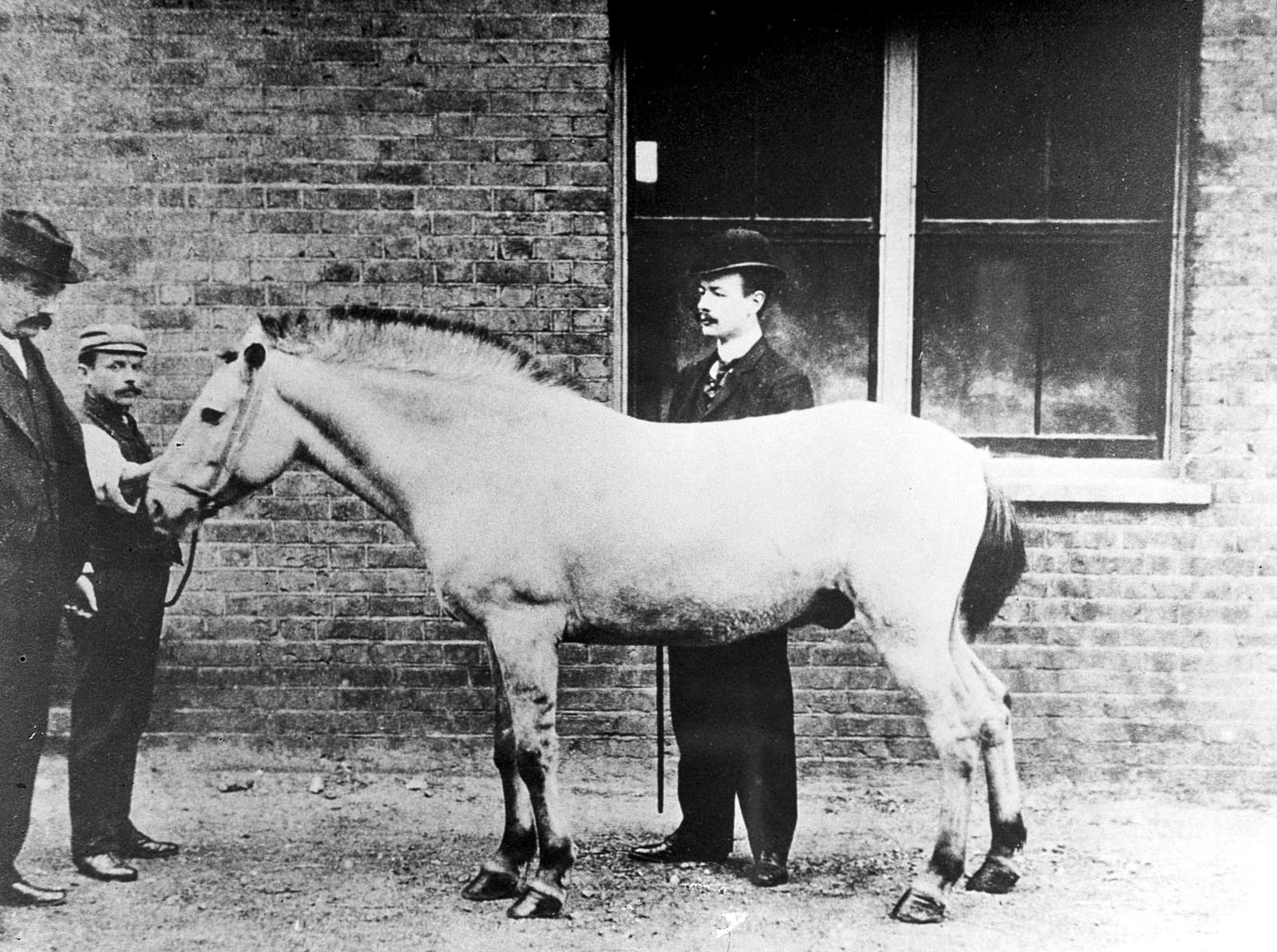
Image context: the cover shows Tom, also known as Tommy, the first English pony inoculated for diphtheria antitoxin production at the Lister Institute in 1894. It is a direct visual anchor for the article's mechanism: before monoclonal antibodies or modern biologics, the scalable source of neutralizing antibody was a living animal deliberately immunized to make serum powerful enough for patients.[6]
The toxin, not the throat culture, sets the danger
Diphtheria begins as an infection, but the disease becomes dangerous because toxigenic Corynebacterium diphtheriae can produce a toxin that acts beyond the site where the bacteria sit.[1] In the throat, the familiar pseudomembrane can threaten the airway. If enough toxin is absorbed, systemic illness follows; CDC describes severe prostration, pallor, rapid pulse, stupor, coma, and death sometimes within 6 to 10 days.[1] The common complications, including death, are toxin-mediated, and their severity generally tracks how extensive the local disease has become.[1]
This is the first causal hinge. A throat infection might tempt a purely antimicrobial mental model: identify the organism, give antibiotics, stop spread. That is necessary, but incomplete. Antibiotics reduce infectiousness and help eliminate the organism; CDC notes that respiratory diphtheria is usually no longer contagious 48 hours after antibiotics begin, and clearance is documented with two negative cultures after therapy.[1] But antibiotics do not instantly remove toxin that is already moving through the body.
Antitoxin answers that separate problem. It supplies antibodies capable of binding circulating diphtheria toxin before that toxin causes further tissue injury.[1][3] CDC's current clinical framing is blunt: antitoxin will neutralize circulating toxin and prevent progression, but it does not neutralize toxin already fixed to tissues.[1] In practical terms, the medicine is strongest before the damage has fully declared itself. The longer the delay, the more the patient shifts from reversible circulating toxin toward established injury.
That is why laboratory confirmation has a strange status in diphtheria care. It matters for public health, culture, toxin testing, contact management, and surveillance, but it cannot be allowed to become the starting pistol for treatment when respiratory diphtheria is clinically suspected.[1] CDC says specimens should be obtained, the patient isolated, and presumptive therapy started promptly.[1] In this disease, the cost of being orderly can be biological lateness.
Borrowed immunity was the original biologic platform
The antitoxin idea emerged before physicians had today's vocabulary of antibodies, antigens, or monoclonal design. Nobel Prize materials record that Emil von Behring received the first Nobel Prize in Physiology or Medicine in 1901 for serum therapy, especially its application against diphtheria.[3] Science History Institute's account places the breakthrough in the early 1890s, when Behring and competitors such as Emile Roux and Alexandre Yersin were working out how blood serum from an immunized organism could carry protective activity into another body.[4]
The scale problem appeared immediately. Recovered human patients could not supply enough serum for an epidemic disease of children. Horses could. Researchers injected horses with increasing doses of diphtheria toxin, making the animal's immune system produce antitoxin, then collected and processed serum for human treatment.[4][6] The animal was not decoration around the discovery. It was the manufacturing platform.
That platform helps explain why serum therapy felt revolutionary. Science History Institute summarizes the clinical effect in stark terms: diphtheria had killed up to half of sickened children in some settings, and injected serum reduced mortality to about 15% in the account it reviews.[4] Another historical review of the French contribution describes Roux, Martin, and Chaillou's 1894 treatment series in Paris, where detailed information was collected on hundreds of children and mortality fell sharply.[5] The exact estimates vary by hospital, severity, timing, and diagnostic certainty, but the direction was not subtle: neutralizing toxin early could convert a terrifying pediatric disease into something physicians could sometimes pull back from the edge.
The causal lesson is more durable than the Victorian drama. Serum therapy did not make the immune system stronger in a general inspirational sense. It imported a specific neutralizing capacity from another immune system. The patient borrowed ready-made antitoxin during the narrow period when that antitoxin could still meet free toxin in the blood.
Why early antitoxin and antibiotics are not substitutes
Modern diphtheria treatment keeps two different jobs side by side. Antitoxin targets toxin already produced and still circulating. Antibiotics target the bacteria that continue to produce toxin and spread to others.[1][2] Treating one side while neglecting the other leaves the mechanism partly open.
This dual logic is why current guidance still sounds urgent despite diphtheria being rare in the United States. CDC's antitoxin page says diphtheria antitoxin is no longer produced in the United States, but the FDA has authorized CDC to distribute it as an expanded-access investigational new drug.[2] U.S. clinicians first consult their state health department and then contact CDC; once use is determined to be indicated, CDC dispatches antitoxin from a quarantine station.[2] The contemporary system is therefore a clinical clock tied to a logistics clock.
The timing problem is not theoretical. If antitoxin cannot reverse toxin already fixed to tissue, then delay has two compounding effects: the patient may become harder to rescue biologically, and the health system may still be moving the product physically.[1][2] That is why a rare disease can remain operationally serious. Rarity lowers routine familiarity and commercial incentive, but suspected cases still require a medicine that has to arrive fast.
Airway care adds a third job. A membrane obstructing the airway is not solved by antibodies alone.[1] If the immediate danger is ventilation, the patient needs airway management and respiratory support while the toxin and bacterial problems are being treated.[1] The full rescue chain is therefore: recognize the syndrome, isolate and sample, obtain antitoxin, give antibiotics, protect the airway, and manage contacts. Diphtheria care fails when those steps are imagined as interchangeable.
The 2020s problem is supply, not only science
The old horse-serum mechanism has not disappeared. A 2025 Emerging Infectious Diseases report states that current treatment of respiratory diphtheria still requires hospitalization, equine diphtheria antitoxin, and antimicrobial drugs, typically for 14 days.[5] It also reports that timely antitoxin can prevent potentially irreversible toxin-related damage and reduce mortality by up to 76%.[5] Those numbers explain why antitoxin remains on the World Health Organization's essential medicines list and why shortages are not a historical footnote.[5]
The same report makes the supply problem visible. In 2023, WHO received reports of 24,782 diphtheria cases globally, up from 10,027 in 2022, while diphtheria is believed to be underreported in many regions.[5] Yet manufacturers and procurement agencies face an awkward market: unpredictable outbreaks, limited return on investment, regulatory requirements for blood-derived products, variable prices, short shelf life, and limited ability to surge production.[5] A disease can be vaccine-preventable and still require emergency treatment stockpiles when vaccine coverage gaps open.
This is the modern version of the original antitoxin paradox. Diphtheria toxoid vaccines are the long-term population answer because they make people generate their own protective antitoxin before exposure.[1][5] But vaccination does not eliminate the need for treatment when an unvaccinated or undervaccinated person develops respiratory diphtheria. At that point, prevention has already missed its best window, and the old passive-immunity logic returns.
Monoclonal antibodies may eventually replace or supplement equine antitoxin. The 2025 EID article describes two candidate monoclonal approaches in development and notes encouraging scientific promise, but it also lists unresolved finance, trial, manufacturing, and regulatory barriers.[5] The direction is clear; the replacement is not yet simple. Until then, the horse-serum lineage still sits inside modern preparedness.
The right mental model
The most useful way to understand diphtheria antitoxin is not as a cure from the past, but as a race against a molecular handoff. The bacterium makes toxin. Toxin leaves the local infection site. Antitoxin can bind toxin still in circulation. Once toxin is fixed to tissue, the antitoxin's job narrows, and supportive care has to carry more of the burden.[1]
That model explains several otherwise disconnected facts. It explains why suspected respiratory diphtheria is treated before lab confirmation.[1] It explains why antibiotics are necessary but not enough.[1] It explains why airway support remains central.[1] It explains why CDC holds antitoxin through a special access pathway even though the disease is rare in the United States.[2] And it explains why global supply fragility matters: antitoxin is only lifesaving when the logistics clock can keep up with the toxin clock.[5]
The history also leaves a useful humility. One of medicine's early triumphs over infectious disease did not come from killing a microbe directly. It came from borrowing another immune system's answer quickly enough to intercept the poison the microbe had already released. That is still the core of diphtheria antitoxin: not magic, not nostalgia, but timing.
Sources
- Centers for Disease Control and Prevention, Pink Book, Chapter 7: "Diphtheria" - clinical features, toxin-mediated complications, antitoxin mechanism, antibiotics, and management sequence.
- Centers for Disease Control and Prevention, "Diphtheria Antitoxin" (December 18, 2024) - U.S. access pathway, expanded-access IND status, and CDC dispatch process.
- Nobel Prize Outreach, "The Nobel Prize in Physiology or Medicine 1901" - Behring's serum-therapy award and official prize framing.
- Science History Institute, "The Story of Serum Therapy" - historical explanation of horse-derived serum therapy, mortality framing, and early public reception.
- Marshall C, Perea Caro W, Costa A, et al., "Diphtheria Antitoxin Production and Procurement Practices and Challenges," Emerging Infectious Diseases 31(12), 2025 - current supply, outbreak, treatment, and monoclonal-antibody context.
- Wikimedia Commons, "File:First English pony innoculated for diphtheria antitoxin 1894 Wellcome L0017191.jpg" - source page for the Wellcome archival photograph used as the article image.