For years, one of the most dangerous facts in transfusion medicine had no proper name. Patients could receive screened blood, avoid hepatitis B, avoid hepatitis A, and still develop chronic liver inflammation after transfusion. The placeholder name was honest and unsatisfying: non-A, non-B hepatitis. It told clinicians what the disease was not. It did not tell blood banks what to remove, patients what they had, or drug developers what to attack.[1][2]
The discovery of hepatitis C mattered because it changed that kind of ignorance into an operating system. The key event was not one person looking through a microscope and seeing a new virus in a clean moment of revelation. It was a sequence: transfusion follow-up defined the residual disease; chimpanzee transmission made the missing agent biologically credible; molecular cloning pulled one viral fragment out of a sea of host genetic material; antibody assays converted that fragment into a blood-test target; and donor screening began turning discovery into prevention.[1][2][3][4][5]
That sequence is why an event reconstruction is more useful than a triumph story. Hepatitis C was discovered when a clinical mystery became a molecular search problem, and when that molecular answer was rapidly forced back into the blood system that had made the mystery visible in the first place.
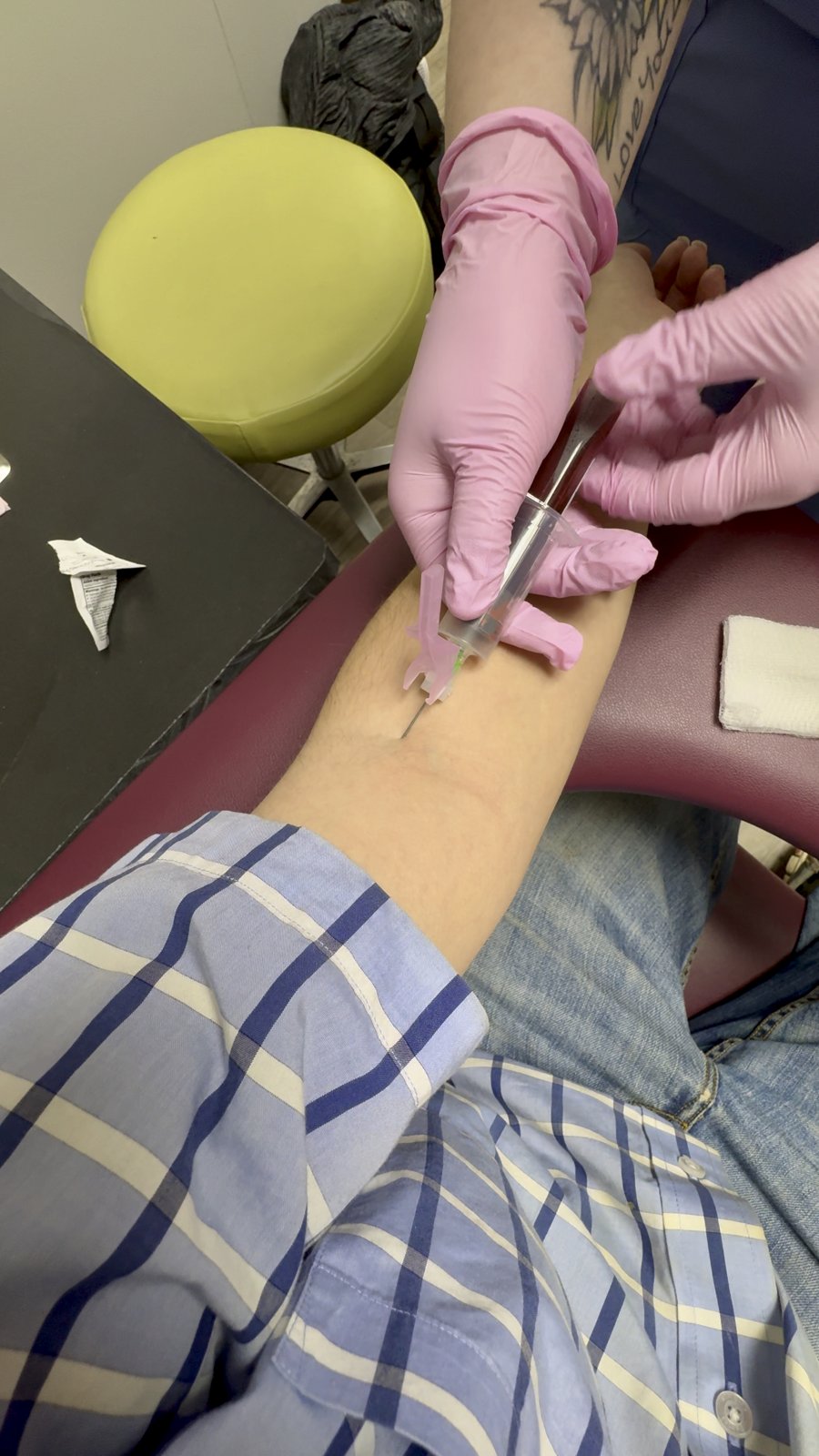
Image context: the cover uses a real documentary venipuncture photograph from Wikimedia Commons.[7] It belongs here because the discovery story became public-health infrastructure only when a molecular target could move into blood samples, donor screening, and follow-up testing.
Timeline anchors
- 1940s-1960s: clinicians separated infectious hepatitis into patterns later associated with fecal-oral hepatitis A and blood-borne hepatitis B, but transfusion-linked cases still remained after hepatitis B testing improved.[1]
- 1975: investigators formally described transfusion-associated hepatitis that was not due to hepatitis A or hepatitis B, giving the field the deliberately negative category "non-A, non-B."[1]
- 1978: Harvey Alter and colleagues showed that the unexplained agent could be transmitted in chimpanzee studies, strengthening the case for a viral cause.[1]
- April 1989: Chiron investigators reported isolation of a cDNA clone derived from a blood-borne non-A, non-B hepatitis genome, and a companion antibody-assay paper linked the clone to patient sera.[1][2][3]
- November 1989: a prospectively followed transfusion-recipient study found anti-HCV evidence across cases of acute and chronic non-A, non-B hepatitis and argued that donor screening could prevent most cases.[4]
- 1990-1992: U.S. blood banks began anti-HCV testing in 1990, and CDC still treats transfusion or organ transplant before July 1992 as a historical risk marker.[5][6]
- 2020: the Nobel Prize in Physiology or Medicine recognized Harvey J. Alter, Michael Houghton, and Charles M. Rice for the discovery of hepatitis C virus.[1]
The first problem was not diagnosis but residual risk
The hepatitis C story begins with subtraction. By the late twentieth century, medicine had already made real progress against transfusion hepatitis. Baruch Blumberg's hepatitis B work had given the field a named virus, tests, and a vaccine path; tests for hepatitis A also clarified a different route of transmission. But Nobel's 2020 summary makes the residual problem plain: after hepatitis B testing reduced transfusion-related hepatitis, a large number of cases still remained unexplained.[1]
That residual category mattered because blood banking is a prevention system, not only a treatment service. If a patient became ill after transfusion and the case was not hepatitis A or B, the system could record the damage but could not yet target the contaminant. The phrase "non-A, non-B" was therefore useful and dangerous at the same time. Useful, because it prevented false closure. Dangerous, because a negative label cannot be screened out of blood.
The early clinical reconstruction also shaped the later laboratory hunt. According to Nobel's account, Alter's group showed that blood from affected patients could transmit disease to chimpanzees, and later work suggested the agent had viral characteristics.[1] That evidence did not identify hepatitis C by itself. It did something narrower but indispensable: it made the unknown agent real enough to keep searching for when ordinary virus-isolation techniques failed.
The search had to escape the ordinary virus-hunting route
The methodological twist was that hepatitis C did not yield quickly to the standard tools. Nobel's press release says traditional virus-hunting techniques were used, but the agent evaded isolation for more than a decade.[1] That failure is the hinge of the event. A weaker reconstruction says "scientists found the virus in 1989." The stronger one asks why the finding took so long and why the winning method looked different.
Michael Houghton and colleagues at Chiron approached the problem as a genetic needle-in-haystack search. They built a collection of DNA fragments from nucleic acids in the blood of an infected chimpanzee. Most fragments were expected to belong to the chimpanzee. The bet was that some would come from the unknown infectious agent, and that antibodies in patient serum could recognize fragments encoding viral proteins.[1]
That was an audacious inversion. Instead of first growing the virus, visualizing it, or purifying it cleanly, the team used the immune memory of patients to fish for viral sequence. The 1989 Science paper's title captures the dry technical result: isolation of a cDNA clone derived from a blood-borne non-A, non-B viral hepatitis genome.[2] In historical terms, the result was less dry. It gave the negative category a molecular handle.
The companion 1989 antibody-assay paper then turned that handle outward. Kuo, Choo, Alter, and colleagues described an assay using a polypeptide synthesized in recombinant yeast clones of hepatitis C virus to capture circulating viral antibodies.[3] This was the crucial translation step. A viral fragment alone would have been scientifically important. An antibody assay made the fragment clinically and operationally useful.
The blood-test turn made the discovery accountable
The November 1989 New England Journal of Medicine paper is important because it brought the new test back to the transfusion cohort problem that had framed the mystery. Alter and colleagues measured anti-HCV in prospectively followed transfusion recipients with acute and chronic non-A, non-B hepatitis. In the abstract's numbers, all 15 patients with chronic non-A, non-B hepatitis documented by liver biopsy seroconverted, and 3 of 5 patients with acute resolving disease seroconverted.[4]
The donor side made the prevention logic sharper. Anti-HCV was detected in donor serum samples given to 14 of 16 anti-HCV-positive patients for whom all donor samples were available. The authors concluded that hepatitis C virus was the predominant agent of transfusion-associated non-A, non-B hepatitis and that donor screening could prevent the majority of cases.[4]
Those numbers did not mean the first assays were perfect. The paper itself noted delayed antibody development, with a mean delay of 21.9 weeks after transfusion, and one patient's antibody took about a year to appear.[4] That window-period problem is exactly why the discovery should not be read as an instant end to risk. It was the beginning of a test-and-refine era. The mystery had become measurable, and measurement could now improve.
Screening changed the blood system faster than it changed every patient
Once anti-HCV testing existed, blood banking could act. CDC's 1991 Public Health Service inter-agency guidelines state that U.S. blood banks voluntarily began anti-HCV testing in 1990.[5] CDC's current clinical overview still preserves the historical boundary in patient-risk language: people who received transfusion or organ transplant before July 1992 remain a group at increased risk for hepatitis C.[6]
That date is one of the most concrete signs that discovery had moved from laboratory event to public-health infrastructure. Before the test era, the risk was distributed invisibly through transfused blood. After screening became available, the risk did not vanish everywhere, and it did not erase infections already acquired, but the blood system had a specific target to exclude.
The distinction matters. Discovery prevents future cases only after it becomes a protocol, a procurement decision, a donor-screening requirement, a laboratory workflow, and a follow-up system. Hepatitis C's scientific identification was decisive because it could travel into those routines. A named virus could become a reagent. A reagent could become a donor screen. A donor screen could become a new baseline expectation for safe blood.
What the discovery did not settle
The strongest interpretation should keep two boundaries visible. First, hepatitis C discovery did not mean every infected person was immediately found. CDC's 2020 adult-screening recommendation says existing testing strategies had limited success, citing 2013-2016 survey data in which only about 56% of people with HCV infection reported ever being told they had hepatitis C.[8] That is a sobering afterlife for a supposedly solved diagnostic problem. A test can exist and still fail to reach the people who need it.
Second, the discovery did not produce a vaccine. CDC's clinical overview is explicit that hepatitis C is transmitted through exposure to infectious blood, that most infected people have no symptoms, and that testing and treatment prevent complications and interrupt transmission.[6] The prevention system therefore rests on screening, safer injection and health-care practices, blood safety, and treatment access rather than on an immunization wall.
The treatment story is the more hopeful boundary. CDC says simple, well-tolerated treatments can cure more than 95% of hepatitis C cases, and its 2020 MMWR notes that direct-acting antiviral treatment can produce virologic cure in most persons with 8-12 weeks of all-oral medication.[6][8] That cure era was made possible by the viral identification, but it should not be retrojected backward. In 1989, the immediate breakthrough was not cure. It was knowing what to look for.
Why the event still matters
The hepatitis C discovery remains a model of how public health advances when several kinds of evidence are allowed to complete one another. Clinical follow-up noticed a stubborn residual disease. Animal transmission showed the unknown category had biological teeth. Molecular cloning identified a viral sequence when conventional routes stalled. Antibody testing connected the sequence back to patients and donors. Blood screening converted the finding into prevention.[1][2][3][4][5]
That chain also explains why the Nobel recognition in 2020 was not simply a delayed prize for naming a virus. The discovery made three later systems possible: safer blood, mass testing, and antiviral drug development.[1][6][8] Each system depends on a different kind of translation. Blood safety needs screening thresholds. Public health needs testing recommendations that reach people who do not feel sick. Treatment needs a molecular target and enough access to make cure real outside specialist clinics.
The lesson is disciplined optimism. Hepatitis C was not defeated at the moment it was named. But the naming changed the field's physics. An unnamed post-transfusion illness could be recorded and feared; a named RNA virus could be tested, excluded from blood, followed in patients, and attacked with drugs. The event matters because it shows what happens when a negative diagnosis finally becomes a positive target.[1][4][5][6][8]
Sources
- NobelPrize.org, "The Nobel Prize in Physiology or Medicine 2020 - Press release" - discovery sequence from non-A/non-B hepatitis to HCV identification, Rice's causation proof, blood testing, and drug-development significance.
- Qui-Lim Choo, George Kuo, Amy J. Weiner, Lacy R. Overby, Daniel W. Bradley, and Michael Houghton, "Isolation of a cDNA clone derived from a blood-borne non-A, non-B viral hepatitis genome," Science 244, 1989.
- George Kuo, Qui-Lim Choo, Harvey J. Alter, et al., "An assay for circulating antibodies to a major etiologic virus of human non-A, non-B hepatitis," Science 244, 1989.
- Harvey J. Alter, Robert H. Purcell, James W. Shih, et al., "Detection of Antibody to Hepatitis C Virus in Prospectively Followed Transfusion Recipients with Acute and Chronic Non-A, Non-B Hepatitis," New England Journal of Medicine, 1989.
- Centers for Disease Control and Prevention, "Public Health Service Inter-Agency Guidelines for Screening Donors of Blood, Plasma, Organs, Tissues, and Semen for Evidence of Hepatitis B and Hepatitis C," MMWR, 1991.
- Centers for Disease Control and Prevention, "Clinical Overview of Hepatitis C" - transmission, asymptomatic infection, pre-July 1992 transfusion risk, RNA-test timing, and current cure framing.
- Wikimedia Commons, "File:Drawing blood from a vein through phlebotomy and venipuncture.jpg" - source page for the documentary blood-draw image used as the article cover.
- Centers for Disease Control and Prevention, "CDC Recommendations for Hepatitis C Screening Among Adults - United States, 2020," MMWR - universal adult screening recommendation and direct-acting antiviral cure context.
Editor’s Pick Review
This article takes today’s merged standard/add-on editor-pick slot because it has the strongest 24-hour quality profile across evidence, narrative discipline, bilingual execution, and the tightened image-policy gate. The English piece reconstructs the hepatitis C discovery as a complete public-health conversion chain — residual transfusion risk, chimpanzee transmission evidence, molecular cloning, antibody assay, donor screening, and later cure infrastructure — while keeping the limits visible through window-period, underdiagnosis, and no-vaccine boundaries. The documentary blood-draw cover is immersive and topic-grounded rather than analytical, and the Chinese edition preserves the same causal sequence with natural cadence, stable medical terminology, and low translationese across a dense source base.