Smallpox eradication is often remembered through maps, surveillance teams, and the last known cases. That is the right scale for the final victory, but it can hide one of the smaller mechanisms that made the campaign practical. The bifurcated needle mattered because it turned vaccination into a cheap, repeatable field gesture: dip the forked tip into vaccine, hold a small drop between the prongs, puncture the skin quickly, and leave behind a lesion that could be checked later.[1][2]
The point was not that a needle defeated smallpox by itself. It did not. CDC's history explicitly places the intensified eradication success inside several linked factors: bifurcated needle development, case surveillance, and mass vaccination campaigns.[1] WHO describes the same strategic arc in broader terms: initial mass vaccination to raise coverage, then case-finding and ring vaccination around known and possible contacts.[3] The needle's importance sits inside that sequence. It made the vaccine easier to carry, easier to conserve, easier to teach, and easier to verify in the places where surveillance found risk.
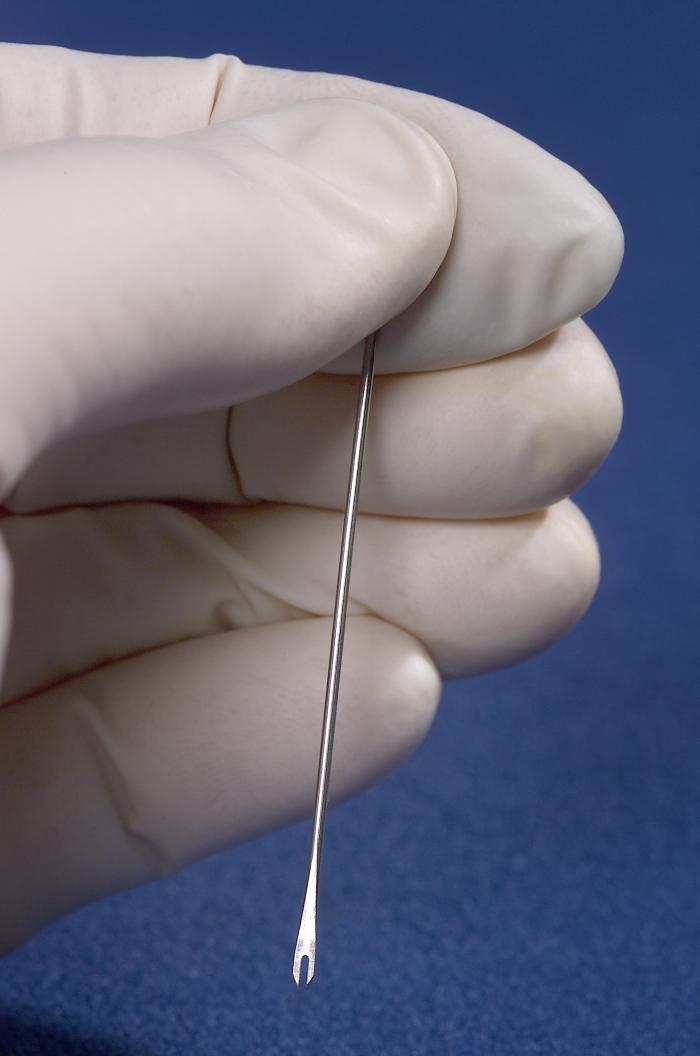
Image context: the cover uses a real CDC Public Health Image Library photograph of the bifurcated needle tip. It is not a diagram or symbolic medical stock image. It shows the physical reason this tool worked: two small prongs designed to hold a tiny drop of live vaccinia vaccine for shallow skin delivery.[6]
Timeline anchors
- 1960s: Benjamin Rubin at Wyeth Laboratories developed the bifurcated needle for smallpox vaccination; Rubin later published a short note on its development in 1980.[5]
- 1967: WHO's intensified smallpox-eradication programme began, pairing vaccination with stronger surveillance and outbreak containment.[1][3]
- Late campaign years: WHO later described bifurcated-needle vaccination as simpler than previous methods and requiring only about one-fourth as much vaccine.[3]
- 1977: the last naturally occurring smallpox case was recorded in Somalia.[1]
- 1980: the World Health Assembly declared smallpox eradicated.[1][3]
- 2024: CDC's current clinical administration page still describes ACAM2000 smallpox vaccine as given by multiple puncture with a bifurcated needle.[2]
The first mechanism was dose economy
The smallpox-eradication campaign was not only a biological campaign. It was also a logistics campaign. Vaccine had to reach people across villages, cities, borders, emergencies, and fragile cold-chain conditions. In that setting, the amount of vaccine consumed per successful vaccination was not a minor technical detail. It shaped how far each vial could travel.
WHO's vaccine history makes the economy plain: bifurcated-needle vaccination used only one-fourth the amount of vaccine needed by earlier methods and was simpler to perform.[3] That number is the key to the device's public-health logic. A tool that stretches vaccine supply does more than save money. It changes campaign reach. The same stock can cover more contacts, more villages, more outbreak rings, and more follow-up work when shortage or transport delay would otherwise narrow the response.
The prongs created the economy. CDC's administration instructions say the needle is dipped into the vial and withdrawn with a tiny drop of vaccine held by the tool, enough for successful vaccination if administered correctly.[2] This is a design that lets surface tension become a dosing system.
The second mechanism was shallow, repeatable delivery
Smallpox vaccination was not an ordinary injection. CDC's current smallpox-vaccine page explains that the vaccine is given with a two-pronged needle dipped into the vaccine solution.[2] The administration page is even more specific: ACAM2000 is given by the multiple-puncture technique using the bifurcated needle, with the needle held perpendicular to the selected deltoid site.[2]
That technique mattered because it converted skill into a bounded motion. A vaccinator did not need to draw up a syringe, estimate a deep injection plane, or manage complex equipment for each person. The procedure asked for controlled repeated punctures in a small area. CDC's instructions specify 15 rapid pricks, or the number stated in the package insert, kept within an area of about 5 mm in diameter. Those same instructions reveal how precise the simple method still had to be: no alcohol before administration because alcohol can inactivate vaccinia, no reinserting a used needle into the vial, and a stable wrist while puncturing.[2]
The field value lies in that mixture of simplicity and discipline. The method is simple enough to teach quickly, but not so loose that every vaccinator invents a new approach. A campaign can scale only when thousands of workers can perform the same act with acceptable consistency.
The third mechanism was visible feedback
The bifurcated needle also helped because smallpox vaccination produced a readable local response. CDC says successful vaccination results in a lesion at the vaccine site.[2] That lesion was not cosmetic. It turned immunization into something inspectable.
In a surveillance-containment campaign, inspectability matters. A person who says they were vaccinated, a team that believes a village was reached, or a supervisor checking campaign quality all need some way to move beyond paperwork. The local "take" did not solve every record problem, and a scar alone could not replace outbreak investigation. But the method helped join the biological effect to a visible field sign.
That sign also explains why the needle should be read as part of a system rather than as a gadget. Vaccination, case-finding, contact tracing, and follow-up worked together. WHO's eradication narrative stresses the shift from broad mass campaigns toward finding cases and vaccinating known and possible contacts around them.[3] The needle supported that strategy because it made rapid local vaccination more feasible once surveillance had found the danger.
The fourth mechanism was maintenance-light equipment
The David J. Sencer CDC Museum frames the bifurcated needle as a replacement for the ped-o-jet in the smallpox programme and emphasizes its use in quick, effective vaccination.[4] That replacement history is important. Jet injectors promised speed, but complex equipment brings maintenance, training, cleaning, and failure modes. A small metal needle is less glamorous, but field public health often rewards tools that break less and travel more easily.
The CDC Museum also notes that more than 7 million bifurcated needles were used in India during the programme.[4] That number gives the object its proper scale. The needle was not a boutique instrument for demonstration clinics. It was disposable, countable campaign hardware.
This is where the smallness becomes powerful. A bifurcated needle is cheap enough to distribute, simple enough to carry in quantity, and standardized enough to become part of a supervised routine. Those qualities are not secondary to the eradication story. They are how medical knowledge survives in places where roads, refrigerators, staff time, and records are uneven.
What the needle did not do
The strongest reading should not turn the bifurcated needle into a magic lever. Smallpox was eradicable for several reasons at once: there was no known nonhuman reservoir, cases were clinically visible, effective vaccine existed, surveillance could identify outbreaks, and containment vaccination could break transmission when executed well.[1][3] The needle improved the delivery layer. It did not create all the other conditions.
That boundary matters because medical-device stories are easy to romanticize. A clever object can make a campaign more feasible without being the campaign's whole cause. In the smallpox case, the needle's value was causal but narrow: it conserved vaccine, simplified administration, gave local feedback, and fit the pace of surveillance-containment work.[1][2][3][4]
The best counterfactual is practical. Imagine a smallpox programme with strong epidemiology but a delivery method that wastes vaccine, demands heavy equipment, and requires highly specialized operators for every contact ring. Surveillance would still find cases, but the response would be slower and thinner. The bifurcated needle did not decide where to go. It made the act at the destination easier to repeat.
The lesson for health systems
The bifurcated needle's deeper lesson is that public-health breakthroughs often happen at the interface between biology and operations. A vaccine can be potent in a vial and weak as a campaign if the delivery method does not fit the terrain. A surveillance system can be brilliant and still fail if every confirmed case requires a response the field team cannot execute quickly.
Smallpox eradication succeeded when many layers held together: vaccine production, freeze-dried stability, field workers, reporting, contact tracing, local persuasion, political commitment, and campaign supervision.[1][3][4] The bifurcated needle belonged to the material layer of that success. It made one crucial action small, cheap, teachable, inspectable, and repeatable.
That is why the object still deserves attention in 2026. It reminds us that health systems do not only need discoveries. They need methods that can be carried into ordinary hands without losing their effect. In the smallpox campaign, two tiny prongs helped convert vaccine from a scarce biological product into a field routine. The eradication story is global. The mechanism was sometimes as small as a drop held between metal tips.[2][3]
Sources
- Centers for Disease Control and Prevention, "History of Smallpox" - overview of vaccination history, intensified eradication factors, last case, and 1980 eradication declaration.
- Centers for Disease Control and Prevention, "Smallpox Vaccine Administration" - current clinical instructions for ACAM2000 multiple-puncture administration with a bifurcated needle.
- World Health Organization, "Smallpox vaccines" - feature story on vaccine generations, mass vaccination, ring vaccination, and the bifurcated needle's vaccine-sparing role.
- David J. Sencer CDC Museum, "Smallpox Eradication" - museum account of field tools, house-to-house vaccination, ped-o-jet replacement, and bifurcated-needle use in India.
- B. A. Rubin, "A note on the development of the bifurcated needle for smallpox vaccination," WHO Chronicle, 1980, PubMed record.
- Wikimedia Commons, "File:Smallpox vaccination needle.jpg" - CDC Public Health Image Library photograph used as the article image.