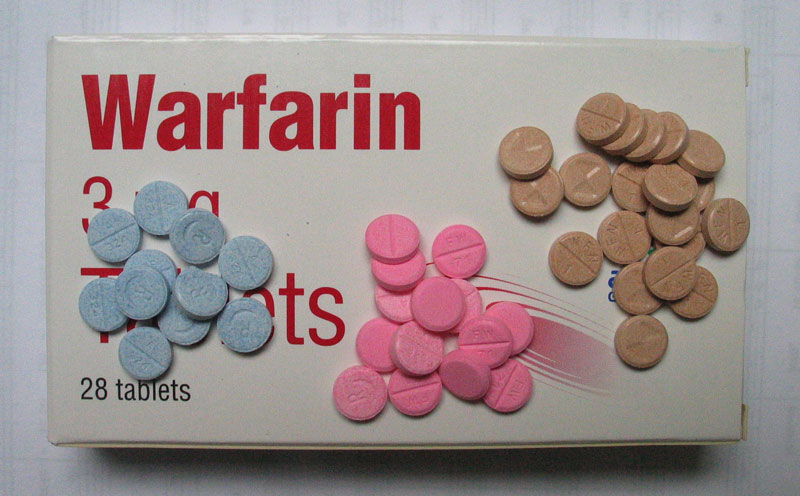
Warfarin has one of medicine's strangest origin stories, but the strangeness is not the main point. The drug did not become important simply because a farm poison was domesticated into a prescription. It became important because clinicians learned to keep a useful danger inside a measured range.
The same broad effect appears in three settings. In the 1920s, cattle eating spoiled sweet-clover hay bled catastrophically. In 1940, Karl Paul Link's Wisconsin laboratory isolated dicoumarol from that agricultural problem. In 1948, the Wisconsin Alumni Research Foundation's more potent coumarin derivative became warfarin, initially pushed as a rodenticide. By 1954, the drug had entered U.S. medical use as Coumadin.[1][2][5] The history is therefore not a straight line from poison to cure. It is a comparison between uncontrolled anticoagulation, deliberately lethal anticoagulation, and clinically governed anticoagulation.
That comparison still matters because warfarin remains a live example of an older therapeutic bargain. Newer direct oral anticoagulants made many patients' treatment simpler, but warfarin's logic has not vanished, especially where cost, kidney function, mechanical valves, drug interactions, or local practice keep vitamin K antagonists in use. The core lesson is not nostalgia. It is that some medicines work only when the drug, the lab value, the diet, the interacting medications, and the follow-up system are treated as one mechanism.[2][3][4][5]
The farm version was a failure of control
The sweet-clover disease story begins as an agricultural mystery, not as a clever drug-discovery plan. Spoiled hay made cattle hemorrhage because microbial action converted coumarin-related material in sweet clover into dicoumarol, a compound capable of blocking vitamin K-dependent clotting.[1][2] The bleeding was not therapeutic. It was uncontrolled exposure: the dose was hidden in feed, the timing depended on spoilage, and the animal's coagulation status was invisible until disaster arrived.
That is the first useful contrast. A chemical effect can be real and still medically useless if no one can meter it. Farmers saw the outcome as dead or bleeding animals. Link's group saw a biochemical clue. The American Chemical Society's landmark account frames the discovery through this chain of sick cattle, moldy hay, dicoumarol isolation, and later warfarin development.[1] The important historical move was not just naming the compound. It was realizing that the bleeding had a mechanism.
Once the mechanism came into view, the field could ask a different question: could the anticoagulant effect be made predictable enough to use? That question separates warfarin from the hay. The hay delivered anticoagulation as accident. Medicine would have to deliver it as a monitored intervention.
The rodenticide version made danger intentional
Warfarin's rodenticide phase can sound like a reputational embarrassment, but it clarifies the pharmacology. A rodenticide does not need a delicate therapeutic window. It needs delayed lethality, oral activity, and enough potency to make a feeding sequence fatal. The VKA review notes that warfarin's name came from Wisconsin Alumni Research Foundation plus the coumarin suffix, and that the compound emerged from work on more potent coumarin-based anticoagulants.[2]
The contrast with clinical use is sharp. In pest control, the same mechanism is allowed to run past safety. In medicine, the same mechanism has to stop short of bleeding catastrophe while still preventing harmful thrombosis. This is why "blood thinner" is an imprecise phrase. Warfarin does not make blood watery. StatPearls describes the mechanism more exactly: it inhibits VKORC1, limiting activation of vitamin K and reducing functional clotting factors II, VII, IX, and X, along with proteins C and S.[3]
That mechanism is powerful partly because it is indirect. Warfarin does not dissolve an existing clot on contact. It changes the liver's ability to produce active clotting proteins over time. StatPearls gives the timing boundary: onset is typically 24 to 72 hours, with peak therapeutic effect usually 5 to 7 days after initiation and a duration of 2 to 5 days after cessation.[3] Those clocks explain why the drug cannot be managed like a switch.
The medical version needed a number
Warfarin became clinically useful when anticoagulation could be connected to a repeatable laboratory target. The modern anchor is INR, the international normalized ratio. For many common indications, guidelines and clinical references use an INR range around 2.0 to 3.0, while specific situations such as mechanical valves may require different targets.[4][5]
That number is not a bureaucratic decoration. It is the boundary between two failures. DailyMed's Coumadin prescribing information places regular INR monitoring inside the boxed bleeding-risk warning and separates target INR ranges by indication.[5] The ACCP evidence review puts the same idea into outcome terms. Compared with INR 2.0 to 3.0, INR values below 2 and above 3.0 to 5.0 were associated with higher relative risks for composite adverse outcomes in the evidence it reviewed.[4]
The result is a therapy that feels old-fashioned because it asks so much of the system. Doses change. Diet matters because vitamin K intake can push against the drug. Other medications matter because metabolism and protein binding can shift exposure. Genetics matter because VKORC1 and CYP2C9 variation can affect sensitivity and clearance.[3] None of that makes warfarin irrational. It makes it a drug whose safety lives in feedback.
Why the newer-drug comparison does not erase the older lesson
Direct oral anticoagulants changed the comparison by offering more predictable anticoagulation for many patients without routine INR monitoring. The CHEST atrial-fibrillation guideline describes newer oral anticoagulants as directly targeting coagulation pathways, having more predictable effects, and not requiring INR monitoring.[4] That is a real advance for many use cases. It reduced some of the ordinary friction that made warfarin clinics, dose calendars, and repeated blood tests part of anticoagulation life.
But the comparison should not flatten into "new drug good, old drug bad." Warfarin's continuing importance is partly clinical and partly infrastructural. Some patients still need or receive vitamin K antagonist therapy because of indication-specific evidence, contraindications, affordability, reversibility practices, kidney function, or local availability. The practical point is that warfarin exposes what every anticoagulant must solve somehow: how to reduce thrombosis without letting bleeding become the price of prevention.
Warfarin makes that balance visible because its management is externalized. The patient and clinician can see the INR drift. They can ask about diet, missed doses, antibiotics, liver disease, alcohol, interacting drugs, or testing error. Newer agents hide less day-to-day friction, but they do not abolish the underlying bargain. They move it into eligibility, renal dosing, adherence, bleeding response, and drug-selection rules.
The real historical conversion
The usual warfarin story likes the irony: cattle poison becomes rat poison becomes medicine. The better history is more disciplined. Spoiled clover showed that vitamin K antagonism could cause fatal bleeding when exposure was uncontrolled. Rodenticide development showed that oral coumarin anticoagulation could be made potent and durable. Clinical anticoagulation then required the opposite discipline: take that dangerous durability and bind it to indication, dose adjustment, laboratory monitoring, and follow-up.[1][2][3][4][5]
That conversion is why warfarin is still worth remembering in 2026. It is not merely a legacy drug from a less precise era. It is a case study in making a narrow therapeutic window governable. The active ingredient matters, but the full therapy is larger than the tablet: a target range, a calendar, a lab method, a response plan, and a patient who knows that the number is not ornamental.
This is also the safety boundary for any reader. Warfarin dosing and INR targets are individualized medical decisions, and changing the dose, diet, or interacting medications without clinician guidance can be dangerous. The historical lesson is not "warfarin is simple." It is the opposite: warfarin works when medicine respects that anticoagulation is useful only as a monitored bargain.
Sources
- American Chemical Society, Warfarin: From Rat Poison to Lifesaving Drug National Historic Chemical Landmark booklet - sweet-clover disease, Karl Link's Wisconsin laboratory, dicoumarol, WARF naming, rodenticide development, and 1954 medical approval.
- Verhoef TI, Redekop WK, Daly AK, et al., "New Insights into the Pros and Cons of the Clinical Use of Vitamin K Antagonists (VKAs) Versus Direct Oral Anticoagulants (DOACs)," Drugs, 2014 - history of sweet-clover disease, dicoumarol, warfarin naming, and VKA/DOAC comparison context.
- Patel S, Singh R, Preuss CV, Patel N, "Warfarin," StatPearls, NCBI Bookshelf - VKORC1 mechanism, clotting-factor effects, pharmacokinetic timing, genetic sensitivity, diet and interaction factors.
- Holbrook A, Schulman S, Witt DM, et al., "Evidence-Based Management of Anticoagulant Therapy," CHEST, 2012 - INR range evidence, monitoring management, and oral anticoagulation guideline context.
- DailyMed, "Coumadin (warfarin sodium) tablets, prescribing information" - boxed bleeding-risk warning, regular INR monitoring requirement, initial U.S. approval in 1954, and indication-specific INR target ranges.
- Wikimedia Commons, "File:Warfarintablets5-3-1.jpg" - source page for the real photograph of 5 mg, 3 mg, and 1 mg warfarin tablets used as the article image.