Heparin was not an obscure medicine when the 2008 crisis began. It was the kind of hospital workhorse that becomes invisible because it is so routine: anticoagulation for dialysis circuits, cardiac procedures, catheters, and clot prevention. That familiarity is exactly why the outbreak mattered. The danger did not arrive as a strange new drug. It arrived inside a trusted injectable product that clinicians already knew how to use.
The event is often remembered as a contaminated-drug scandal. That is true, but too blunt. The sharper reconstruction is this: a contaminant called oversulfated chondroitin sulfate, or OSCS, was similar enough to heparin to move through ordinary quality checks, yet different enough biologically to trigger severe allergic-type reactions in patients.[3][4] The crisis became visible only when bedside events, public-health case finding, analytical chemistry, recall logistics, and supply-chain investigation were forced to connect.
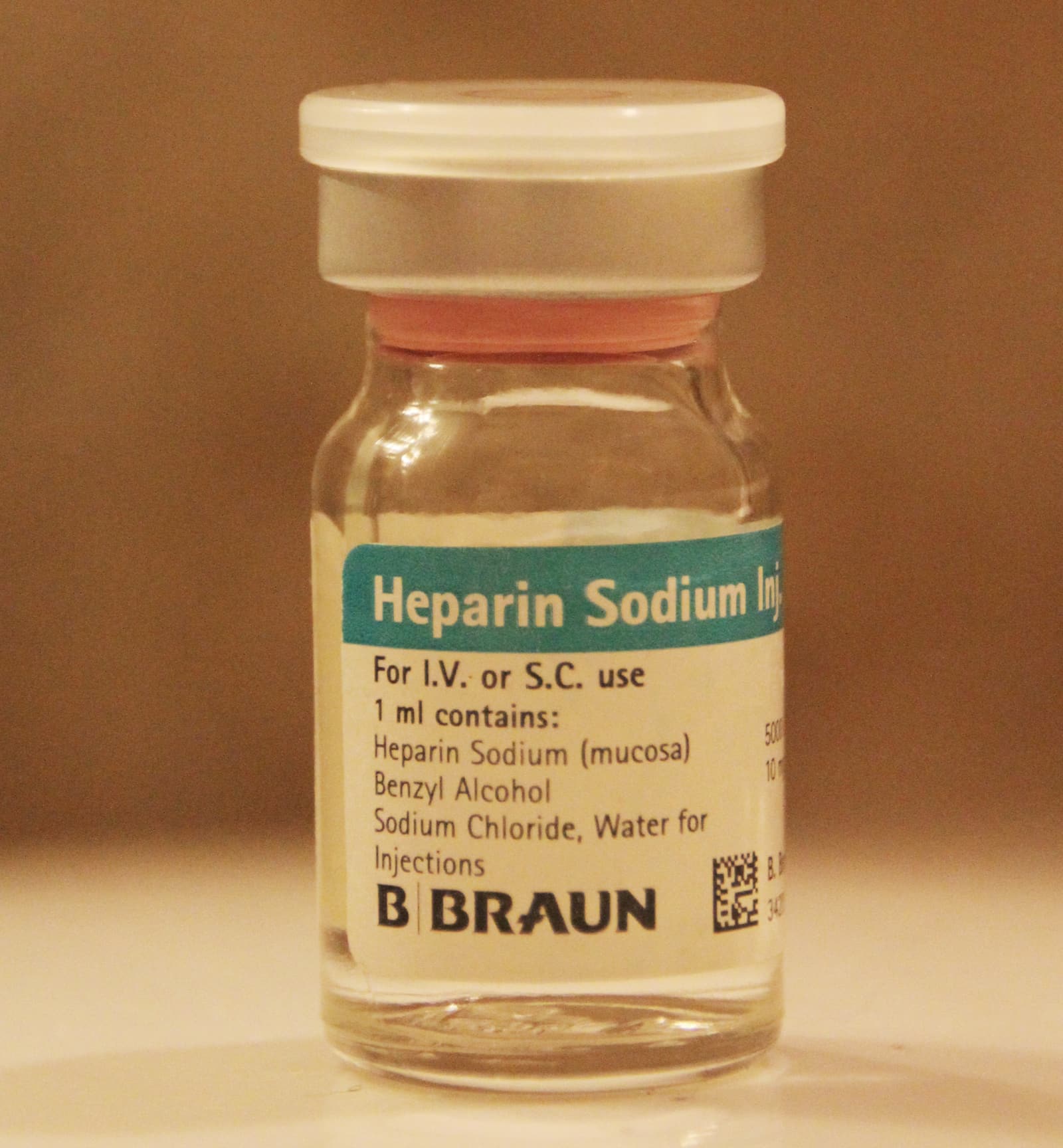
Image context: the cover photograph is not a 2008 recall image, but a real heparin sodium injection vial. It is used here because the article is about a routine injectable product whose apparent ordinariness was part of the safety problem: the vial looked like medicine, while the contaminant could hide inside the drug's own chemical neighborhood.[7]
Timeline
- November 19, 2007: allergic-type reactions later counted in the national investigation began appearing among hemodialysis patients.[2][3]
- January 7, 2008: CDC was notified by Missouri health officials about a pediatric hemodialysis cluster.[2]
- January 9, 2008: CDC alerted FDA after additional reports suggested a wider pattern across dialysis facilities.[2]
- January 17, 2008: Baxter recalled nine implicated lots of heparin.[1]
- February 22, 2008: FDA formed its Heparin Task Force as the agency worked with outside scientists to identify the contaminant and develop detection methods.[1]
- February 29, 2008: Baxter expanded the recall to all lots of its single-dose and multidose vial heparin products, after FDA judged that market supply could be managed.[1]
- March 6, 2008: FDA posted screening methods for contaminated heparin.[1]
- March 17, 2008: FDA identified OSCS as the specific contaminant associated with U.S. adverse events.[1]
- By April 2008: FDA determined that heparin adverse events had returned to precrisis levels.[1]
1. The first signal came from dialysis rooms, not from a factory certificate
The first public-health clue was clinical rhythm. CDC reported that it was notified on January 7, 2008 of allergic-type reactions among pediatric hemodialysis patients at a Missouri hospital, with symptoms including facial swelling, tachycardia, hypotension, urticaria, and nausea.[2] These were not slow, ambiguous background complaints. They appeared within minutes of dialysis initiation, close enough to the procedure to make the treatment environment itself suspicious.
Then the geography widened. On January 9, a dialysis supply company told CDC that it had heard of roughly 50 similar reactions among adult hemodialysis patients in six states over the previous two weeks.[2] By January 30, CDC had identified 65 confirmed or probable episodes among 53 hemodialysis patients at 19 dialysis facilities in 12 states.[2]
That is the first lesson of the event. The earliest useful detector was not a routine release assay. It was pattern recognition across facilities. The patients were scattered, the reactions were acute, and the shared exposure was buried in ordinary dialysis workflow. In 61 of those early 65 cases, CDC reported that the affected patient had received Baxter heparin during hemodialysis.[2] That did not yet prove causation, but it pointed investigators toward a common product when no single clinic could have explained the outbreak alone.
2. The recall had to move faster than certainty
Recall decisions in this case sat between two risks. If suspect heparin stayed in circulation, more patients could be exposed. If too much heparin disappeared suddenly, dialysis and other hospital care could run into shortages. GAO's later review makes that tension unusually visible. FDA learned by January 23 that Baxter's heparin active pharmaceutical ingredient came through Scientific Protein Laboratories establishments in Wisconsin and China, and in early February FDA worked to postpone an expanded recall so it could consult with another supplier about maintaining U.S. heparin supply.[1]
That detail matters because it prevents an easy morality play. The question was not simply "why recall slowly?" or "why recall everything?" Heparin was medically necessary, widely used, and not easily replaced overnight. FDA still moved toward a broader withdrawal: Baxter's second recall, on February 29, covered all lots of its single-dose and multidose vial heparin products, and FDA also facilitated recalls of heparin-containing medical devices.[1]
The February 29 step shows the practical boundary of outbreak control. Regulators did not need complete chemical certainty before reducing exposure, but they did need enough supply-chain and substitute-supply awareness to avoid turning contamination control into a treatment-access problem. The event was therefore a recall story and a continuity-of-care story at the same time.
3. OSCS hid because it was close enough to the drug to fool the old question
The central chemical finding changed the interpretation of the whole crisis. Nature Biotechnology's April 2008 paper reported that the contaminant had an unusual sulfation pattern and that traditional screening tests could not differentiate affected from unaffected lots.[4] That is the hinge. The contaminant did not merely slip through because someone forgot to test. It slipped through because the tests were asking an insufficiently discriminating question.
Pew's later supply-chain brief puts the economic and structural vulnerability plainly: OSCS was much cheaper to produce than heparin and similar enough to the actual drug to evade standard tests.[5] GAO's technical appendix adds the molecular implication: OSCS was chemically similar to heparin, probably not naturally occurring, and was confirmed against synthetic OSCS made by chemical modification of chondroitin sulfate.[1]
That is why "contamination" is not a strong enough word by itself. Some contaminants are foreign dirt. This one behaved more like a counterfeit neighbor. It could imitate enough of heparin's analytical identity to pass through a system built around older assumptions, while still creating a dangerous biological response in patients.
4. Epidemiology and chemistry had to lock together
The later NEJM outbreak investigation is important because it joined the clinical pattern to the chemical finding. Investigators identified 152 adverse reactions in 113 patients across 13 states from November 19, 2007 through January 31, 2008.[3] At the facility level, use of Baxter-manufactured heparin was the strongest associated factor, and tested Baxter vials from facilities that reported reactions contained OSCS.[3]
The patient-level linkage was also strong. Of 130 reactions for which facility heparin-lot information was available, 128 occurred at facilities that had OSCS-contaminated heparin on the premises; of 54 reactions with known administered lot number, 52 followed administration of OSCS-contaminated heparin.[3] The clinical features fit the same story: hypotension, nausea, and shortness of breath often appeared within 30 minutes after administration.[3]
This is what made the event resolvable. Chemistry alone could identify a suspicious molecule. Epidemiology alone could identify a suspicious product pattern. The crisis required both. Without the clinical cluster, the contaminant might have remained an analytical curiosity or gone unnoticed. Without the chemical work, the outbreak could have looked like a vague Baxter association without a mechanism.
5. The downstream problem did not stop at injectable vials
One of the less remembered features of the crisis is that heparin is not only a drug in a vial. It is also used in medical devices and diagnostic materials. FDA's current device guidance still reflects that afterlife: it discusses in vitro diagnostic devices such as heparinized blood collection tubes, dispensers, assay kits, and reagents that might have been manufactured using heparin contaminated with OSCS.[6]
That guidance is dry, but its existence is revealing. It asks manufacturers to identify affected devices, select contaminated and uncontaminated controls, run comparative analytical testing, and in some cases collect paired blood samples from 40 volunteers.[6] In other words, the contaminant raised a second safety question: not only "did this injectable medicine harm patients?" but also "could contaminated heparin distort the tests and tools built with it?"
This is the broader public-health lesson. Complex drugs do not stay inside one labeled product category. Heparin moved through dialysis, hospital anticoagulation, device coatings, collection tubes, and diagnostic systems. A contaminant that enters upstream can therefore create multiple downstream obligations, some urgent and clinical, others technical and delayed.
6. The event changed what "quality" had to mean
The 2008 heparin crisis is easiest to misread as a bad-supplier episode. Supplier failure was real, but the stronger lesson is about quality-system imagination. A system that tests only for expected impurities can miss a deliberately selected mimic. A system that relies on paper trust can be too slow when active ingredients cross borders and pass through animal-tissue collection, crude processing, API manufacture, finished-drug production, and device use.[1][5]
GAO's timeline shows the emergency arc clearly: notification, early recall, task force, broader recall, new screening methods, identification of OSCS, international coordination, and return of adverse-event counts to baseline by April.[1] That sequence worked well enough to end the immediate crisis. But the reason the crisis happened was that the precrisis system could not see the right thing soon enough.
The deepest event reconstruction therefore starts at the dialysis chair and ends at the assay. Patients reacted before the system knew what to call the contaminant. CDC case finding made scattered reactions look like one outbreak. FDA and outside scientists turned an unknown heparin-like signal into OSCS. Recalls reduced exposure while supply had to be protected. Device guidance then showed how far an upstream ingredient problem could travel.
Heparin's 2008 lesson is not that all global drug supply is unsafe. That would be too broad and not useful. The lesson is narrower and harder: for complex biologically derived medicines, quality control has to anticipate intelligent resemblance, not just accidental impurity. A contaminant can be dangerous precisely because it looks enough like the product to enter the bloodstream under the product's name.
Sources
- U.S. Government Accountability Office, Food and Drug Administration: Response to Heparin Contamination Helped Protect Public Health; Controls That Were Needed for Working With External Entities Were Recently Added (GAO-11-95, 2010) - recall timeline, FDA task force, OSCS identification, screening methods, and response chronology.
- Centers for Disease Control and Prevention, "Acute Allergic-Type Reactions Among Patients Undergoing Hemodialysis - Multiple States, 2007-2008" (MMWR, February 1, 2008) - early case-finding signal, dialysis symptoms, state spread, and Baxter-heparin exposure pattern.
- David B. Blossom et al., "Outbreak of adverse reactions associated with contaminated heparin" (New England Journal of Medicine, 2008; PubMed record) - national outbreak counts, facility association, lot association, symptoms, and OSCS epidemiologic linkage.
- Marco Guerrini et al., "Oversulfated chondroitin sulfate is a contaminant in heparin associated with adverse clinical events" (Nature Biotechnology, 2008) - structural identification of OSCS and why traditional screening tests could not distinguish affected lots.
- The Pew Charitable Trusts, "Heparin: A Wake-Up Call on Risks to the U.S. Drug Supply" (May 16, 2012) - supply-chain interpretation, OSCS cost incentive, standard-test blind spot, and multinational recall context.
- U.S. Food and Drug Administration, "Suggested Analytical Testing Protocol for In Vitro Diagnostic Devices Manufactured with Heparin Contaminated With Oversulfated Chondroitin Sulfate" - downstream device and diagnostic-testing implications of contaminated heparin.
- Wikimedia Commons, "File:Heparin Sodium sample.jpg" - real photograph of a heparin sodium injection vial used as the article image.