An oxygen mask makes intuitive sense in a heart attack. Heart muscle is being deprived of oxygen; supplying more seems like an immediate answer. Yet the underlying emergency often begins with an obstructed blood supply. Raising the oxygen available to the lungs and restoring blood flow to threatened muscle are different interventions.[1]
That distinction helped overturn a familiar assumption: every suspected heart attack should automatically receive supplemental oxygen. The 2025 American guideline for acute coronary syndromes recommends oxygen for confirmed hypoxia, but advises against its routine administration when oxygen saturation is at least 90%. The change concerns a particular treatment in a particular population. It leaves the urgency of the heart attack intact.[2]
The reassuring equipment conceals a question
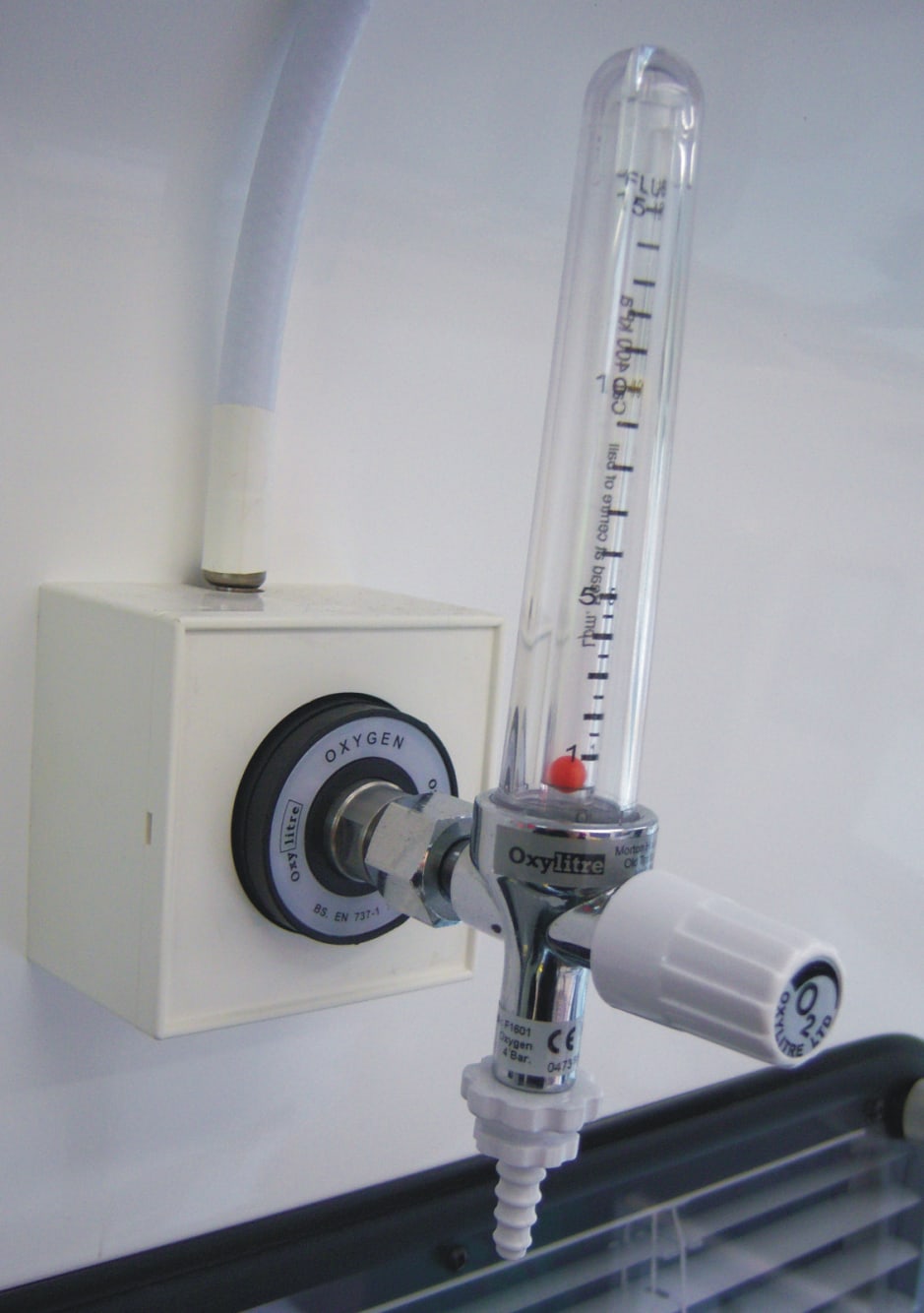
The photograph shows an ambulance's oxygen outlet, flowmeter and adjustment knob. It records equipment ready to deliver a measured flow, without telling us whether a particular patient needs it.[3] That missing decision is the subject of the evidence.
The strongest case for routine oxygen begins with a correct observation: oxygen deprivation damages heart muscle. Its weak point is the untested leap from that observation to a universal remedy. If oxygen in the circulating blood is already adequate, does increasing it improve what reaches the injured tissue—and, ultimately, the patient's outcome?
A small physiological study complicated the answer well before the largest clinical trial. In 2005, Patrick McNulty and colleagues studied 18 people with stable coronary disease undergoing cardiac catheterization. Breathing pure oxygen for 15 minutes increased coronary vascular resistance by roughly 40% and reduced coronary blood flow by roughly 30%. The researchers proposed an effect involving nitric oxide, a molecule involved in blood-vessel relaxation.[4]
This was a short experiment in stable patients, not a survival trial during heart attacks. Its value was to expose a countervailing mechanism: a gas supplied to improve oxygen delivery could also change the vessels carrying the blood. Physiology made routine treatment questionable; it could not, by itself, determine the bedside answer.[4]
A warning signal needs the right-sized conclusion
The Australian AVOID trial, published in 2015, moved the question into emergency care. It compared oxygen at 8 liters per minute with no supplemental oxygen in patients whose ECG suggested an ST-elevation heart attack, or STEMI, and whose oxygen saturation was at least 94%. Of 638 people randomized, 441 with confirmed STEMI entered the primary analysis.[5]
Its results were uncomfortable but uneven. Peak troponin, one blood marker of heart injury, did not differ significantly. Another marker, creatine kinase, was higher with oxygen. In the 139 participants who underwent cardiac MRI at six months, measured infarct mass was greater in the oxygen group: 20.3 versus 13.1 grams.[5]
Those findings challenged the presumption of harmlessness. But a later scan in a subset of participants is a different kind of evidence from a reliable estimate of survival. The study warranted concern about injury; turning it into proof that oxygen invariably worsens a heart attack would outrun its design.
The Swedish SOCCER trial, first published online in 2016, supplied an important counterweight. It compared high-flow oxygen with room air in patients with adequate oxygen levels who were undergoing urgent coronary intervention. Among 95 patients in its reported comparison, MRI found no significant differences in myocardial salvage or infarct size. The scan occurred within days, rather than six months, and the trial was small.[6]
Taken together, these studies undermine two tidy stories. They offer no convincing reason to expect routine oxygen to rescue more muscle, but they also do not establish that every extra dose causes measurable damage. Different endpoints, scan timings and sample sizes deserve to remain visible.
The larger trial asked about survival
In 2017, the Swedish DETO2X-AMI trial reported results for 6,629 patients with suspected myocardial infarction and baseline oxygen saturation of at least 90%. Participants received either oxygen at 6 liters per minute for 6–12 hours or ambient air. Clinicians could give oxygen if hypoxemia developed; the comparison did not require leaving deteriorating patients untreated.[7]
At one year, 5.0% of the oxygen group and 5.1% of the ambient-air group had died. The mortality hazard ratio was 0.97, with a 95% confidence interval of 0.79–1.21. That interval leaves uncertainty in both directions. The trial did not demonstrate a survival benefit from routine oxygen, and its result cannot establish that the true effect is exactly zero.[7]
For the routine-use argument, this changed the burden of proof. A plausible intervention had been tested against a patient-important outcome in thousands of people. The expected survival advantage had not appeared.
What the evidence leaves in the ambulance
The 2025 guideline preserves the distinction the trials depend on. It recommends supplemental oxygen when saturation is below 90%, to bring it to at least 90%, while classifying routine oxygen at or above that threshold as offering no demonstrated cardiovascular benefit.[2] This is a clinical treatment boundary, not a home test for deciding whether chest pain is serious.
A suspected heart attack still requires immediate emergency assessment. NHLBI advises calling emergency services at once; restoring blood flow quickly can limit the damage.[1] The oxygen studies concern what trained teams add to that care, not whether the patient needs it.
The flowmeter remains on the wall. What changed is the justification for turning its knob. The evidence supports choosing oxygen because the patient's condition calls for it, with the same attention to indication and outcome that any other treatment deserves.
Sources
- National Heart, Lung, and Blood Institute, “What Is a Heart Attack?” (updated March 24, 2022) — interrupted blood flow, oxygen deprivation and emergency response.
- Rao et al., 2025 ACC/AHA/ACEP/NAEMSP/SCAI Guideline for the Management of Patients With Acute Coronary Syndromes, section 4.1, “Oxygen Therapy” — official AHA publication page and full-guideline link.
- Owain.davies, “Oxygen piping.png,” May 13, 2009 — original ambulance-equipment photograph and CC BY 3.0 provenance, Wikimedia Commons.
- McNulty et al., “Effects of supplemental oxygen administration on coronary blood flow in patients undergoing cardiac catheterization,” American Journal of Physiology–Heart and Circulatory Physiology (2005) — Penn State research record.
- Stub et al., “Air Versus Oxygen in ST-Segment-Elevation Myocardial Infarction,” Circulation (2015) — AVOID report, full text hosted by Boston University.
- Khoshnood et al., “Effect of oxygen therapy on myocardial salvage in ST elevation myocardial infarction: the randomized SOCCER trial” — online November 23, 2016; journal issue 2018; Lund University research record.
- Hofmann et al., “Oxygen Therapy in Suspected Acute Myocardial Infarction,” New England Journal of Medicine (2017) — DETO2X-AMI report, institutional full-text copy.