One of the most revealing entries on a premature baby's chart is a date a nurse can recognize only in hindsight. A baby comes off breathing support on Tuesday, needs it again on Thursday, then breathes without it from Saturday onward. Saturday is the date that counts. In a trial of caffeine for very small newborns, that last day of positive airway pressure came a week earlier, at the median, in the babies assigned to caffeine. What could anyone infer from that week about the child who would one day go to school? [1][2]
Between 1999 and 2004, Barbara Schmidt and her colleagues enrolled 2,006 infants weighing 500 to 1,250 grams at birth. Babies born early can have pauses in breathing, called apnea, while their control of breathing matures. Caffeine stimulates breathing. Within each baby's first ten days, the investigators randomly assigned caffeine citrate or a placebo. The two groups could then be compared even years after the nursery had stopped giving the drug. [1][3]
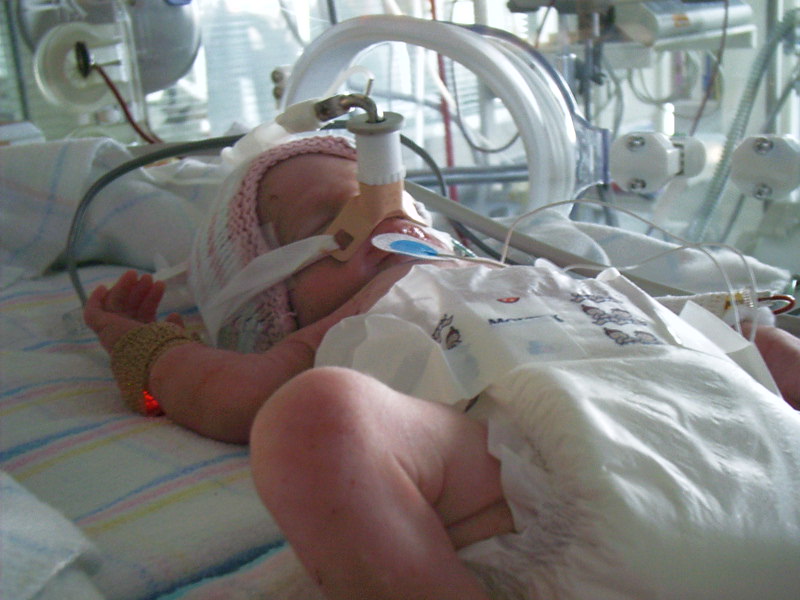
Two ways to read the nursery chart
The 2006 report gives the median age at last use of positive airway pressure as 31 weeks in the caffeine group and 32 in the placebo group. Those ages include the weeks of pregnancy before birth. The paper also lets us picture both nurseries at the same point in development. Among babies alive at 36 weeks on that clock, 36 in every 100 assigned caffeine still needed supplemental oxygen, compared with 47 in every 100 assigned placebo. One measure captures the day a baby crossed a threshold. The other asks how many still needed oxygen on a particular day. [1]
Either result would matter to a family waiting beside an incubator. Neither observation, on its own, could tell them whether their child would find it easier to walk. Chance had determined which babies received caffeine. The babies' condition helped determine when clinicians could withdraw breathing support. That distinction matters when reading the next paper. The authors found that earlier withdrawal could statistically explain part of the later benefit. The trial had never assigned babies to an extra week on or off a machine, so it could not isolate what that week itself had done. [1][2]
What changed between the toddler test and the school test
In 2007 the investigators reported their planned primary outcome. By 18 to 21 months of corrected age, 40.2% of the caffeine group had died or met at least one criterion for developmental disability, compared with 46.2% of the placebo group. Corrected age counts from the baby's expected due date. Death alone occurred at similar rates. Differences in cerebral palsy and in low scores on a toddler development test helped account for the six-percentage-point gap. [2]
At five years the corresponding percentages were 21.1 and 24.8. The estimate still favored caffeine, but its confidence interval allowed for no difference. It is tempting to line up those percentages beneath the toddler figures and read down each column to see how many children recovered. Look first at the two tests. A toddler counted as cognitively delayed with a developmental score below 85. A five-year-old counted as cognitively impaired with an IQ below 70. The investigators had changed both the instrument and the cutoff. They had also added behavior and general health to the combined outcome. A child could cross from one category to the other for several reasons, and a pair of group percentages cannot tell us which one applied. [2][3]
At eleven the children could do things no nursery chart could anticipate, including sit for tests of reading, spelling and arithmetic. The 2017 paper had enough information on 920 children for its combined measure of difficulty with schoolwork, movement or behavior. Overall, 31.7% of the caffeine group and 37.6% of the placebo group met at least one criterion. Again the range of uncertainty included no difference. Looking at the parts separately, the researchers found fewer children with impaired motor skills in the caffeine group. School performance and behavior showed no clear advantage. The smaller group available for follow-up also limits how confidently we can extend that picture to everyone enrolled as a newborn. [4]
For a parent asking about movement, the motor assessment at eleven offers a more direct answer than the date on the nursery chart. For a parent asking about reading, the same follow-up gives a different answer. The value of keeping in touch with these children for a decade was that they could finally show the investigators both things for themselves. [4]
Sources
- Barbara Schmidt and colleagues, “Caffeine Therapy for Apnea of Prematurity,” New England Journal of Medicine, 2006.
- Barbara Schmidt and colleagues, “Long-Term Effects of Caffeine Therapy for Apnea of Prematurity,” New England Journal of Medicine, 2007.
- Barbara Schmidt and colleagues, five-year follow-up of the Caffeine for Apnea of Prematurity trial, JAMA, 2012.
- Barbara Schmidt and colleagues, academic performance, motor function and behavior at eleven years, JAMA Pediatrics, 2017.
- Wikimedia Commons, “Prematur in CPAP,” photograph dated August 16, 2003.